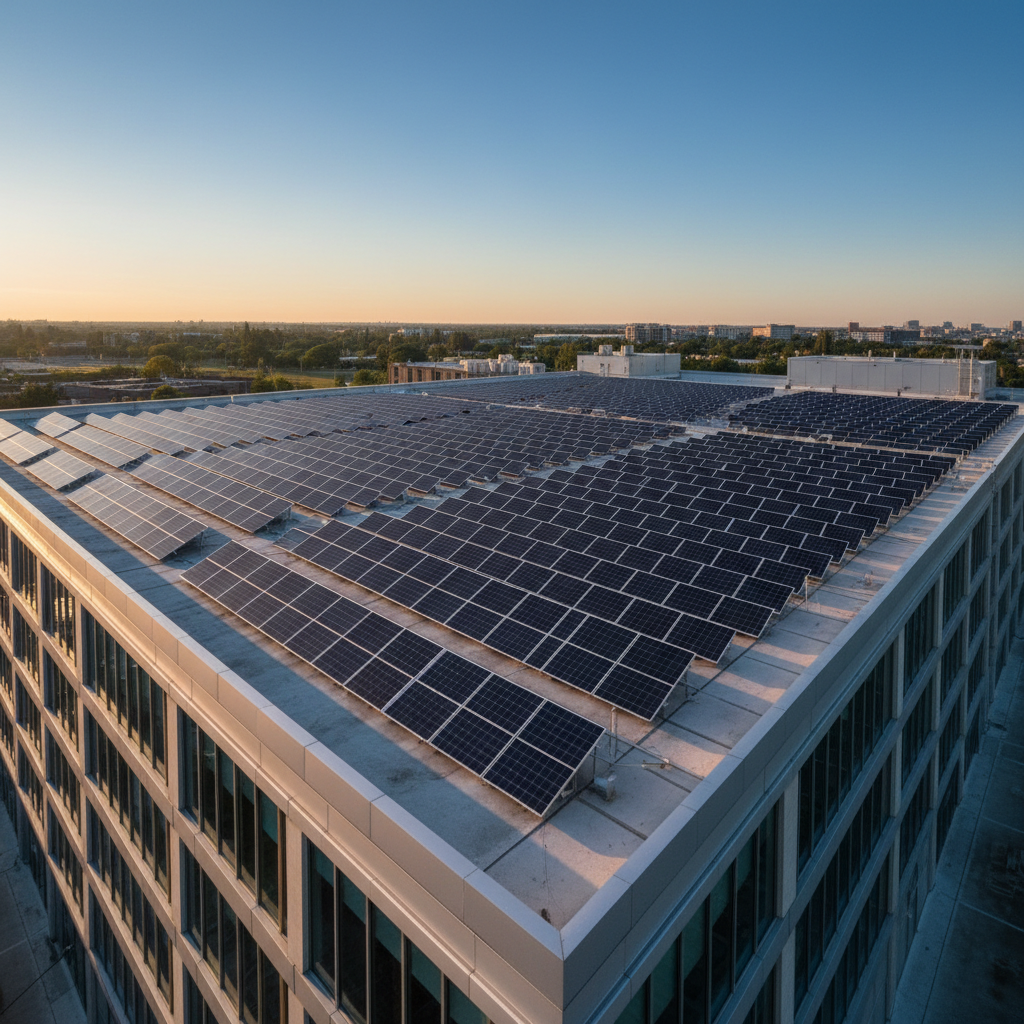
Perovskite Solar Cells: The Technology About to Disrupt the Industry
Key Takeaways
- LONGi set a new world record of 35.0% efficiency for perovskite-silicon tandem cells in early 2026, pushing the boundaries of what solar can deliver.
- The global perovskite market is on a rocket trajectory, projected to hit $370.7 million by end of 2026 at a CAGR exceeding 50%.
- GCL Optoelectronics launched the world's first gigawatt-scale perovskite factory in June 2025, signaling the end of lab-only status for this technology.
- Durability hurdles — long the Achilles' heel of perovskites — are being systematically conquered through molecular-level breakthroughs and rigorous certification testing.
- Beyond rooftops, perovskites are heading for electric vehicle roofs, building facades, and anywhere lightweight, high-efficiency power generation matters.
For decades, silicon has been the undisputed king of solar energy. Reliable, well-understood, and continuously improving, it has powered the global clean energy transition from a niche curiosity to a multi-trillion-dollar industry. But a new contender has been quietly maturing in laboratories across China, Europe, and North America — and in 2025 and 2026, it stepped decisively onto the commercial stage.
Perovskite solar cells, named after the crystal structure they share with the mineral calcium titanium oxide, are no longer a promising future technology. They are a present-tense disruption in motion. Here is everything you need to know about where the technology stands, why it matters, and what comes next.
What Makes Perovskite Solar Cells Different?
At their core, perovskite solar cells use a class of synthetic materials — typically methylammonium lead halide compounds — that can be tuned to absorb specific portions of the solar spectrum by simply adjusting their chemical composition. This tunable bandgap is a property that conventional silicon simply cannot match, and it is the foundation of everything that makes perovskites exciting.
Key physical advantages include:
- Lightweight construction — perovskite layers are measured in nanometers, not the millimeter-scale wafers required by silicon
- Low-cost deposition — perovskite films can be applied using solution-based printing processes, potentially far cheaper than the energy-intensive crystal growth required for silicon
- High absorption efficiency — perovskite materials absorb sunlight extremely effectively, enabling high performance even in thin layers
- Spectral tunability — by adjusting the halide composition, manufacturers can engineer cells to capture different wavelengths of light, a critical advantage in tandem cell architectures
That last point is arguably the most transformative. When a perovskite top cell is stacked onto a conventional silicon bottom cell, the two layers capture complementary portions of the solar spectrum, dramatically exceeding what either material could achieve alone.
The Efficiency Numbers Are Rewriting the Rules
The headline figures emerging from 2025 and 2026 have left the solar industry taking notice.
In early 2026, LONGi — one of the world's largest solar manufacturers — achieved a certified world record of 35.0% efficiency for a perovskite-silicon tandem cell, surpassing the previous record of 34.85%. To put that in perspective, the best commercial silicon-only modules today typically deliver 22–24% efficiency. A pathway to 35% and beyond fundamentally changes the economics and physics of solar energy generation.
Single-junction perovskite cells — those not paired with silicon — are also making rapid strides. A certified 27.3% efficiency was recorded for single-junction perovskite in early 2026, narrowing the gap with tandem results and underscoring how rapidly the base technology is maturing.
On the commercial side, Oxford PV is already delivering modules at 24.5% efficiency to paying customers, with a target of 26.0% efficiency for its late 2026 product line. These are not laboratory curiosities. These are panels being installed in real projects today, and their performance numbers are beginning to make conventional silicon look like a mature, plateau-bound technology.
From Lab Bench to Gigawatt Factory: The Industrial Leap
Perhaps the most significant development of the past 18 months is not a record-breaking efficiency figure — it is the movement from laboratory-scale research to industrial-scale manufacturing.
In June 2025, GCL Optoelectronics launched the world's first gigawatt-scale perovskite manufacturing facility, a milestone that fundamentally changes the conversation around this technology. You cannot credibly claim a solar technology is ready to disrupt the industry if you can only make it in milligram quantities. GCL's 1GW factory obliterates that objection.
GCL was not alone. UtmoLight's GW-scale factory in China began production in February 2025, and the company made a statement that would have been unthinkable just a few years ago: a 25-year power output guarantee on perovskite modules. For context, that is the same warranty benchmark that crystalline silicon manufacturers have spent 30 years building credibility around. Matching it — in the technology's commercial infancy — signals genuine confidence in long-term reliability.
The manufacturing hub geography is telling. The leading centers of perovskite industrial scale-up are currently in China, South Korea, and Germany, reflecting both the capital availability and the existing solar manufacturing ecosystems in those regions. China, in particular, is applying the same manufacturing intensity to perovskites that it previously used to drive silicon module prices down by over 90% in a decade.
Solving the Durability Problem
If efficiency has been perovskite's headline advantage, stability has historically been its headline weakness. Early perovskite cells degraded rapidly when exposed to moisture, heat, and prolonged illumination — a serious commercial liability for a technology expected to perform for 25+ years outdoors.
That narrative is now being actively dismantled on multiple fronts.
In January 2026, researchers at Xi'an Jiaotong University published a landmark "Molecular Press Annealing" strategy in the journal Science, describing a technique that dramatically reduces the crystallographic defects responsible for perovskite degradation. By applying controlled mechanical pressure during the annealing process, the team achieved significantly more uniform crystal structures — directly translating to improved long-term stability. Publications in Science do not guarantee commercial deployment, but they do signal that the fundamental materials science is converging on workable solutions.
On the certification front, Hanwha Qcells achieved something equally significant in May 2025: its tandem perovskite-silicon modules successfully passed international IEC and UL stress tests, the industry-standard durability benchmarks used to qualify panels for real-world deployment.
Danielle Merfeld, Global Chief Technology Officer at Hanwha Qcells, described the achievement with rare directness: "To Hanwha Qcells' knowledge, this is the first report of tandem modules passing these stress tests... this is truly a pivotal moment for tandem solar technology."
When a company's own CTO calls something a "pivotal moment," it is worth paying attention.
Beyond Rooftops: Perovskites Are Going Mobile
One of the most compelling aspects of perovskite technology is that its advantages — lightweight, thin, flexible, and spectrally tunable — make it applicable in contexts where conventional silicon panels simply cannot go.
The most dramatic emerging application is Vehicle-Integrated Photovoltaics (VIPV). In April 2026, Oxford PV partnered with Nissan's SUITE consortium to integrate high-efficiency tandem cells directly into electric vehicle roofs. The goal is not to replace grid charging, but to meaningfully extend daily range through continuous solar harvesting.
Oxford PV's CTO Ed Crossland articulated the potential with striking clarity: "As efficiencies approach 30%, solar could meet the full daily energy needs of up to 50% of drivers on many vehicles."
Consider what that means in practice. For a large proportion of drivers who cover typical urban and suburban distances, a solar roof could effectively eliminate routine charging needs on sunny days. Perovskite's lightweight nature means the added weight penalty is negligible compared to the energy benefit — a trade-off silicon's bulk simply cannot match.
Building-integrated applications are equally promising. Perovskites can be manufactured as semi-transparent films suitable for windows, spandrel glass, and curtain-wall facades. Their tunable color properties — another function of that adjustable bandgap — mean they can be designed to architectural specifications without sacrificing significant power output. For urban environments where rooftop space is scarce, this opens an entirely new surface area for distributed generation.
The "Tandem Ready" Silicon Ecosystem Takes Shape
A quieter but strategically important trend is emerging among established silicon wafer manufacturers: the development of "Tandem Ready" silicon wafers specifically engineered to simplify the application of perovskite top layers.
This is the solar industry's equivalent of a platform strategy. Rather than waiting for perovskite manufacturers to solve silicon compatibility issues independently, leading wafer producers are building the solution into their product specifications. It accelerates the entire ecosystem, lowers the technical barriers for new entrants, and accelerates the transition from hybrid laboratory stacks to standardized commercial tandem products.
This kind of infrastructure investment does not happen speculatively. It happens when major manufacturers are convinced a technology is genuinely arriving — and betting their product roadmaps accordingly.
What the Market Trajectory Tells Us
The commercial momentum is reflected in the investment numbers. The global perovskite solar cell market is estimated to reach $370.7 million by the end of 2026, growing at a projected CAGR of over 50%. That kind of sustained growth rate, applied to an already measurable market base, points toward a technology that is not merely promising but actively compounding.
For comparison, conventional silicon solar scaled from niche to dominant global energy source over roughly two decades. Perovskite is scaling against an existing, mature solar infrastructure — which means it benefits from existing financing mechanisms, installation networks, and policy frameworks, while simultaneously leapfrogging silicon on pure performance metrics.
Bottom Line
Perovskite solar cells have crossed the threshold that separates "promising laboratory technology" from "commercially credible disruption." World-record efficiencies above 35%, gigawatt-scale factories in operation, durability certifications achieved, and landmark partnerships with automotive manufacturers have collectively answered the most pressing questions that have held the technology back. The remaining challenges — cost parity, further stability optimization at scale, and supply chain development — are engineering problems, not fundamental physics barriers. The solar industry spent 40 years perfecting silicon; it will not take anywhere near that long to industrialize perovskite. The disruption is not coming. It is already underway.
Ready to take advantage of today's most advanced solar technology? Get your free, no-obligation solar proposal and find out how the latest high-efficiency panels can work for your home or business.