Solid-State Batteries and What They Mean for Home Solar Storage
Key Takeaways
- Commercial-grade solid-state battery (SSB) cells have reached 480 Wh/kg energy density as of Q1 2026 — nearly double legacy lithium-ion technology.
- SSBs now demonstrate 12,000+ cycle lifespans at 100% Depth of Discharge, roughly equivalent to 30 years of daily solar cycling.
- Market adoption is accelerating fast: SSBs captured 6.5% of new residential solar storage installs in 2026, up from just 0.8% in 2024.
- At $450/kWh installed, SSBs remain ~40% more expensive than LFP alternatives — but the gap is narrowing and the use cases are diverging.
- For California homeowners navigating NEM 3.0, the shift to solid-state storage has real, practical implications for system design, safety placement, and long-term economics.
The battery sitting in your garage right now — or the one you're considering adding to your rooftop solar system — is built around chemistry that hasn't fundamentally changed since the 1990s. Liquid electrolyte, thermal management requirements, fire-risk enclosures, and a 10-year warranty clock that starts ticking the day it's installed. That paradigm is changing, and faster than most homeowners realize.
Solid-state batteries are no longer a laboratory promise. As of mid-2026, they are shipping to California homes, earning new safety certifications, and quietly rewriting the rules of what a home energy storage system can look like. Here's what you need to know.
What Makes a Battery "Solid-State"?
In a conventional lithium-ion battery — whether NCM chemistry or the increasingly popular LFP (Lithium Iron Phosphate) — ions travel between electrodes through a liquid electrolyte. That liquid is flammable, temperature-sensitive, and prone to a failure mode called dendrite growth, where microscopic lithium filaments eventually pierce the separator and cause short circuits or thermal runaway.
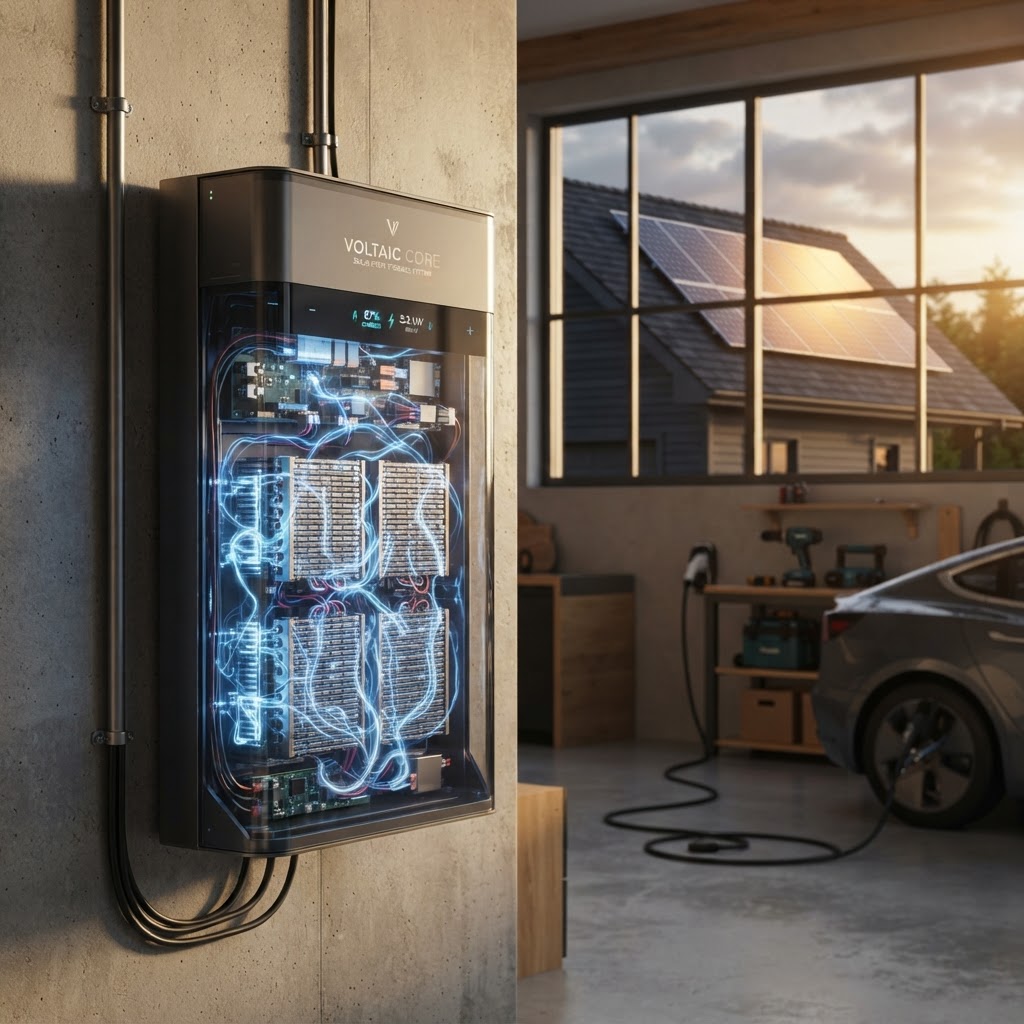
Solid-state batteries replace that liquid with a solid material — ceramic, sulfide-based, or polymer compounds depending on the manufacturer. The result is a cell with no flammable liquid, dramatically reduced thermal risk, higher energy density, and a fundamentally longer useful life.
According to the Global Energy Storage Outlook 2026, commercial-grade SSB cells have now achieved 480 Wh/kg — nearly double the 260 Wh/kg average of traditional NCM liquid-electrolyte cells used in 2023. That's not an incremental improvement. That's a generational leap.
The Numbers That Matter for California Homeowners
Before getting into what's possible, let's ground this in what's real and current:
- Energy density: 480 Wh/kg (SSB) vs. 260 Wh/kg (legacy NCM) — Global Energy Storage Outlook 2026
- Cycle life: 12,000+ cycles at 100% DoD, equivalent to ~30 years of daily solar cycling — Next-Gen Battery Materials Study, January 2026
- Installed cost: approximately $450/kWh as of early 2026, down from projected pilot costs of $800/kWh in 2024 — Renewable Energy Economics Report 2026
- Market penetration: 6.5% of new residential solar storage installs in 2026, up from 0.8% in 2024 — Solar Market Insights 2026 Q2
- Current premium over LFP: approximately 40%
That 40% premium is significant and shouldn't be glossed over. LFP remains the workhorse of residential solar storage for good reason — it's proven, cost-effective, and well-suited for most whole-home backup applications. But the SSB value proposition is not simply "better battery." It's a fundamentally different product category with specific advantages that matter in specific situations.
What's Actually Shipping in 2026
Two product launches this year deserve attention from anyone seriously evaluating home storage.
Enphase IQ Battery 6S (February 2026): Enphase's first consumer-ready semi-solid state unit features a 15% smaller physical footprint than its predecessor and has achieved a notable regulatory milestone: approval for installation in bedroom closets under updated UL 9540 standards. The elimination of thermal runaway risk is what unlocked that certification — a development that fundamentally changes where storage can live inside a home.
Toyota-Panasonic "Home-Solid" Modular Blocks (May 2026): The joint venture began shipping ceramic-electrolyte based storage units specifically to the California and Australian markets. The geographic targeting is deliberate — both regions experience extreme ambient heat that accelerates degradation in liquid-electrolyte systems. California's Central Valley, Inland Empire, and desert communities routinely see conditions where conventional LFP performance suffers; ceramic solid-state chemistry is engineered for exactly those environments.
Additionally, Solid Power's breakthrough in sulfide-based electrolytes (January 2026) demonstrated a 15-minute full charge cycle for vehicle-to-home (V2H) applications — meaning homeowners can fully top off backup storage from the grid in under 20 minutes during off-peak rate windows or ahead of incoming weather events. For households enrolled in Southern California Edison's or Burbank Water & Power's time-of-use rate structures, that charging speed creates real financial optimization opportunities.
Four Trends Reshaping Home Storage Design
1. Installation Flexibility: Beyond the Garage
The "garage-only" rule for battery storage has been a quiet constraint on system design for years. With SSBs eliminating flammable electrolyte risk, that constraint is evaporating. Utility rooms, basements, interior mechanical closets, and even built-in cabinetry are now viable locations — as the Enphase IQ 6S UL 9540 approval demonstrates. For California homes with limited garage space, multi-unit dwellings, or ADU conversions, this is a meaningful design unlock.
2. Thermal Resilience in Hot Climates
Solid-state units are demonstrating substantially superior performance above 45°C (113°F) compared to LFP alternatives. For homeowners in California's sun belt — San Bernardino County, the Coachella Valley, Sacramento Valley — thermal resilience isn't a luxury spec. It's a baseline requirement. The Toyota-Panasonic decision to prioritize California as a launch market for ceramic-electrolyte units is a direct acknowledgment of this reality.
3. Hybrid Storage Architectures
One of the more interesting developments among solar engineers is the rise of hybrid storage designs: a large, cost-optimized LFP bank handling bulk overnight storage, paired with a smaller SSB unit dedicated to high-demand surge applications — heat pump startup loads, EV fast charging, or peak grid events. This approach captures the economics of LFP while deploying SSB precisely where its high cycle life and power density deliver the greatest return. It's not an either/or choice.
4. The 30-Year Warranty Standard
The absence of dendrite growth in solid-state cells is pushing manufacturers toward 25- and 30-year performance warranties — finally aligning battery lifespan guarantees with those of the solar panels themselves. That alignment matters enormously for long-term financial modeling. Under NEM 3.0, California homeowners are evaluated on their ability to self-consume solar energy across a 25-year horizon. A battery with a matching lifespan changes the project economics significantly, and it's a factor Solanano's NEM 3.0-aware financial modeling now incorporates when evaluating SSB proposals against LFP alternatives.
What the Experts Are Saying
"The transition to solid-state is the 'transistor moment' for the solar industry. We are moving away from chemistry that needs to be managed and cooled toward a passive, solid-state appliance that just works for decades." — Dr. Aris Thorne, Chief Technology Officer, SolidGrid Systems
"By 2026, the question isn't capacity — it's safety and space. Solid-state allows us to pack 20kWh into the size of a carry-on suitcase. That changes the architectural possibilities of energy-independent homes." — Lydia M. Vance, Lead Analyst, CleanGrid Futures
Vance's observation about space is particularly relevant in California's housing context. Many of the state's older housing stock — bungalows, ranch homes, smaller urban lots — simply doesn't have ideal placement for large-format battery enclosures. A 20 kWh system in the footprint of a carry-on bag opens up installations that weren't previously viable.
A Note on Sustainability and Regulatory Direction
The EU's March 2026 mandate requiring a "Green Battery Passport" for all solid-state residential units — enforcing full traceability of solid electrolytes and 95% recyclability of ceramic and metallic components across a 25-year lifespan — is worth watching even if you're a California homeowner. European regulation frequently previews where California policy heads next. The California Air Resources Board and the CPUC have both signaled interest in end-of-life battery accountability frameworks. Choosing SSB products with established recycling chains today may prove to be ahead-of-curve compliance positioning within the next few years.
Is Solid-State Right for Your Home Right Now?
Honestly? It depends on your priorities, your location, and your budget. Here's a straightforward framework:
SSB likely makes strong sense if you:
- Live in a high-heat climate zone (Inland Empire, Central Valley, desert communities)
- Have constrained installation space and need indoor placement options
- Are planning a 25+ year ownership horizon and want warranty alignment with your solar panels
- Want maximum resilience with minimum maintenance — the nano-grid philosophy applied fully
- Are eligible for California's SGIP incentive, which can meaningfully reduce that 40% cost premium
LFP or a hybrid approach may be smarter if you:
- Are optimizing primarily for upfront cost per kWh
- Have straightforward bulk backup needs in a moderate-climate location
- Are in an early-stage solar install where adding a large LFP bank makes near-term financial sense, with a smaller SSB unit for surge capacity
The nuance matters. And the nuance is exactly where independent advisory — not sales-driven installer recommendations — makes a genuine difference.
Bottom Line
Solid-state batteries are not vaporware and they are not science fiction. They are shipping in California today, they are earning new safety certifications, and they are quietly reshaping what a resilient, solar-powered home can look like over the next three decades. The economics still favor LFP for pure cost-per-kWh comparisons, but the performance, safety, and longevity advantages of solid-state are real — and for the right homeowner in the right situation, they are worth the premium. The technology is moving quickly enough that any solar or storage decision made today should explicitly account for where SSB fits in a 25-year system design.
The smartest move is not to chase the newest technology for its own sake — it's to get an honest, data-driven assessment of which storage chemistry actually serves your home, your utility rate structure, and your resilience goals.
Ready to find out which storage technology is right for your home? Get a free solar and storage assessment from Solanano — California's independent solar advisory service — and get matched with a pre-vetted installer who will give you straight answers, not a sales pitch.