How Machine Learning Is Predicting Solar Panel Failures Before They Happen
Key Takeaways
- Predictive ML algorithms now identify inverter and transformer failures up to 7 days in advance with 95% accuracy, dramatically shrinking the window between fault detection and resolution.
- AI-monitored solar systems reduce unplanned downtime by 30–45% and can extend asset lifespan by 20–25%, turning maintenance from a cost center into a competitive advantage.
- U.S. solar facilities lost an average of $5,720 per MW to equipment underperformance in 2024 — the financial case for predictive diagnostics has never been stronger.
- Emerging technologies — from edge-compute smart inverters to drone-mounted thermal imaging — are making ML-powered fault detection accessible to residential as well as commercial systems.
- California homeowners face unique stakes: under NEM 3.0, every kilowatt-hour lost to underperformance carries a steeper financial penalty than ever before.
Solar panels are sold on a promise of 25-year durability. But between micro-cracks invisible to the naked eye, inverters quietly drifting out of spec, and bypass diodes failing without a single warning light, the gap between promise and performance has historically cost the industry billions. Now, machine learning is closing that gap — not by making hardware more robust, but by making failure essentially predictable.
This is not a distant technology story. As of mid-2026, the tools exist, the data is rolling in, and the financial argument is overwhelming. Here is what solar owners, project developers, and California homeowners need to understand about AI-driven predictive maintenance — and why it matters for every system on every rooftop.
The $5,720-Per-MW Problem That Sparked an Industry Shift
Equipment underperformance in U.S. solar facilities generated losses averaging $5,720 per MW in 2024, according to PV Magazine reporting from December 2025. At the utility scale, that number is catastrophic. At the residential scale, it represents a quieter but equally real erosion of the returns homeowners were promised when they signed their contracts.
The core problem has always been timing. Traditional maintenance is either reactive — you wait for something to break — or scheduled, meaning technicians arrive on a calendar cadence regardless of what the system actually needs. Both approaches are expensive and inefficient. Reactive maintenance means extended downtime. Scheduled maintenance means unnecessary truck rolls and missed early-warning signals that fall between visit windows.
This is what drove the industry-wide pivot to machine learning diagnostics between 2025 and 2026. The question stopped being "How do we fix failures faster?" and became "How do we predict them before they happen?"
What 95% Accuracy at 7 Days Out Actually Means
The headline statistic from Heaven Green Energy's 2025–2026 research is striking: predictive maintenance algorithms have achieved a 95% accuracy rate in identifying inverter and transformer failures up to 7 days in advance. To appreciate why this matters, consider the operational chain that typically follows a fault.
A failing inverter in a traditional setup might degrade performance for days or weeks before triggering an alarm. Once an alarm fires, a technician must be scheduled, parts ordered, and a site visit completed. AI-monitored systems, by contrast, have compressed that entire sequence dramatically — reducing downtime-per-fault from weeks to mere hours, resulting in a 1–3% increase in total annual energy yield across commercial portfolios (Portlandia Electric Supply, 2026).
A 1–3% yield improvement may sound modest, but on a California residential system sized at 8–10 kW operating under NEM 3.0's export compensation structure, that difference represents real money across a 25-year asset life.
The Architecture Behind the Prediction: From Regression to LSTM
Not all machine learning is created equal for this application. A May 2026 study published in Emerging Research confirmed that LSTM (Long Short-Term Memory) models have overtaken standard regression as the most accurate architecture for real-time solar performance forecasting.
LSTMs are a class of recurrent neural network specifically designed to learn patterns in time-series data — exactly the kind of data a solar system generates continuously: irradiance levels, temperature coefficients, string voltages, inverter operating temperatures, and hundreds of additional variables streaming around the clock. Where a regression model might notice that voltage has dropped, an LSTM learns how voltage typically drops before a failure event and flags the pattern weeks before thresholds are breached.
This temporal intelligence is precisely what Dr. Yue Zhao, Lead Researcher at Stony Brook University, is describing when he says:
"We are moving away from reactive 'truck rolls' to a world where software predicts a failure before the hardware even knows it is stressed."
In March 2026, Zhao's team, in collaboration with Ecogy Energy, announced the release of a self-supervised ML algorithm capable of identifying physical anomalies weeks or even years before they manifest as measurable performance losses. Self-supervised models are particularly significant because they do not require massive labeled failure datasets to train — a critical advantage for newer installations with limited operational history.
Four Emerging Technologies Reshaping Solar Diagnostics
1. Edge-Compute Smart Inverters
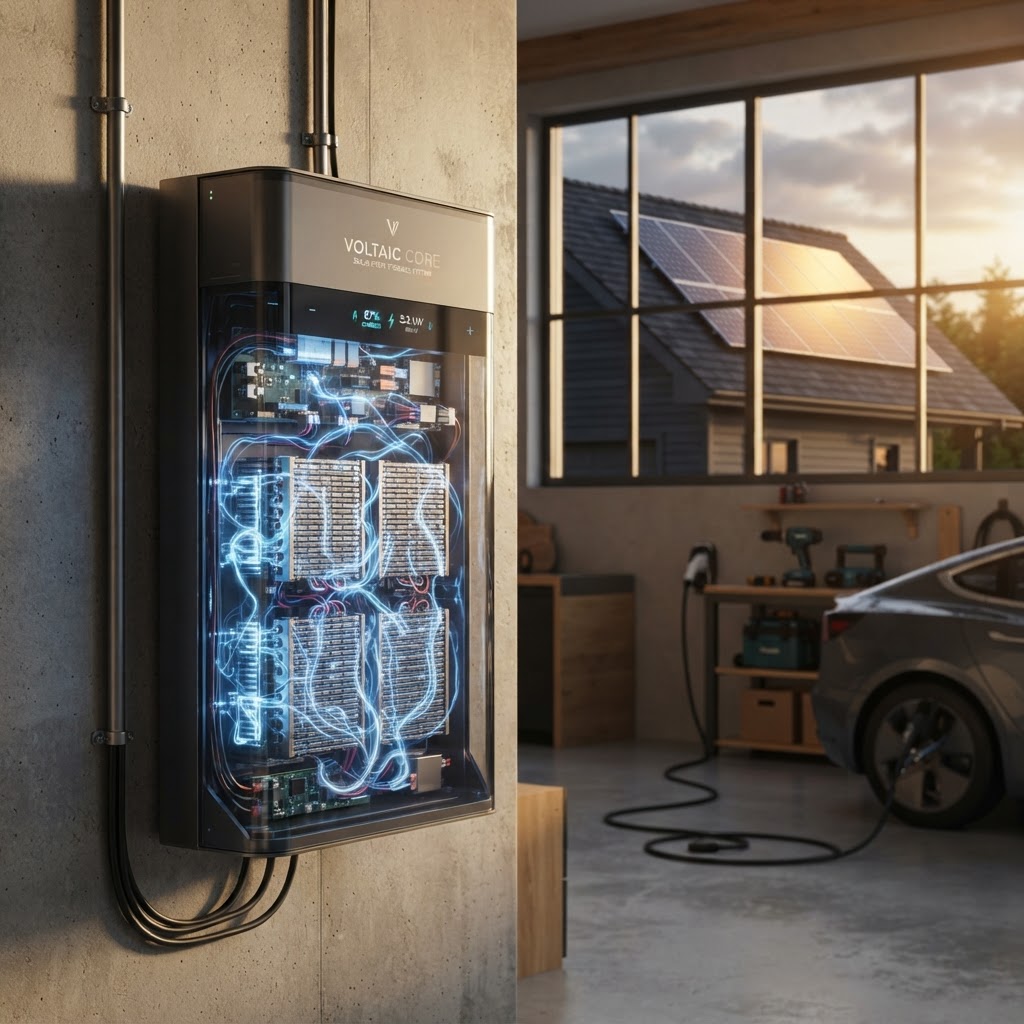
The latest generation of inverters does not just convert DC to AC — it thinks. By integrating ML processing directly into the inverter hardware, these systems can analyze 10,000+ data points per minute with zero latency, flagging anomalies in real time without waiting for data to travel to a remote cloud server. Huawei's FusionSolar 6.0+, launched in January 2026, exemplifies this trend with its "Full Intelligence" AI that automatically optimizes string-level performance by predicting shading and soiling impacts before they compound into losses.
2. Drone-ML Integration
Manual infrared inspections require a technician on-site, good weather, and significant labor hours. Automated drone-based thermal imaging paired with computer vision is rapidly replacing that process. These systems can identify micro-cracks, soldering defects, and bypass diode failures across an entire array in minutes, feeding images directly into classification models that prioritize repair urgency without any manual review. For large California ground-mount systems or commercial rooftop arrays, this is transformative.
3. Synthetic Data Training for New Systems
One persistent challenge in predictive ML is the "cold-start" problem: a brand-new installation has no historical failure data to train on. The industry's answer is synthetic data training using physics-informed simulations and domain randomization. By modeling how a specific panel model, inverter brand, and microclimate combination degrades under thousands of simulated conditions, ML models arrive pre-trained on new systems from day one — no years-long data collection required.
4. Condition-Based O&M
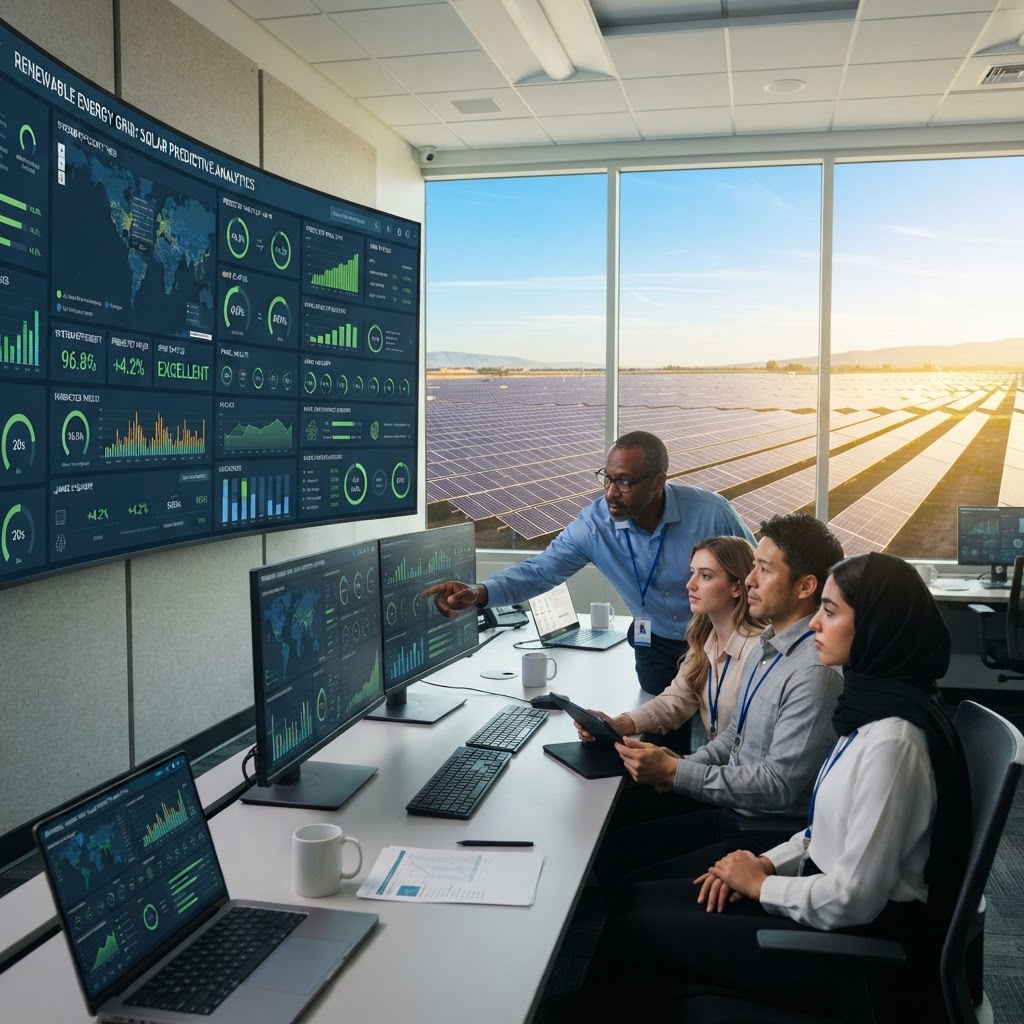
The cumulative result of all these technologies is a fundamental shift in how operations and maintenance contracts are structured. Condition-based O&M replaces fixed quarterly or annual service visits with AI-triggered dispatches based on real-time health scores and early-warning signatures. Technicians show up when — and only when — the data says something needs attention, carrying the right parts for the right repair. This model has contributed directly to the 30–45% reduction in unplanned downtime and the 20–25% extension of operational asset lifespan documented in Heaven Green Energy's 2026 research.
What This Means for Panel Technology Choices
Machine learning is also beginning to influence which panels are worth buying in the first place. NREL and Energy Solutions' 2026 update found that N-type TOPCon panels monitored by ML-driven diagnostic platforms show annual degradation rates as low as 0.3%, compared to 0.7% for legacy P-type panels. When that differential is compounded over a 25-year warranty period, the gap in total lifetime energy output is substantial.
Meanwhile, PV Tech reported in February 2026 that Tier 1 manufacturers are now using ML during production itself — predicting solar cell efficiency directly from wafer quality measurements before final assembly. Panels that would have subtly underperformed are caught before they ever reach a rooftop, raising the floor on manufactured quality across the industry.
The implication for California buyers is direct: panel brand selection, monitoring platform capability, and inverter intelligence are now inseparable from the financial modeling of a solar investment. As John Gorman, CEO of Ecosuite, put it plainly:
"In 2026, the competitive edge in solar isn't hardware efficiency alone; it's the AI layer that prevents that efficiency from degrading."
The California Dimension: NEM 3.0 Raises the Stakes
California's NEM 3.0 framework, which dramatically reduced export compensation rates compared to its predecessor, fundamentally changed the economics of residential solar. Under NEM 3.0, self-consumption and storage optimization drive returns far more than grid exports. That makes system health and predictable output more critical than ever.
A system underperforming by even a modest margin due to an undetected inverter drift or soiling pattern doesn't just lose a few kilowatt-hours — it shifts consumption back to the grid at retail rates during peak hours, directly undermining the financial model. Add to this the SGIP battery incentive structure, California utility-specific rate schedules from SCE and other providers, and the nano-grid resilience case for paired solar-plus-storage, and the argument for ML-enhanced monitoring becomes a California-specific financial imperative, not merely a technological luxury.
At Solanano, our hyperlocal satellite irradiance modeling, shade analysis tools, and NEM 3.0-aware financial modeling are built to incorporate exactly these variables — ensuring the systems we recommend are matched with monitoring and O&M solutions that protect your investment over the long term.
Bottom Line
Machine learning has moved from the research lab to the rooftop faster than most of the solar industry anticipated. The combination of LSTM-based forecasting, edge-compute inverters, drone thermal imaging, and condition-based maintenance is transforming solar from a "set it and forget it" asset into a dynamically managed energy system — one where failures are predicted before they happen, downtime is measured in hours rather than weeks, and panel lifespan is extended by decades rather than months. For California homeowners navigating NEM 3.0, where every kilowatt-hour of system performance carries measurable financial weight, the question is no longer whether predictive AI monitoring matters — it is whether your current system has it.
Ready to find out how your solar system stacks up — or to make sure your next system is built around the monitoring and vetting standards that protect your investment? Get a free solar assessment from Solanano and let our independent experts show you what your home's energy future actually looks like.