How Machine Learning Is Predicting Solar Panel Failures Before They Happen
Key Takeaways
- AI-driven predictive maintenance can reduce unexpected solar equipment failures by up to 70% at utility-scale farms.
- The global solar predictive maintenance market is on track to hit $965.1 million in 2026, growing at 7.4% annually.
- Machine learning models now achieve up to 96.8% accuracy in diagnosing panel faults using infrared thermography.
- Edge AI deployed directly on smart inverters is replacing cloud-dependent systems, enabling millisecond fault detection.
- "Out-of-the-box" AI models without domain-specific training can misclassify up to 20% of issues — making data quality critical.
The solar industry has a quiet, expensive problem. Panels bake in the desert sun. Inverters cycle through thousands of charge-discharge events. Soiling, micro-cracks, delamination, and thermal hotspots accumulate invisibly — until the day a string goes offline, a farm underperforms its PPA targets, and someone has to explain why revenue just dropped 15% in a quarter.
For most of the industry's history, the answer was reactive maintenance: wait for something to break, then fix it. That era is ending. Machine learning is now sophisticated enough to predict failures days, weeks, and in some cases months before they manifest — and the financial case for adoption has never been stronger.
Why Traditional O&M Is No Longer Good Enough
Manual inspection of a utility-scale solar farm is a labor-intensive, infrequent, and fundamentally backward-looking process. A technician walking rows of panels can identify a cracked cell or a blown fuse — but only after the damage is done. Meanwhile, the real killers of solar performance are slow, systemic, and invisible to the naked eye.
Consider inverters. In 2026, roughly 32% of all predictive maintenance efforts in the solar sector are focused specifically on inverter monitoring — and for good reason. Inverters are the most critical point of failure in any solar installation. A single failed inverter at a utility-scale plant can take hundreds of kilowatts offline for days. Industry benchmarks now show that AI-optimized Operations and Maintenance (O&M) can cut total maintenance costs by 25% to 40%, a figure that transforms the business case for solar project financing.
The math is compelling. The question is no longer whether to deploy AI-driven predictive maintenance, but how to do it right.
How Machine Learning Actually Works in Solar Fault Detection
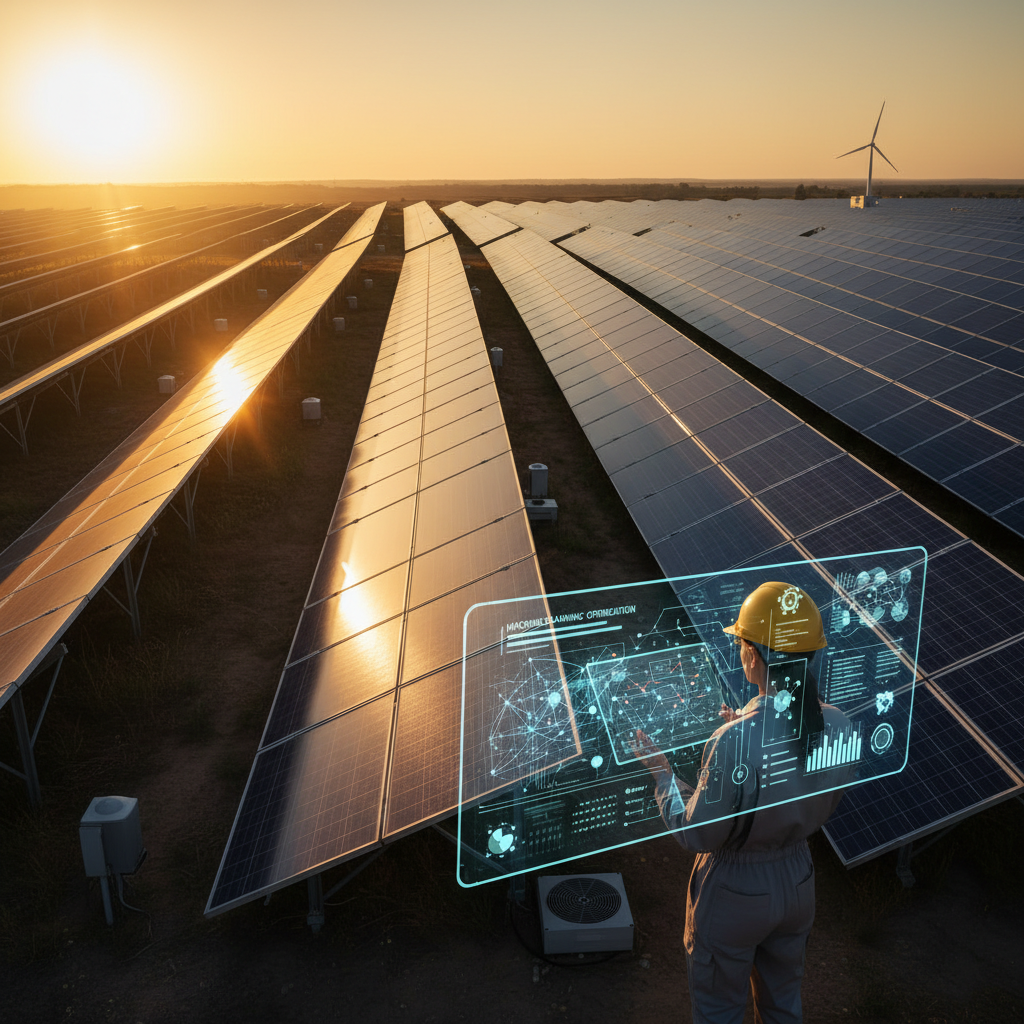
At its core, machine learning for solar fault detection involves training algorithms on large datasets of sensor readings — current, voltage, temperature, irradiance, string-level production data — so that the model learns what "healthy" performance looks like. When real-world readings deviate from that learned baseline in statistically significant ways, an alert is triggered.
But the science has advanced well beyond simple anomaly detection. Here's what modern ML systems are capable of in 2026:
Hybrid Feature Extraction with Infrared Thermography
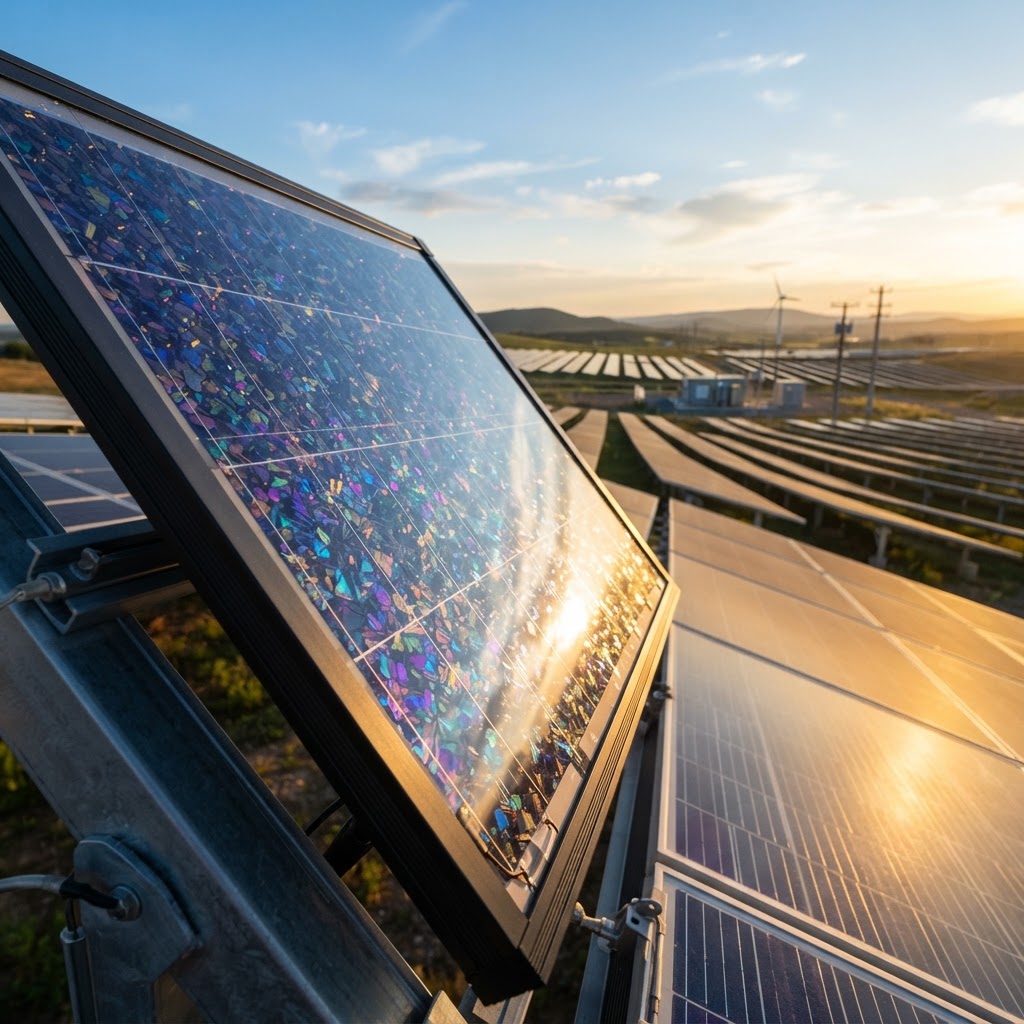
One of the most significant technical advances comes from combining local feature extraction with thermal imaging. A February 2025 study demonstrated that machine learning models using this hybrid approach achieved a record 96.8% testing accuracy for panel fault diagnosis — even in noisy, hazy real-world conditions.
"Existing machine learning approaches are often limited to specific datasets; our new hybrid models are designed to resist noise and haze, achieving nearly 97% accuracy in real-world conditions." — Dr. Waqas Ahmed, Solar Research Lead, Jönköping University
This matters enormously in the field, where dust haze over a Rajasthan solar farm or coastal fog at a California installation can corrupt thermal images and fool simpler algorithms into false positives — or worse, false negatives.
Degradation-Aware Deep Learning
A February 2026 study published in Applied Sciences introduced a degradation-aware deep learning model that tackles one of the field's thorniest problems: separating long-term panel efficiency loss from normal weather fluctuations. This distinction is critical. A panel performing 3% below baseline on a partly cloudy day is not necessarily failing. A panel that is consistently 3% below baseline across all irradiance conditions over six months almost certainly is.
By disentangling these signals, the model gives O&M teams actionable intelligence rather than noise-driven false alarms — one of the biggest complaints operators have about first-generation AI monitoring platforms.
Synthetic Data for Rare Failure Modes
Not all faults happen frequently enough to generate sufficient training data. Specific chemical delamination events, for instance, may occur only a handful of times across an entire fleet over a decade. Machine learning models cannot learn to recognize what they have barely seen.
The solution emerging in 2026 is the use of Generative Adversarial Networks (GANs) to create synthetic training data for rare failure modes. Researchers feed GANs examples of known fault signatures, and the network generates statistically plausible variations — effectively giving the model thousands of "practice runs" at identifying a fault it might otherwise miss in the real world.
The Edge AI Revolution: From Cloud to Smart Inverter
Perhaps the single most consequential trend reshaping solar predictive maintenance in 2026 is the shift from cloud-based to edge-based AI deployment.
Legacy monitoring architectures work like this: sensors collect data, upload it to the cloud, cloud servers run analysis, results come back with recommendations. The round-trip latency on this process — even on fast networks — is measured in seconds to minutes. For a fault that can cascade within milliseconds (such as an arc fault leading to a fire), that is far too slow.
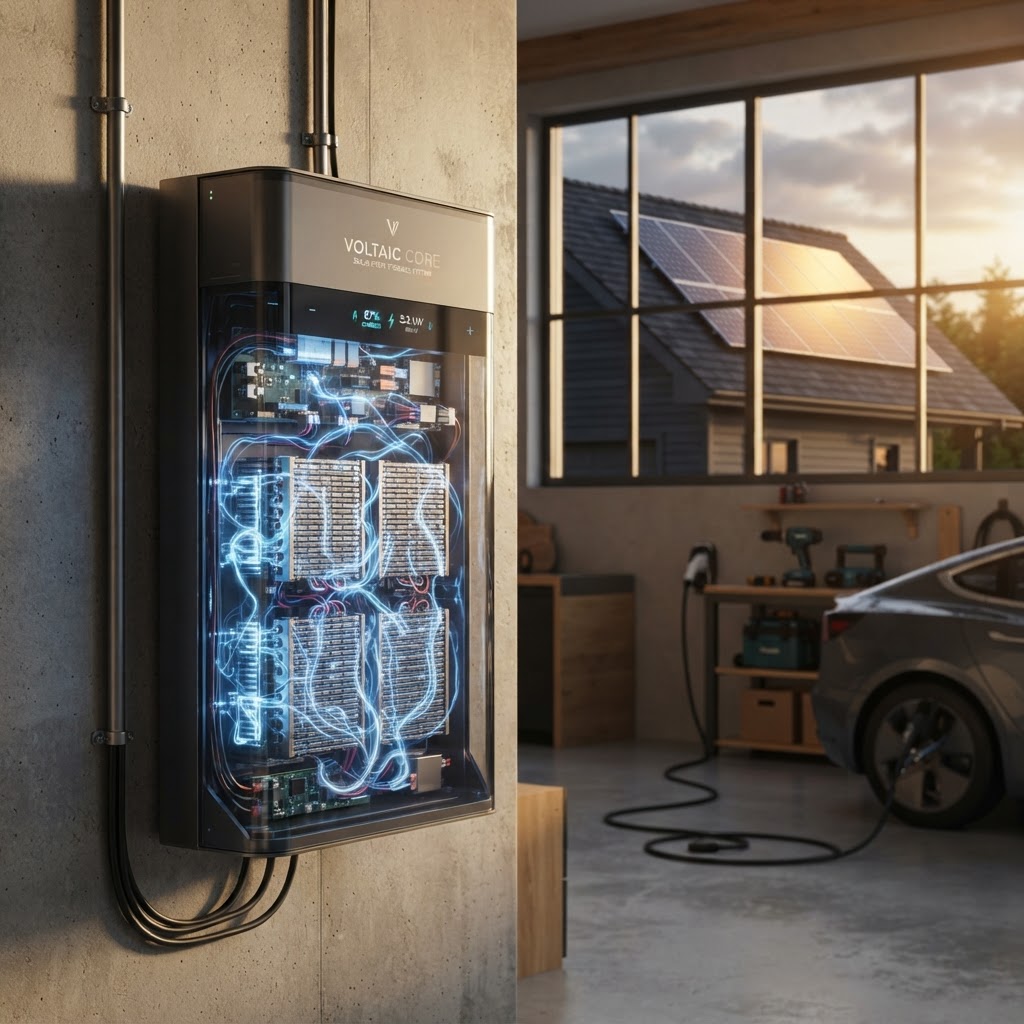
The new paradigm deploys AI models directly onto smart inverters and monitoring edge nodes. The inverter itself runs the inference engine. When a fault signature emerges, the device responds in milliseconds — potentially isolating a string before damage propagates.
This architecture also has significant implications for data privacy and connectivity. A farm in a remote location with unreliable internet connectivity can now maintain full predictive intelligence without depending on a cloud uplink.
"2026 marks the year AI stops being a buzzword and becomes essential infrastructure for managing the sheer complexity of the terawatt-scale grid." — Vneet S. Jaain, Managing Director, Adani Green Energy Ltd
Drone-AI Integration: The New Standard for Asset Health Audits
Walking the rows is out. Automated drone inspections are in.
Across utility-scale solar farms globally, autonomous drones equipped with thermal cameras and computer vision AI are replacing manual thermal scanning as the standard method for large-scale asset health audits. A drone can complete an inspection of a 100 MW farm in hours rather than days — and the AI processes the thermal footage in near real-time, flagging hotspots, soiling gradients, and structural anomalies for human review.
This drone-AI integration feeds directly into the predictive maintenance loop: drone inspection data enriches the training datasets that power ongoing ML models, creating a virtuous cycle of improving accuracy over time.
Real-World Proof: From India to Adani's Balance Sheets
The business case for AI-driven solar maintenance is no longer theoretical. Two major developments in early 2026 illustrate where this technology is going at scale.
India's national ambition: India's Ministry of New and Renewable Energy (MNRE) announced a proposal for a national AI-driven Solar Inverter Fault Prediction System — a centralized platform designed to reduce rooftop solar downtime across the country by 40%. For a nation with millions of small rooftop installations, many of them unmonitored, this represents a fundamental shift in how distributed solar assets are managed.
Adani Green's financial proof point: Adani Green Energy Ltd (AGEL) reported an industry-leading 91% EBITDA margin for FY26, explicitly citing the successful deployment of sophisticated machine learning for real-time plant monitoring. When a company with gigawatts under management attributes margin leadership partly to AI-driven O&M, the investment community listens.
The Critical Warning: Domain-Specific Training Data Is Non-Negotiable
Success stories, however, come with an important caveat that the industry must not overlook.
A joint 2025 report from Clean Power Research and kWh Analytics issued a pointed warning: "out-of-the-box" AI models — generic algorithms applied to solar data without domain-specific customization — can misclassify up to 20% of operational issues.
A 20% misclassification rate is not a minor tuning problem. It means one in five alerts is either a false alarm (sending technicians on wasteful wild-goose chases) or a missed fault (allowing real degradation to go unaddressed). The report's conclusion is clear: the quality and domain-specificity of training data matters as much as the sophistication of the algorithm itself.
Key factors that separate high-performing AI maintenance platforms from mediocre ones include:
- Site-specific baseline modeling — accounting for local climate, soiling rates, and panel technology
- Fleet diversity in training data — exposure to multiple panel manufacturers, inverter brands, and installation ages
- Continuous retraining pipelines — models that update as equipment ages and conditions change
- Human-in-the-loop validation — experienced solar engineers reviewing and correcting model outputs to improve future accuracy
Predictive Maintenance Meets the Virtual Power Plant
One emerging trend worth watching: predictive analytics are expanding beyond pure maintenance functions into grid-level asset protection. As solar farms increasingly participate in Virtual Power Plants (VPPs) — providing grid balancing services by ramping output up and down rapidly — the physical stress on inverters and power electronics increases significantly.
Advanced AI systems are now being integrated into VPP control layers to monitor asset health in real-time during grid balancing events, throttling dispatch requests when sensors indicate that a component is approaching a thermal or electrical stress threshold. This protects physical assets from premature wear caused by aggressive grid service provision — a frontier that will only grow more important as grid complexity increases.
Bottom Line
Machine learning has crossed the threshold from promising technology to essential operational infrastructure in the solar industry. With verified failure reductions of up to 70%, accuracy rates approaching 97%, and a market approaching $1 billion, the question for every solar asset owner and developer is not whether AI-driven predictive maintenance is worth deploying — it is how quickly they can do it without compromising on data quality or domain expertise. The farms that get this right will operate with stronger margins, fewer outages, and longer asset lifespans than those still relying on reactive repair strategies.
Ready to maximize the performance and longevity of your solar investment from day one? Get your free solar proposal today and connect with experts who build AI-ready monitoring into every system design.