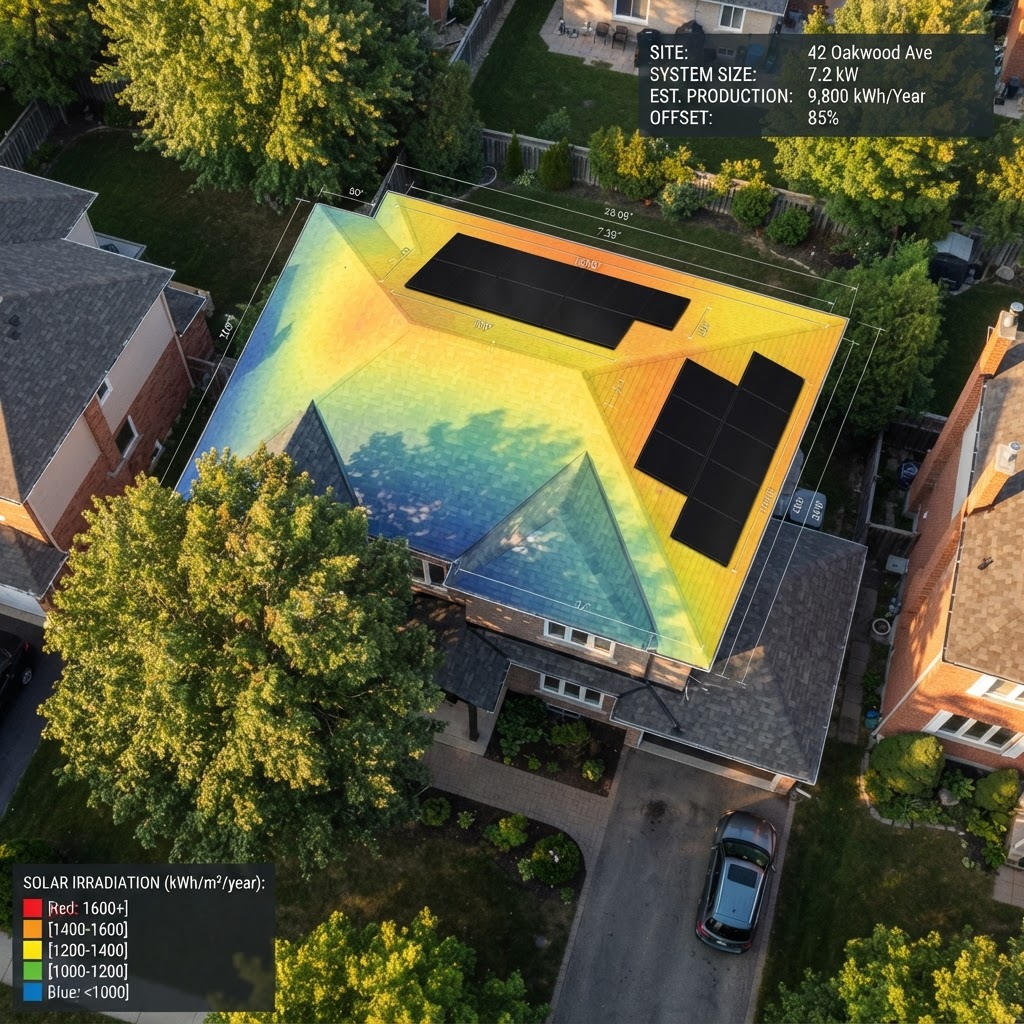
Why South-Facing Isn't Always Best: Shade Modeling Explained
Key Takeaways
- South-facing solar is no longer automatically the optimal orientation — under California's NEM 3.0, when your panels produce energy matters as much as how much they produce.
- West-facing arrays can deliver up to 20% higher financial returns in time-of-use (TOU) rate environments, even with 5–15% less total annual energy output.
- AI-powered LiDAR shade modeling now achieves ±1–2% precision, making professional-grade shade analysis faster, cheaper, and more accurate than ever.
- A single unmodeled shading obstruction — a neighbor's oak tree, a chimney, an HVAC unit — can silently drain thousands of dollars from your system's lifetime return.
- Proper shade analysis isn't a luxury add-on. In 2026, it is the foundation of any financially credible solar proposal.
For decades, the first thing any solar installer said to a California homeowner was some version of: "Which way does your roof face? South? Perfect." South-facing was the gold standard. It maximized total annual kilowatt-hours, and under the old Net Energy Metering (NEM 2.0) rules, more kilowatt-hours meant more credits, which meant more savings. The math was simple.
That math no longer holds.
Under California's Net Billing Tariff (NEM 3.0), active through 2026, solar export credits have dropped by approximately 75% compared to what NEM 2.0 customers enjoyed. The financial priority has shifted decisively from total kilowatt-hours generated to on-site self-consumption — using the solar energy you produce yourself, right when you need it, rather than exporting surplus power to the grid for a shrinking credit. The implications for system design are profound, and shade modeling sits at the center of all of it.
The Orientation Myth: Why "South is King" Is Over
The traditional case for south-facing arrays was straightforward: they receive the most direct sunlight over the course of a day, delivering peak production around solar noon. In an era when utilities paid you well for every excess kilowatt-hour you pushed onto the grid, maximizing total output made complete sense.
But as Dr. Aris Veldkamp, Lead Grid Analyst at RenewaSource Global, puts it plainly:
"We are officially exiting the 'South is King' era. In a 2026 grid environment, the value of an electron depends entirely on when it arrives. A west-facing panel that hits its stride at 5:00 PM is now worth more than a south-facing panel peaking at noon."
This isn't a minor nuance — it's a fundamental restructuring of solar economics. Here's why:
- South-facing arrays peak around solar noon (11 AM–1 PM), when most households are empty, air conditioning loads are moderate, and TOU electricity rates are at their lowest.
- West-facing arrays peak in the late afternoon (3 PM–7 PM), precisely when California utilities like SCE charge their highest TOU rates, household energy demand surges, and battery storage systems benefit most from a fresh afternoon charge cycle.
- Research confirms that west-facing systems in the Northern Hemisphere typically produce 85–95% of the annual energy of south-facing systems, but can yield up to 20% higher financial value in peak-pricing regions — a category that now includes virtually all of California.
The trend is already reshaping industry behavior. Major solar design platform SolarGenix rolled out an "Economic-First" layout tool in January 2026 that automatically favors west-facing roof planes to maximize battery charging efficiency during peak TOU windows. This isn't a workaround or a compromise — it is now considered best practice.
What Shade Modeling Actually Does (And Why It's Not Optional)
Most homeowners, when they think about shading, think about obvious problems: a massive redwood tree blocking the entire south slope, or a chimney casting a hard shadow across half the array. These are easy to spot. The dangerous shading problems are the ones nobody sees coming.
Consider a typical California suburban roofline:
- A neighbor's Italian cypress growing two feet per year that seems harmless today but will shade your southeast-facing modules significantly within four years
- A rooftop HVAC unit that casts a diagonal morning shadow across three modules in winter
- Neighboring two-story additions approved after your system was designed
- Utility poles or wires that create micro-shading losses on individual cells throughout the day
Sarah T. Miller, Chief Design Officer at SunPrecision Systems, captures exactly why this matters financially:
"Modern shade modeling isn't just about avoiding shadows; it's about predictive revenue mapping. With 2026 LiDAR accuracy, we can tell a customer exactly how much a neighbor's growing oak tree will cost them in lost credits over the next decade."
That predictive capability is now commercially accessible. AI-powered LiDAR shade modeling has achieved a ±1–2% precision rate in 2025, enabling bankable yield assessments without a physical site visit. The cost of professional-grade 3D shade analysis has stabilized between $50 and $200 per residential site in 2026, largely due to the automation of high-resolution aerial imagery processing. For a system with a 20-year financial horizon worth $30,000–$60,000 in total value, spending $150 on a precise shade model is one of the highest-return decisions a homeowner can make.
How Modern Shade Analysis Works
Gone are the days of a technician standing on your roof with a Solar Pathfinder — a physical dome device that captures a fisheye photo of the sky and requires manual interpretation. In 2026, most top-tier solar firms have eliminated handheld shade tools entirely, replacing them with instant AI-driven aerial simulations.
Here's what a rigorous modern shade analysis actually involves:
- Satellite and aerial LiDAR data capture: High-resolution 3D point clouds of your roof and every surrounding structure and tree, accurate to centimeters.
- Sun path modeling: Simulation of the sun's trajectory across every hour of every day of the year for your specific GPS coordinates, layered onto the 3D model.
- Obstruction identification: Automatic flagging of objects — trees, chimneys, dormers, neighboring structures — that intersect the sun path during high-value production hours.
- Module-level shading impact: Because shade on even one cell in a traditional string inverter system can reduce output from the entire string, shade analysis must operate at the individual panel level.
- Financial overlay: In a NEM 3.0 environment, shade losses are then mapped to TOU rate periods — a shadow at 5 PM costs far more than the same shadow at 10 AM.
- Predictive growth modeling: Vegetation databases and growth rate algorithms project how tree canopy will evolve over 5, 10, and 20-year periods.
At Solanano, this kind of hyperlocal analysis — integrating satellite irradiance modeling, shade simulation, and NEM 3.0-aware financial modeling — is a standard part of how we evaluate every California home before recommending a single panel or a single installer.
The Technology Making Partial-Shade Sites Viable
One of the most consequential shifts in residential solar design over the past two years is what the industry calls shade-agnostic system design. Two technologies are driving this:
Module-Level Power Electronics (MLPE): Microinverters and DC optimizers, now standard in most premium installations, allow each panel to operate independently. A shaded panel no longer drags down an entire string. This doesn't eliminate shading losses — physics still applies — but it contains them, and it makes roofs that would previously have been dismissed as "too shaded" now economically viable.
Bifacial Panels: Modern bifacial modules harvest diffuse and reflected light from their rear surface. On a white membrane rooftop or a light-colored tile roof, rear-side gain can add 5–15% additional energy — energy that doesn't depend on direct sun angle at all. This makes bifacial panels particularly effective on east-facing or even north-facing roof sections that receive significant sky diffusion.
These technologies don't replace shade modeling — they make accurate shade modeling more important, because you need to know the precise shade profile to correctly specify which electronics and panel types will perform best on each section of the roof.
The Nano-Grid Angle: Shade, Storage, and Resilience
There's another dimension to this conversation that goes beyond bill savings: energy resilience. California homeowners increasingly view solar and battery storage not just as a financial tool but as a hedge against grid outages, wildfire-related Public Safety Power Shutoffs (PSPS events), and long-term utility rate increases.
This is the core of Solanano's nano-grid philosophy — designing solar-plus-storage systems that give homeowners genuine energy independence, not just a smaller bill. And orientation matters enormously in this context.
A west-facing array charging a home battery from 3–7 PM delivers a fully charged battery heading into the evening — exactly when grid outages are most disruptive and when households draw the heaviest loads. A purely south-facing system might finish charging your battery by 2 PM, leaving you with nowhere to put the afternoon production surplus (which NEM 3.0 barely compensates) and a battery that sat idle during peak grid stress hours.
Accurate shade modeling ensures that the battery charging profile matches the real production profile — not an idealized one — so your resilience strategy actually works when you need it.
What This Means for California Homeowners Specifically
If you're evaluating solar in Southern California Edison, Burbank Water and Power, or any other California utility territory, here is what you should demand from any proposal you receive:
- A shade analysis report, not a verbal assurance that "your roof looks good"
- Orientation-specific financial modeling under NEM 3.0 TOU rates, not generic kWh production estimates
- SGIP eligibility assessment if battery storage is part of the design
- NABCEP-certified design review — a credential that Solanano's 4-stage installer vetting process specifically checks
The industry is moving fast. In Q1 2026, solar and battery storage accounted for a record 91% of all new electricity-generating capacity added to the U.S. grid — a statistic that reflects not just solar's growth, but the acceleration toward time-shifted, self-consumed energy that NEM 3.0 incentivizes. Internationally, new European Solar Standard regulations now mandate high-fidelity 3D shading analysis for all commercial rooftop installations over 50kW — a policy direction that will likely influence U.S. residential standards within the decade.
California homeowners who get serious about shade modeling and orientation economics today are positioning themselves ahead of that curve.
Bottom Line
South-facing solar arrays are not bad — they remain an excellent choice on many roofs, for many homeowners. But they are no longer automatically the right choice. Under NEM 3.0, in a TOU pricing environment, with battery storage as the financial and resilience backbone of a modern residential energy system, orientation is a financial decision that must be modeled, not assumed. Shade analysis has become precise enough, affordable enough, and fast enough that there is no credible reason to skip it. The homeowners who will get the most from solar in 2026 and beyond are the ones who understand that the best system isn't the one with the most panels pointed south — it's the one designed with full knowledge of their specific roof, their specific shading environment, and their specific utility rate structure.
Ready to find out what your roof is actually worth under NEM 3.0? Get a free solar assessment from Solanano — independent analysis, no sales pressure, just the numbers your roof actually earns.


