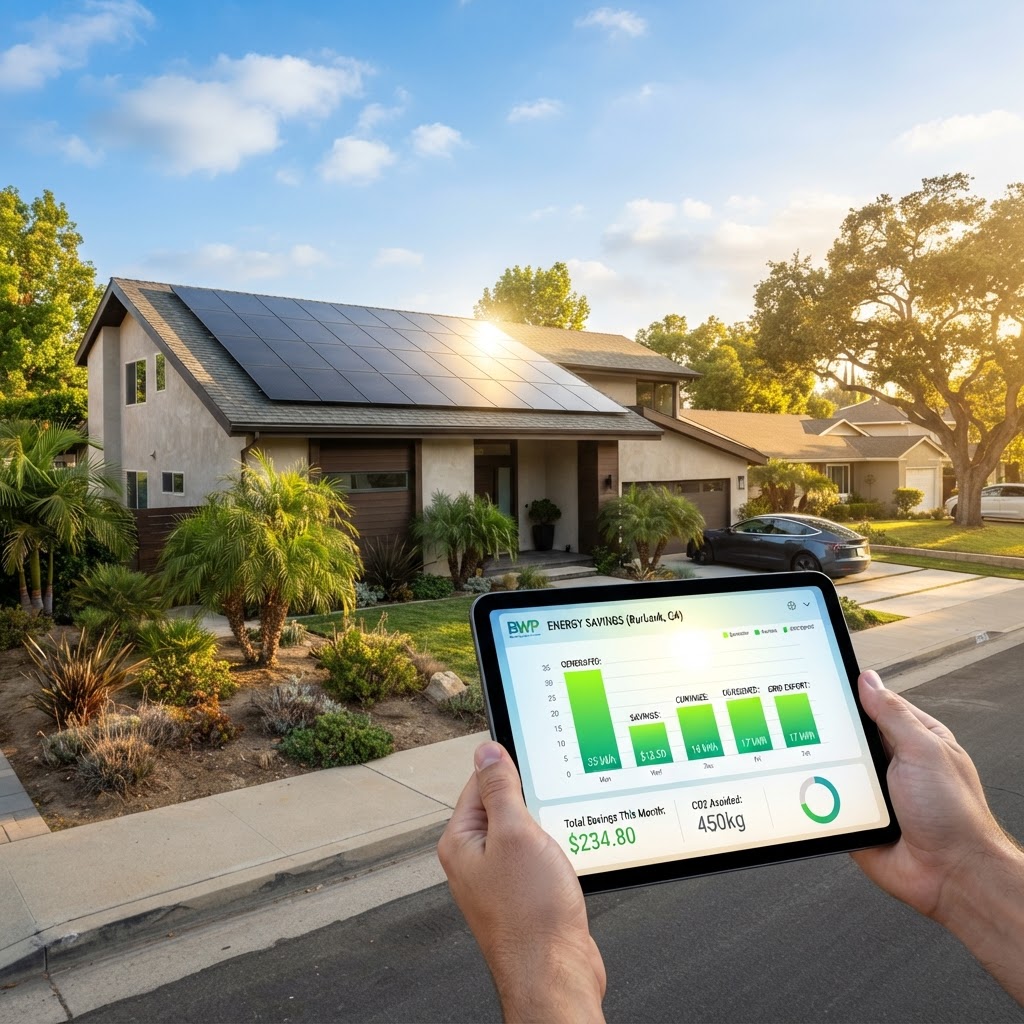
Home Energy Independence With Solar and Batteries: The Nano-Grid Approach
Key Takeaways
- A home nano-grid — solar panels paired with battery storage — lets you generate, store, and manage your own electricity, reducing or eliminating dependence on the utility grid.
- Storage attachment rates have surged to 78% of new U.S. residential solar installs as of Q2 2026, signaling a fundamental shift in how homeowners think about energy.
- California's NEM 3.0 rate structure makes battery storage nearly mandatory for a strong financial return — and new state building codes now require nano-grid-ready circuitry in all new construction.
- Emerging technologies — V2H integration, AI energy orchestration, and second-life EV batteries — are making nano-grids smarter, cheaper, and more capable than ever.
- Working with an independent, unbiased advisor is critical to sizing your system correctly and avoiding costly mistakes.
The power went out on your street last summer. Your neighbor's house stayed lit. That wasn't luck — that was a nano-grid.
The concept is straightforward: combine rooftop solar with battery storage, add intelligent controls, and your home stops being a passive consumer at the end of a utility wire and starts functioning as its own small power station. The term "nano-grid" captures exactly that — a self-contained energy ecosystem operating at the residential scale, capable of generating, storing, distributing, and even trading electricity largely on its own terms.
What was once an expensive experiment for early adopters is rapidly becoming the mainstream standard. Here's what's driving that shift, what it means for California homeowners specifically, and how to do it right.
What Exactly Is a Home Nano-Grid?
A nano-grid is more than a solar system with a battery bolted on. At its core, it's an integrated energy architecture with four functional layers:
- Generation: Rooftop (or ground-mount) solar panels producing DC electricity from sunlight
- Storage: A battery system — typically Lithium Iron Phosphate (LFP) chemistry today — that holds surplus energy for use when the sun isn't shining
- Control: An intelligent inverter or energy management system (EMS) that decides in real time whether to use solar power directly, charge the battery, draw from storage, or interact with the grid
- Distribution: A critical-load sub-panel or whole-home integration that determines which circuits get priority power during an outage
The "nano" in nano-grid matters. Unlike a community microgrid — which might serve a neighborhood or campus — a nano-grid is designed around the energy profile of a single household. That specificity is exactly what makes it powerful: the system can be precisely tailored to your consumption patterns, your local utility's rate structure, and your resilience goals.
The Numbers Tell the Story
The market has moved decisively. According to the Solar Energy Industries Association's 2026 Mid-Year Outlook, the storage attachment rate for new residential solar installations in the United States has reached 78%, up from just 45% in 2024. In roughly two years, battery storage went from a popular add-on to the default choice.
Cost is a major driver. The BloombergNEF Energy Storage Cost Survey 2026 reports that residential LFP battery systems now average $380 per kWh installed — a 22% drop since early 2025. A 10 kWh system that might have cost $6,000 in installed costs two years ago is now closer to $3,800 for the storage component alone. That's a meaningful change in payback math.
Internationally, the proof-of-concept phase is over. The European Association for Storage of Energy (EASE) reports that over 1.2 million EU households now operate as functional nano-grids, maintaining critical loads for at least 72 hours without any grid input. Europe's grid challenges have accelerated adoption there, and California — with its wildfire-driven Public Safety Power Shutoffs (PSPS) and aging transmission infrastructure — is on an identical trajectory.
California's NEM 3.0 Reality: Why Batteries Aren't Optional Anymore
For California homeowners, the financial case for going solar without storage has weakened considerably under Net Energy Metering 3.0, which took full effect in 2023. Under NEM 3.0, the compensation utilities pay for excess solar exported to the grid dropped by as much as 75% compared to NEM 2.0. Simply overbuilding your solar array and dumping surplus power onto the grid no longer pencils out.
The strategic response is to consume your own solar production as much as possible — and that means storage. A properly sized battery system lets you:
- Charge during peak solar hours and discharge during SCE or PG&E's expensive evening peak windows (typically 4–9 PM)
- Minimize grid exports that would be compensated at low avoided-cost rates
- Time-shift your consumption to maximize self-sufficiency
At Solanano, our hyperlocal financial modeling — built specifically around NEM 3.0 tariff structures and utility-specific rate schedules from SCE, PG&E, and BWP — consistently shows that solar-plus-storage systems achieve stronger 10-year returns under NEM 3.0 than solar-only systems did under NEM 2.0, when correctly sized. The math has changed; the strategy has to change with it.
California homeowners should also investigate the Self-Generation Incentive Program (SGIP), which offers rebates of up to $1,000 per kWh for qualifying battery installations, with priority equity tiers for customers in high-fire-threat districts or with low incomes. This incentive meaningfully compresses payback periods and is still active as of mid-2026.
The Technology Is Evolving Fast — And Getting Smarter
AI-Driven Energy Orchestration
In March 2026, a consortium of leading inverter manufacturers released a new software standard — informally called "Grid-Free OS" — that uses predictive weather modeling and real-time utility pricing to optimize when a nano-grid charges, discharges, or interacts with the grid. The result: a 30% reduction in battery cycling wear, which translates directly to longer hardware lifespan and lower lifetime system costs. This class of intelligent EMS is now standard in premium systems and trickling into mid-market offerings.
Vehicle-to-Home (V2H) Integration
In January 2026, Ford and Enphase finalized a universal V2H standardization for the F-Series lineup — the first truly plug-and-play system where your truck's battery serves as primary home storage with zero manual configuration. Marcus Thorne, Lead Engineer at NexaStorage Systems, captures the implication well: "The 2026 nano-grid isn't just a battery on a wall; it's an intelligent ecosystem. With V2H integration, the average driveway now holds enough energy to power a standard household for over a week."
An F-150 Lightning, for context, carries up to 131 kWh of usable capacity — roughly 10–13 times the capacity of a standard residential battery pack. For households that own an EV, V2H transforms a depreciating asset into a resilience resource.
Solid-State Batteries and Second-Life Options
On the premium end, Clean Energy Associates reports that solid-state residential batteries captured 8% of the premium home energy market in H1 2026, offering 40% higher energy density than conventional lithium-ion. On the budget end, second-life EV battery modules — refurbished cells from retired electric vehicles — are hitting the mainstream market at roughly 40% lower cost than new packs, giving budget-conscious homeowners a credible path to meaningful storage capacity.
Nano-Grids as Grid Assets: The VPP Opportunity
Here's where the story gets genuinely interesting for forward-thinking homeowners: your nano-grid doesn't have to operate in isolation. Virtual Power Plants (VPPs) aggregate the capacity of thousands of residential batteries and make them available to the grid during peak stress periods — compensating homeowners for the service.
During the Summer 2025 heatwaves, residential nano-grid participation via VPPs provided 4.5 gigawatts of peak capacity to the North American bulk power system, according to the Federal Energy Regulatory Commission's 2026 Infrastructure Report. That's roughly equivalent to four large utility-scale power plants — assembled entirely from home energy systems.
As Dr. Elena Vance, Chief Researcher at the Institute for Decentralized Energy, puts it: "We are moving away from the era of 'backup power' and into the era of 'primary autonomy.' The home is no longer the end of the grid; it is the center of its own universe."
VPP enrollment through programs like SCE's Emergency Load Reduction Program can generate $100–$300 per year in direct bill credits or payments, adding another financial layer to an already compelling investment case.
What a Well-Designed Nano-Grid Looks Like in Practice
Getting the design right requires more than picking a battery brand. Key decisions include:
- System sizing: Matching solar array output, battery capacity, and your actual load profile — not generic rules of thumb
- Critical load separation: Identifying which circuits (refrigerator, medical equipment, Wi-Fi, EV charger) need priority backup, and wiring accordingly. California's new building codes, effective May 2026, now mandate nano-grid-ready circuitry — including separated essential-load sub-panels and pre-wired bi-directional EV ports — in all new residential construction
- Inverter architecture: String inverters, microinverters, and hybrid inverters each have tradeoffs for nano-grid performance, particularly under shade conditions
- Installer quality: The difference between a system that performs as modeled and one that underdelivers by 20–30% often comes down to installation craft and commissioning rigor
This last point is where Solanano's role is most tangible. Because we are entirely independent — we don't sell equipment, don't install systems, and receive no manufacturer commissions — our only incentive is to match you with a solar professional who will do the job right. Our 4-stage installer vetting process evaluates licensing and insurance status, NABCEP certification, project track record, and ongoing performance scoring. Our satellite-based irradiance modeling and shade analysis ensure your system is sized for your actual roof, not a regional average.
Emerging Frontiers Worth Watching
- DC-native home ecosystems: A growing movement toward homes where solar and batteries feed DC loads directly — lighting, HVAC, EV chargers — bypassing AC/DC inversion and recovering the 10–15% energy typically lost in that conversion
- Peer-to-peer energy trading: Blockchain-based platforms allowing nano-grid clusters to trade surplus power with immediate neighbors at rates below utility retail — hyperlocal energy markets in embryonic form
- Grid defection: In Sun Belt states with high utility fixed-connection fees, a segment of prosumers is choosing total grid disconnection as battery economics improve — a trend worth monitoring even if it remains niche in California's regulatory environment
Bottom Line
The home nano-grid is no longer a futuristic concept or a wealthy homeowner's hobby — it is the logical, financially defensible response to California's NEM 3.0 tariff structure, its wildfire-driven grid reliability challenges, and a battery market that has dropped costs by more than 20% in under two years. Solar and storage, correctly sized and expertly installed, transforms your home from a passive utility customer into an active, resilient energy node. The technology is mature, the incentives are real, and the installers who can deliver a high-quality outcome exist — the challenge is finding them.
Get a free, no-obligation solar and storage assessment from Solanano today — and let our independent experts build the hyperlocal financial model and system design your home actually deserves.