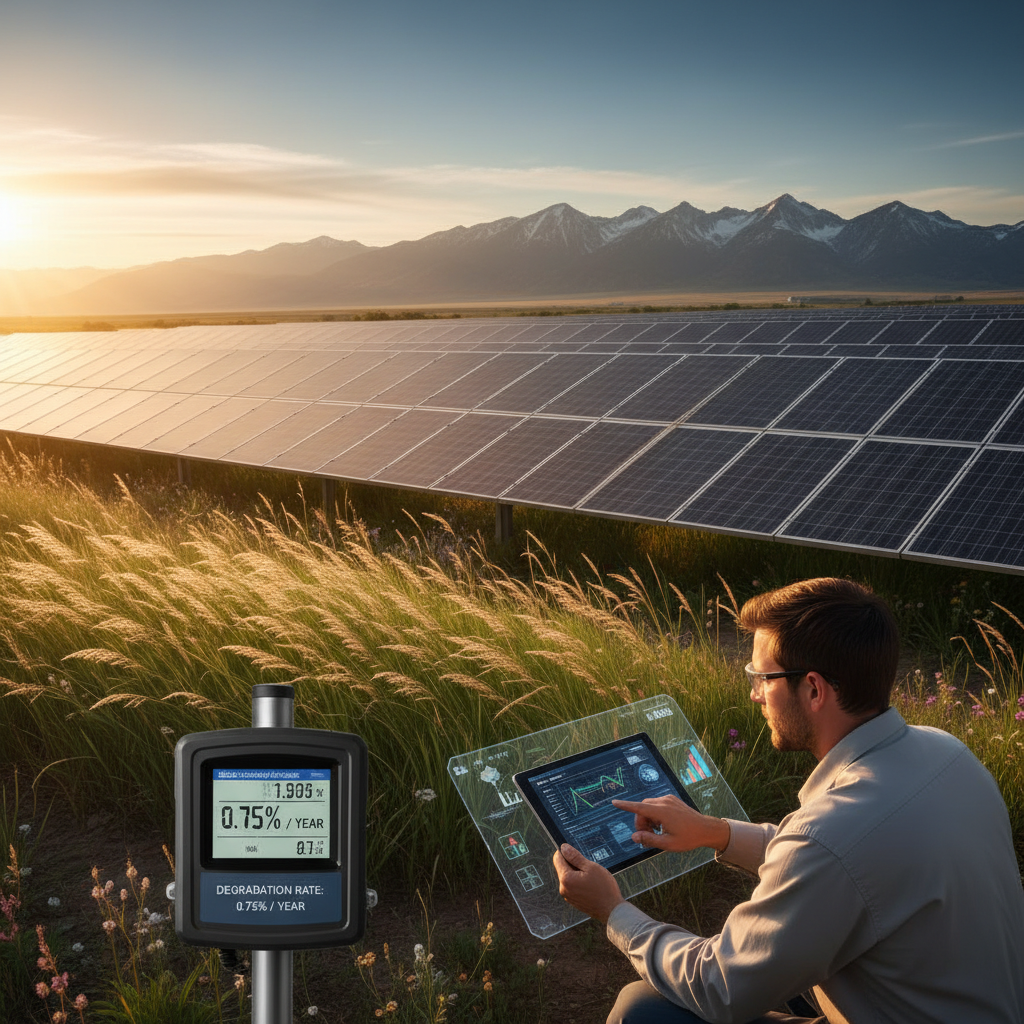
The Truth About Solar Panel Degradation Rates in 2026
By Solanano Editorial Team | Solar Engineering & Project Management | California
Key Takeaways
- Modern N-type TOPCon modules degrade at just 0.35% per year — nearly half the rate of 2020-era panels — fundamentally changing the economics of solar ownership.
- 92% of top-tier manufacturers now guarantee 89% output after 30 years, and the first 40-year performance warranty has arrived in 2026.
- LeTID degradation — a major concern for California's Inland Empire and desert climates — has been reduced by 40% in new cell architectures.
- Glass-glass bifacial modules show 15% less mechanical-stress degradation, making them ideal for high-wind coastal and mountain installations.
- AI-powered monitoring and Digital Twin modeling are making degradation prediction a precision science, not a guessing game.
- For California homeowners navigating NEM 3.0, understanding real degradation rates is critical to accurate 25-year financial modeling.
Why Degradation Rates Matter More Than Ever in 2026
When a solar salesperson hands you a proposal, somewhere buried in the fine print is a single number that quietly shapes your entire return on investment: the annual degradation rate. It's the percentage by which your panels lose output each year. And for most of the past decade, the industry standard — roughly 0.5% to 0.6% per year — was accepted as an unchangeable fact of physics.
That assumption is now obsolete.
Thanks to a wave of material science breakthroughs, new cell architectures, and rigorous real-world field data collected through 2025 and into early 2026, the story of solar panel longevity has been fundamentally rewritten. If you're a California homeowner evaluating solar in the NEM 3.0 era — where maximizing self-consumption and battery storage over a longer horizon is the financial game — these updates aren't just interesting. They're essential.
The Degradation Benchmark Has Officially Shifted
The most consequential data point to emerge from early 2026 is this: high-efficiency N-type TOPCon (Tunnel Oxide Passivated Contact) modules are now demonstrating stabilized annual degradation rates of just 0.35%, according to field performance data published in the first quarter of the year. Compare that to the 0.6% annual rate typical of 2020-era P-type modules, and the math becomes significant over a 25-to-30-year system lifetime.
To put it plainly: a system that might have been operating at 83% of its original capacity after 30 years under old assumptions could now realistically be producing at 90% or above using modern modules. For a 10kW system, that's a meaningful difference in kilowatt-hours — and in California's NEM 3.0 environment, where every unit of self-consumed solar carries premium value relative to grid export, cumulative energy production over the life of the system directly determines your payback period.
The 2025 PV Module Index reinforces this shift: 92% of top-tier manufacturers now guarantee 89% performance after 30 years, a figure made possible by advances in passivation layer technology that reduce the surface recombination responsible for gradual efficiency loss.
"In 2026, we are no longer asking if solar panels will last 25 years; the real-world data now proves that 40 years is the new operational benchmark for high-purity silicon." — Dr. Aris Thorne, Chief Scientist, Solar Longevity Institute
That 40-year benchmark isn't just theoretical. In January 2026, a leading global manufacturer announced the longest performance warranty in industry history: 40 years, citing breakthroughs in POE (Polyolefin Encapsulant) encapsulation stability that dramatically reduce the delamination and moisture ingress that have historically driven accelerated aging.
The Hidden Threat: LeTID and Extreme Weather Micro-Fractures
Progress in degradation science doesn't mean every threat has been neutralized. Two emerging risks deserve serious attention — especially for California installations.
Light and Elevated Temperature Induced Degradation (LeTID) has been a persistent problem for solar systems in high-heat regions. If you live in the Coachella Valley, Riverside County, the San Fernando Valley, or any part of California's interior where summer temperatures routinely exceed 100°F, LeTID has historically been a significant driver of above-average degradation. The good news: 2026 field data from high-temperature regions, including the Southwest US, confirms that new cell architectures have reduced LeTID by 40% compared to 2023 baselines. This is a direct result of improved hydrogen passivation and better bulk material purity in N-type wafers.
The second threat is less discussed but arguably more urgent. As California continues to experience more intense weather events — from the powerful atmospheric rivers of recent winters to the extreme wind events that accompany Santa Ana conditions — physical stress on installed panels is increasing.
"The biggest threat to degradation rates in 2026 isn't the sun — it's the increasing frequency of extreme weather events that cause micro-fractures we can't see with the naked eye." — Sarah Jenkins, VP of Asset Management, SunCorp Energy
These micro-fractures, known as Potential Induced Degradation (PID) and cell cracking, can silently reduce a panel's output by 5-15% over time without any visible damage. This is precisely why the 2026 update to IEC Standard 61215 — the international benchmark for module certification — now mandates 2,000-hour damp heat testing, reflecting the global reality of more volatile humidity and temperature cycling. Any panel shortlisted for a California installation should carry this new certification.
Glass-Glass Bifacial: The Architecture Built for California Conditions
One of the clearest structural improvements validated by 2026 data is the superiority of glass-glass bifacial module construction over traditional glass-backsheet designs. A 2026 longitudinal study confirms that glass-glass bifacial modules experience 15% less mechanical-stress degradation in high-wind environments.
For California homeowners — particularly in coastal zones, hilltop properties, or the high-desert communities north of Los Angeles — this is directly actionable information. Glass-glass construction also provides superior resistance to UV-induced backsheet cracking and dramatically reduces the risk of moisture ingress over long time horizons.
Bifacial panels also capture albedo (reflected) light from rooftops, ground surfaces, or surrounding structures, providing a natural production bonus that compounds over the life of the system. When Solanano's engineers run hyperlocal satellite irradiance modeling and shade analysis for a California property, bifacial performance is modeled based on the specific surface reflectivity and tilt conditions of that roof — not generic industry averages.
What's Next: AI Monitoring, Digital Twins, and Perovskite on the Horizon
The science of degradation is rapidly moving from reactive to predictive. Several 2026 developments are reshaping how homeowners and asset managers understand panel aging:
-
Chemical Signature Monitoring (NREL, February 2026): NREL published a breakthrough report on an AI-driven monitoring approach that detects degradation-related gas leakage in junction boxes before any power loss occurs. This could fundamentally change O&M (operations and maintenance) by enabling replacement or repair of failing components years before they impact production.
-
Digital Twin Degradation Modeling: The industry is rapidly adopting "Digital Twin" systems that feed real-time local weather data — including UV index, thermal cycling frequency, and humidity — into predictive models that generate the precise aging curve for a specific installation at a specific location. This is moving from utility-scale solar farms to residential applications.
-
N-type HJT (Heterojunction Technology) is becoming the default choice for commercial and industrial projects requiring the absolute lowest degradation profiles — often sub-0.3% annually — and is increasingly accessible for premium residential installations.
-
Perovskite-Silicon Tandem Modules, targeting a 0.5% degradation rate with efficiencies exceeding 30%, moved from pilot phases into commercial demonstrations in 2026. While not yet mainstream for residential California installations, they represent the next significant step change in the technology curve.
-
Circularity and Re-powering Planning: With 40-year operational lifespans now credible, installers and asset managers are beginning to model the optimal year to either recycle modules or resell them into secondary markets — a discipline that will become standard in system design within the next few years.
What This Means for California Homeowners Under NEM 3.0
Under California's NEM 3.0 tariff structure — which replaced the highly favorable NEM 2.0 with a framework that significantly reduces export compensation — the financial case for solar has shifted decisively toward maximum self-consumption and battery storage. Every kilowatt-hour your panels produce and you use directly offsets expensive retail electricity. Every kilowatt-hour you export earns far less.
This makes degradation rates more financially consequential than they were under NEM 2.0. A system modeled on outdated 0.6% degradation assumptions will overestimate how much self-consumption it delivers in years 10-25 compared to a modern N-type system modeled at 0.35%. Solanano's NEM 3.0-aware financial modeling accounts for real, current degradation curves — not industry boilerplate — when projecting payback periods and lifetime bill savings for California homeowners.
Additionally, California's SGIP (Self-Generation Incentive Program) battery storage incentives interact with solar production over time. A system that maintains higher output in years 10-20 changes the economics of battery cycling and SGIP benefit realization in ways that generic proposals routinely miss.
Bottom Line
The solar panels being installed on California rooftops in 2026 are fundamentally different — and dramatically more durable — than the equipment that defined the industry even five years ago. N-type TOPCon and HJT architectures, glass-glass bifacial construction, improved encapsulants, and AI-powered monitoring tools have collectively pushed the realistic operational lifespan of a well-specified system well beyond 30 years. The first 40-year warranty isn't a marketing stunt; it reflects measurable, field-validated improvements in how silicon behaves over time. But realizing those gains requires choosing the right technology for your specific location, climate zone, and utility — and modeling the financial returns with accurate, current data. In California's NEM 3.0 landscape, where every percentage point of long-term production matters, the difference between a generic proposal and a precisely engineered assessment could be worth thousands of dollars over the life of your system.
Ready to find out what 2026's best panel technology can actually deliver for your specific home and utility? Get a free, no-obligation solar assessment from Solanano — independent advice, zero conflict of interest, and hyperlocal financial modeling built for California.


