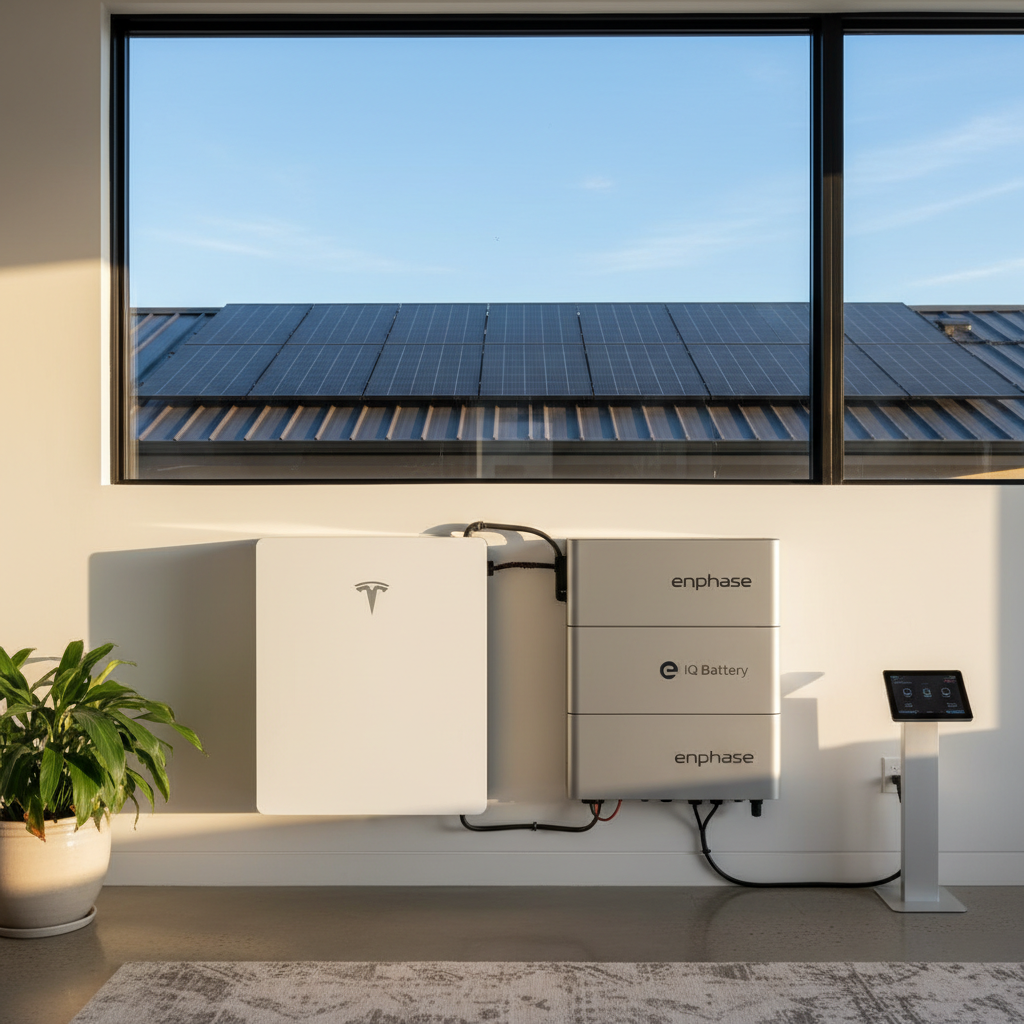
Tesla Powerwall 3 vs. Enphase IQ Battery 5P: Which Wins in 2026?
Key Takeaways
- Tesla Powerwall 3 leads on raw power output (11.5 kW continuous) and cost-per-kWh ($580 installed), making it the value-performance frontrunner in 2026.
- Enphase IQ Battery 5P/6 wins on modular resilience, superior field-serviceability, and a 90% round-trip efficiency edge in real-world testing.
- Enphase now qualifies for the 2026 Residential Energy Credit 5% domestic content bonus, meaningfully shifting its total cost equation.
- For California homeowners navigating NEM 3.0, the right choice depends on your utility territory, load profile, and whether you prioritize peak shaving or fail-safe redundancy.
- Neither battery "wins" universally — the smarter question is which architecture fits your home's nano-grid strategy.
The residential battery storage market in 2026 looks nothing like it did three years ago. Lithium iron phosphate chemistry is now the default. Virtual Power Plants are mainstream. And the debate between Tesla Powerwall 3 and Enphase IQ Battery 5P (with the new IQ Battery 6 series entering the picture) has never been more consequential — or more nuanced.
If you're a California homeowner operating under NEM 3.0, a battery isn't optional anymore. It's the core of your energy economics. Choosing the wrong one means leaving thousands of dollars on the table. Here's what the data, the industry news, and the engineering realities of 2026 actually tell us.
The Hardware Showdown: Power, Capacity, and Chemistry
Both products have converged on LFP (Lithium Iron Phosphate) chemistry — a meaningful win for consumers. LFP delivers 10,000+ cycle lifespans, superior thermal stability, and eliminates the fire anxiety that haunted earlier NMC lithium packs. On chemistry alone, it's a draw.
Where they diverge sharply is architecture.
Tesla Powerwall 3 is a fully integrated, all-in-one unit combining a 13.5 kWh battery with a built-in inverter and solar gateway. Its headline stat is impossible to ignore: 11.5 kW of continuous power output, the highest in the residential segment as of Q1 2026, according to GridMetrics Research. For California homes running heat pumps, EV chargers, or whole-home backup, that number matters enormously.
Enphase IQ Battery 5P takes the opposite approach — a modular, AC-coupled system that pairs with Enphase microinverters to create what the company calls a "fail-safe" distributed architecture. Its 48-amp peak current capability for heavy appliance starting (that's the "Power Start" metric the industry has been tracking closely) drove a 38% installation surge in 2025, per SolarData 2026. If your home has a variable-speed pool pump, a large compressor, or a heat pump water heater, that peak current headroom is exactly what prevents nuisance tripping during grid outages.
The trend toward prioritizing Power Start ratings over total capacity is real and growing. Raw kilowatt-hours stored matters less than whether your battery can actually start your loads when the grid goes down. On this dimension, both products are credible — but for different load profiles.
The Cost Reality in 2026
Let's talk numbers, because the pricing landscape has shifted significantly.
- Tesla Powerwall 3: ~$580/kWh installed (CleanEnergy Index, early 2026)
- Enphase IQ Battery 5P: ~$720/kWh installed (CleanEnergy Index, early 2026)
At face value, Tesla wins on cost. For a typical California home needing 27 kWh of storage (two Powerwall 3 units), that's roughly a $3,780 difference versus an equivalent Enphase configuration — before incentives.
But the incentive landscape complicates this picture considerably. The 2026 Residential Energy Credit update introduced a 5% bonus for battery systems using 70% domestic content. Enphase crossed that domestic content threshold in Q4 2025. Tesla has not yet publicly confirmed achieving the same benchmark. That 5% bonus, applied to a $15,000–$20,000 system, can offset $750–$1,000 in federal tax liability — meaningfully narrowing Enphase's price gap for qualified buyers.
California homeowners should also factor in SGIP (Self-Generation Incentive Program) rebates, which remain active in 2026 for equity-resiliency and general market tiers. Both systems qualify, but your utility territory — SCE, PG&E, SDG&E, or a municipal like Burbank Water & Power — affects rebate availability and stacking eligibility. This is precisely the kind of hyperlocal financial modeling that separates a good battery decision from a costly one.
Software and Intelligence: The Diverging Platforms
This is where the 2026 competition gets genuinely interesting.
Tesla launched Powerwall Dashboard 3.0 in March 2026, introducing AI-driven predictive energy trading for homeowners in deregulated markets. The system analyzes real-time grid pricing signals, weather forecasts, and your historical usage to automatically charge, discharge, and — where supported — trade energy in Virtual Power Plant programs. With over 600,000 Powerwalls now enrolled in active VPP programs across North America (Tesla Investor Relations, May 2026), the platform has real-world scale behind it.
For California homeowners on Time-of-Use rates under NEM 3.0, this kind of predictive intelligence isn't a gimmick — it's the mechanism that makes your solar-plus-storage system financially self-optimizing. Charging from solar during the day, discharging during SCE's on-peak windows (4–9 PM), and potentially earning VPP event credits is the playbook. Powerwall 3.0's AI layer attempts to automate all of it.
Enphase counters with the IQ Battery 6 series announced in late 2025, emphasizing ultra-compact form factors and dramatically enhanced field-serviceability — a nod to their installer-friendly reputation. Their Enlighten monitoring platform remains best-in-class for granular panel-level data, and the new "Green Grids" gamification features (part of a broader industry trend toward community energy competition via mobile apps) are genuinely engaging for homeowners who want visibility into their energy independence.
As Sarah Jenkins, Lead Engineer at GridResilience Labs, put it: "The real winner in 2026 is the consumer; the interoperability between Tesla's software and Enphase's microinverter precision has forced both companies to eliminate proprietary bottlenecks."
The competitive pressure is producing better products on both sides. That's good news for everyone in the market right now.
V2H, VPP, and the Ecosystem Factor
One development that deserves serious attention: Tesla and Ford finalized a V2H (Vehicle-to-Home) standard in 2026, enabling Powerwall 3 to bridge seamlessly with non-Tesla EV batteries. For the roughly 40% of California solar homeowners who own or plan to own an EV, this is a significant capability unlock. Your Ford F-150 Lightning or Mustang Mach-E can now serve as supplemental backup storage — coordinated through the Powerwall ecosystem.
This positions Tesla's platform as the hub of a genuine nano-grid: solar generation, dedicated battery storage, EV battery as an extended reserve, and AI-driven trading interfacing with the broader grid. It's the kind of whole-home energy resilience architecture that Solanano has been advocating for years — treating your home not as a passive utility customer, but as an intelligent energy node.
Enphase's ecosystem answer is the continued reliability of its microinverter backbone. In partial-shade scenarios, complex roof geometries, or homes where individual panel performance is critical, Enphase's distributed architecture means a single point of failure never takes down the whole system. As Dr. Aris Thorne, Chief Analyst at SolarEdge Projections, observed: "The Powerwall 3 has become a commodity appliance, winning on price and raw power, whereas Enphase has successfully positioned itself as the premium, 'fail-safe' architecture for complex solar arrays."
Efficiency: The Closest Race
Round-trip efficiency — how much energy you get back for every kilowatt-hour you store — is a sleeper metric that compounds significantly over a decade.
- Enphase IQ Battery 5P: 90% round-trip efficiency (real-world)
- Tesla Powerwall 3: 89% round-trip efficiency (real-world VPP testing, NREL 2025)
One percentage point. Over 10 years, on a heavily cycled California system, that 1% difference could represent 500–800 kWh of additional usable energy from Enphase — worth $150–$250 at current SCE residential export rates. Real, but not decisive. Both systems are excellent by any historical standard.
Which Battery Is Right for Your California Home?
Here's a practical decision framework:
Choose Tesla Powerwall 3 if:
- You want the lowest cost-per-kWh installed
- Your home has high, sustained power draw requirements (EV fast-charging, HVAC, whole-home backup)
- You're interested in VPP enrollment and AI-driven energy trading
- You own or plan to own a compatible non-Tesla EV and want V2H capability
Choose Enphase IQ Battery 5P or 6 if:
- You have a complex roof or shading conditions that benefit from microinverter architecture
- You're prioritizing long-term serviceability and modular expandability
- You want to capture the 2026 domestic content tax credit bonus
- System resilience and fail-safe redundancy matter more than peak power output
Bottom Line
In 2026, there is no objectively superior battery. Tesla Powerwall 3 dominates on price and raw power. Enphase IQ Battery 5P/6 leads on modular resilience, efficiency, and domestic content incentives. The convergence on LFP chemistry and the industry's push toward interoperability means both products are dramatically better than what existed even two years ago.
What determines your winner isn't a spec sheet — it's your utility territory, your load profile, your roof geometry, your tax situation, and your vision for energy independence. Under NEM 3.0, getting that analysis wrong is expensive. Getting it right turns your home into a self-sustaining nano-grid that hedges against rate increases, grid outages, and an increasingly volatile California energy market.
Get your free, independent solar and storage assessment from Solanano — with satellite irradiance modeling, NEM 3.0-aware financial projections, and access to our network of pre-vetted, licensed installers, we'll tell you exactly which system earns its keep on your specific roof.


