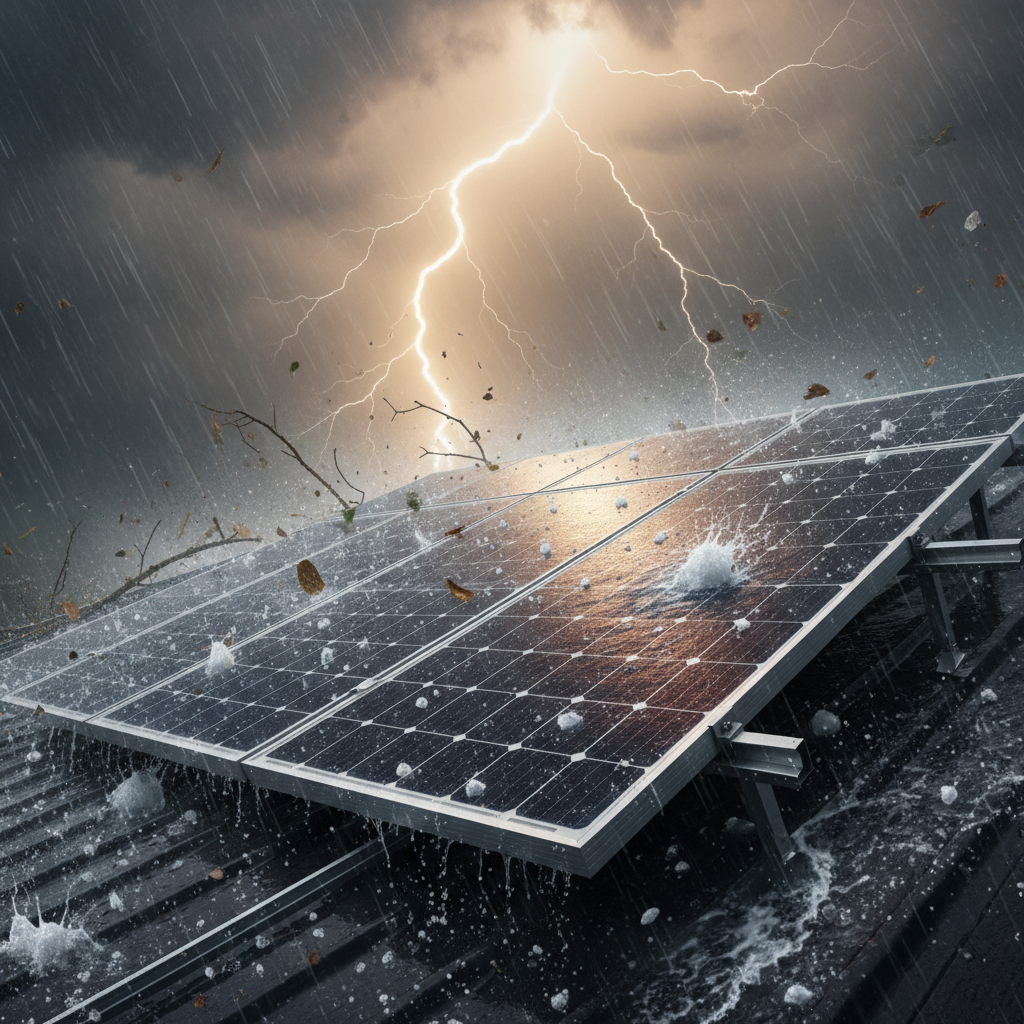
What Happens to Solar Panels During a Hurricane or Hailstorm?
Key Takeaways
- Hail damage accounted for 73% of total solar insurance loss costs in 2025, despite representing only 6% of claim counts — making it the industry's single biggest catastrophic risk.
- Advanced "High-Tilt Stow" protocols (tilting panels to 75°) can slash potential storm losses from over $50 million to below $5 million per event.
- The average utility-scale hail claim has risen to $58.4 million, driven by the sheer size of modern solar facilities.
- New AI-driven forecasting and automated stow systems are transforming how the industry responds to severe weather — with some platforms providing 60-minute advance warnings.
- Smarter glass, smarter positioning, and smarter site selection are the three pillars of next-generation storm resilience.
As solar energy becomes the backbone of the modern electrical grid — accounting for 92% of new power capacity additions in high-wind regions during the 2025 hurricane season — the question of how solar panels survive extreme weather has never been more consequential. Hurricanes, hailstorms, and severe convective events are no longer edge cases. They are routine operational realities.
So what actually happens to solar panels when nature turns violent? The answer is more nuanced — and more actionable — than most people realize.
How Solar Panels Are Engineered to Handle High Winds
Modern solar panels are not fragile. Utility-scale and residential systems alike are engineered to withstand significant mechanical stress. Most panels sold today carry certifications for wind loads up to 2,400 pascals (roughly equivalent to a Category 1 hurricane), and premium racking systems push that threshold considerably higher.
During a hurricane, the primary threats are:
- Uplift forces — wind traveling beneath a panel array and creating a lifting effect that can tear modules from their mounts
- Flying debris — projectiles carried by high winds that can crack glass or damage frames
- Racking failure — structural compromise of the mounting system itself, particularly in ground-mount configurations on soft or saturated soil
- Flooding and water intrusion — especially for rooftop systems in storm surge zones
For ground-mounted utility-scale installations, tracker systems — which orient panels to follow the sun throughout the day — introduce an additional vulnerability. A tracker locked in the wrong position during a hurricane can act like a sail, dramatically amplifying wind load forces. The solution is storm stow protocols: pre-programmed commands that reposition panels to a flat or near-flat orientation to minimize wind resistance before a storm arrives.
A January 2026 study of the 2025 hurricane season found that solar, wind, and storage made up 92% of new power capacity in high-wind regions, which is driving regulators and insurers to demand far more rigorous structural standards than were common just five years ago.
The Real Threat: Why Hail Is Now Solar's #1 Catastrophic Peril
If hurricanes are the dramatic headline risk, hail is the quiet financial catastrophe hiding in plain sight.
In 2025, hail damage accounted for 73% of total solar insurance loss costs, despite representing only 6% of total claim counts. That staggering disproportion tells the story clearly: when hail hits a solar farm, the damage is enormous.
"Large-scale solar projects are entering a mid-life phase where considerations are more focused on the long haul; hail is now the number one catastrophic peril facing the industry." — Brian Grenko, CEO of VDE Americas
The scale of modern solar facilities is a core part of the problem. The average utility-scale hail claim in 2025–2026 rose to approximately $58.4 million, a figure that reflects the reality that a single Texas or Colorado solar farm can encompass hundreds of thousands of individual modules. A hailstorm that sweeps across a 200 MW facility doesn't just break a few panels — it can cause tens of millions of dollars in simultaneous module damage, downtime losses, and replacement logistics costs.
In March 2026, VDE Americas updated its proprietary Hail Risk Model to incorporate new meteorological data showing that wind speeds during hailstorms are often twice as high as previously estimated. This finding is critical because wind-driven hail strikes at an angle, and the kinetic energy of an angled impact at higher velocity is significantly more destructive than a slow, vertical fall — meaning risk models built on older data have been systematically underestimating real-world exposure.
The Glass Problem: Why Panel Materials Matter More Than Ever
Not all solar glass is created equal. The industry has quietly been grappling with a materials choice that carries enormous financial consequences.
Research confirms that 3.2mm fully tempered glass is approximately 1.7 to 2.0 times more resistant to hail impacts than the 2.0mm heat-strengthened glass often used in large-format bifacial modules. Yet many manufacturers pivoted to thinner, lighter glass to reduce shipping costs and improve the power-to-weight ratio of their panels — a commercially rational decision that comes with real physical vulnerability.
The industry response is a clear trend toward thicker, tougher glass, particularly for projects in "Hail Alley" — the corridor running through Texas, Colorado, Kansas, and Nebraska that experiences some of the world's most intense hailstorm activity. Procurement teams at major solar developers are increasingly specifying 3.2mm or 4mm fully tempered glass as a non-negotiable project requirement, accepting modest cost and weight increases in exchange for significantly reduced catastrophic loss exposure.
Storm Stow: The Tactical Response That Can Save Tens of Millions
The most operationally significant development in solar storm resilience is the evolution of stow protocols — the procedures used to reposition panel arrays before and during severe weather.
Traditional "Passive Stow" positions panels flat (0° tilt), which reduces wind loading but leaves the full panel surface directly exposed to vertical hail impact. The emerging best practice is "High-Tilt Stow": rotating panels to approximately 75 degrees during a hailstorm, dramatically reducing the surface area exposed to falling hailstones.
The financial impact of this single tactical change is remarkable:
- Without High-Tilt Stow: Potential losses exceeding $50 million per storm event
- With High-Tilt Stow: Potential losses reduced to below $5 million per event
The insurance industry has taken notice. In February 2026, underwriters began mandating verified "Hail-Stow" procedures as a prerequisite for coverage in high-risk zones like Texas and Colorado. Operators who cannot demonstrate documented, tested stow protocols may find themselves uninsurable — or facing prohibitive premium increases.
AI and Automated Warning Systems: The Next Frontier
Executing a storm stow protocol depends entirely on knowing the storm is coming with enough lead time to act. That forecasting challenge is being addressed by a new generation of precision weather technology.
In September 2025, Vaisala Xweather launched a first-of-its-kind automated hail forecasting system that provides site-specific storm warnings 60 minutes in advance — enough time to trigger automated tracker stowing across an entire utility-scale facility without requiring human intervention. The system integrates directly with tracker control software, meaning the protective response is both faster and more reliable than manual procedures.
This is part of a broader trend toward AI-driven "Storm-Sense" platforms that use real-time lightning detection, dual-polarization radar data, and machine learning to predict severe weather impacts at the individual project level. These platforms are becoming standard infrastructure for large solar operators, sitting alongside SCADA systems and energy management software as core operational tools.
"As renewable energy becomes the backbone of the electrical grid, ensuring system resilience is no longer optional — it is a financial and operational imperative." — Jason Kaminsky, CEO of kWh Analytics
Climate-Specific Site Selection: Building for the Future
Beyond reactive technology, the industry is shifting toward a more fundamental rethinking of where and how solar farms are built.
The concept of "Climate-Specific Site Selection" is gaining traction, under which facilities are engineered not to generic regional building codes but to withstand 1-in-50-year extreme weather events specific to their exact location. This means:
- Detailed historical hail trajectory analysis at the project site level before construction begins
- Wind tunnel testing of tracker and racking configurations for site-specific storm profiles
- Elevated panel heights in flood-prone regions to reduce storm surge vulnerability
- Reinforced pile foundations in areas with high saturation risk from hurricane rainfall
This approach requires greater upfront engineering investment but produces assets that are substantially more resilient — and far more insurable — over a 30-year project life.
What Homeowners Need to Know
For residential solar owners, the practical implications are more straightforward:
- Most rooftop systems survive moderate hail and wind events intact. Panel glass is certified to withstand hailstones up to 25mm (1 inch) at 23 m/s under IEC 61215 testing standards.
- Your installation angle matters. Steeply pitched rooftops naturally present panels at an angle to falling hail, offering some inherent protection.
- Review your homeowner's insurance. Solar panels on your roof are typically covered under your homeowner's policy, but confirm your coverage limits and document your system with photos before storm season.
- Choose quality glass. If you're buying a new system, ask your installer specifically about glass thickness and hail resistance ratings.
Bottom Line
Solar panels are tough, increasingly sophisticated structures — but the era of assuming they can quietly endure any weather event without consequence is over. Hail is now the dominant financial threat to the solar industry, the average damage event costs tens of millions of dollars, and the gap between protected and unprotected facilities is growing wider every year. The good news: the solutions exist. Smarter glass, automated stow protocols, AI-powered storm forecasting, and climate-specific engineering are delivering measurable, dramatic reductions in storm-related losses for operators who invest in them.
Whether you're evaluating a utility-scale development or a rooftop system for your home, storm resilience should be part of your conversation from day one — ready to find out what a well-engineered solar system looks like for your specific location? Get your free solar proposal today.


