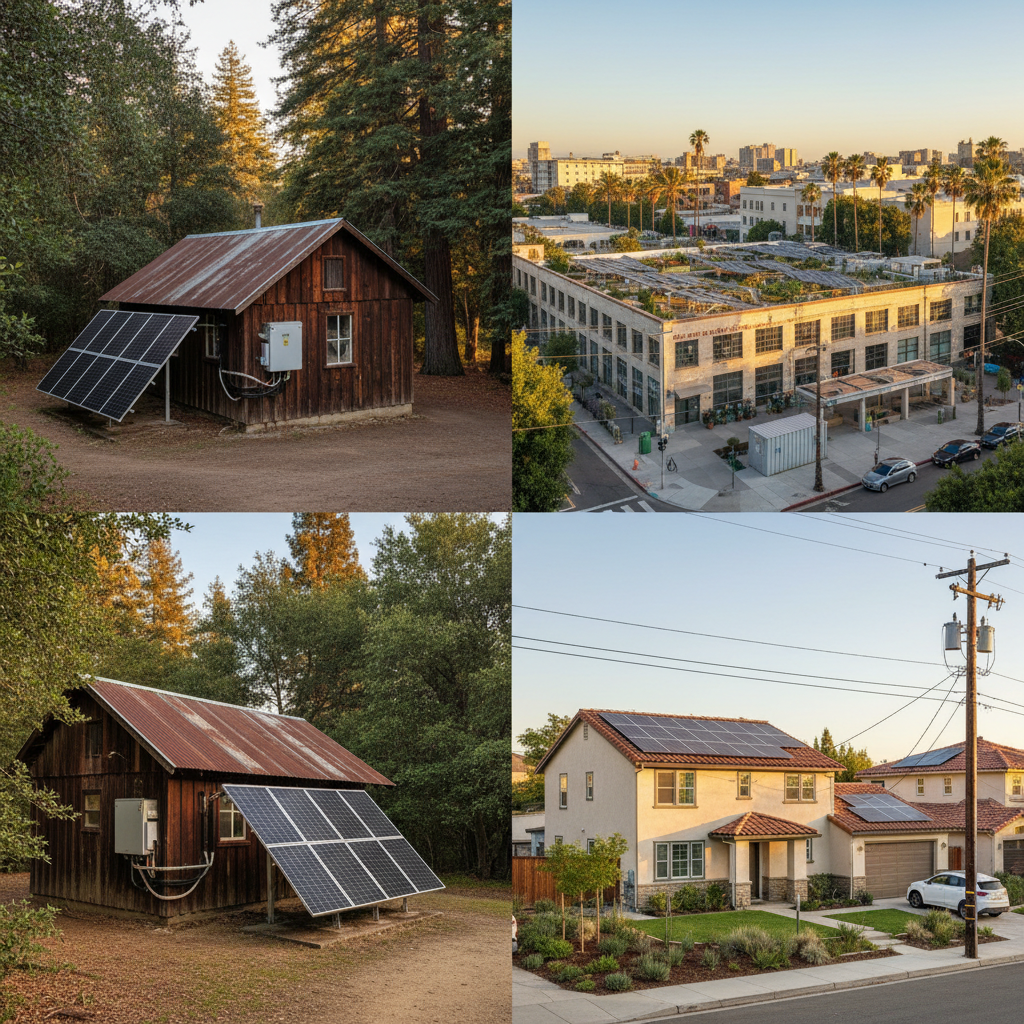
Off-Grid vs. Grid-Tied vs. Nano-Grid Solar in California: A Practical Comparison
Key Takeaways
- California's solar landscape has fundamentally shifted: 92% of new residential installs in Q1 2026 paired storage with solar under NEM 3.0, making battery-free systems essentially obsolete.
- The traditional binary of "on-grid" versus "off-grid" no longer reflects how California homes actually operate — the nano-grid is the emerging third path.
- Ultra-Peak utility rates reaching $1.02/kWh during 2025 heatwaves, income-graded fixed charges, and PSPS wildfire events are making energy independence a financial necessity, not just an ideological choice.
- A 6.2-year payback period for hybrid grid-tied systems in San Diego (2025) signals that the economics of solar-plus-storage have crossed a decisive threshold.
- Your optimal configuration depends heavily on your California utility territory, wildfire risk zone, EV ownership, and household load profile — one size emphatically does not fit all.
Why the Old Categories No Longer Hold
For most of solar's history in California, the choice was straightforward: stay connected to the grid and receive credits under the old NEM 2.0 rules, or go fully off-grid and accept higher upfront costs and operational complexity. That framework is now outdated.
As Dr. Aris Varma, Director of the California Energy Resilience Lab, puts it: "By 2026, the binary choice between 'on' or 'off' the grid has vanished. The modern California home is a 'Smart Nano-Node' that dynamically switches its grid connection based on real-time price signals and wildfire risk."
This isn't marketing language. It's a precise description of what California's policy environment, technology costs, and utility pricing structures have forced into existence. Here's what each configuration actually means in 2026 — and who each one is right for.
Option 1: Fully Off-Grid Solar
What It Is
A fully off-grid system severs your utility connection entirely. You generate, store, and manage 100% of your own electricity. This typically requires significantly oversized panel arrays, large battery banks (often 20–40+ kWh), backup generators, and careful load management.
Where It Makes Sense in California
Off-grid isn't for everyone, but it's growing rapidly in specific contexts. CPUC Energy Division data shows permit requests for fully off-grid "resiliency clusters" in California's Wildland-Urban Interface (WUI) increased 34% year-over-year in late 2025. In communities like parts of the Sierra Nevada foothills, San Bernardino mountain zones, and the North Coast, PSPS events lasting five to seven days make grid dependency genuinely dangerous.
Off-grid is the right choice when:
- You are in a Tier 3 or Tier 4 High Fire Threat District with a history of multi-day PSPS events
- Your property lacks reliable grid access or faces prohibitive utility interconnection costs
- You own a rural property or second home with low, predictable loads
- You want complete immunity from utility rate volatility
The Real Costs and Tradeoffs
Off-grid demands the highest upfront investment and the most operational discipline. Seasonal solar production variation in California — particularly in Northern California from November through February — can stress undersized storage systems. You'll need a qualified professional who understands load calculations specific to your climate zone, not just a standard residential installer.
The CPUC's February 2026 "Independence Directive" has streamlined the legal disconnection process for urban residences that can demonstrate minimum 72-hour storage capacity, removing a significant bureaucratic barrier. But urban off-grid remains a niche application best suited to low-consumption households with disciplined energy habits.
Option 2: Grid-Tied Solar (With and Without Batteries)
What It Is
A grid-tied system keeps your utility connection active. Your panels generate power, you consume what you need, and the surplus flows to the grid in exchange for credits. Under NEM 3.0 (now formally called the Net Billing Tariff), those export credits are substantially lower than they were under NEM 2.0 — a shift that has fundamentally changed the math.
The NEM 3.0 Reality
Sarah Jenkins, Chief Policy Analyst at CalSolar Research, frames it bluntly: "NEM 3.0 was the painful catalyst the industry needed. In 2025, we no longer sell solar panels; we sell energy independence packages where the grid is merely a backup generator of last resort."
Under NEM 3.0, exporting excess solar midday earns you minimal credit — sometimes as low as $0.02–$0.05/kWh — while you buy power back during Ultra-Peak hours at rates that hit $1.02/kWh during the June 2025 California heatwaves. A battery-free grid-tied system is now, in most cases, a financially irrational choice. The 92% storage attachment rate in Q1 2026 (per CALSSA) confirms that the market has reached the same conclusion.
Grid-tied with battery storage makes sense when:
- You live in a moderate-risk fire zone and want resilience without full independence
- Your load profile is consistent and well-characterized
- You want to participate in California's growing Virtual Power Plant (VPP) ecosystem, earning "Resiliency Credits" for discharging your battery during grid stress events
- You're in an SCE, PG&E, or SDG&E territory where interconnection is straightforward
The payback numbers are compelling: the average hybrid grid-tied system in San Diego reached a 6.2-year payback period in 2025, driven partly by a 15% drop in LFP (lithium iron phosphate) battery manufacturing costs per the DOE's 2025 Solar Report.
Micro-Islanding: Grid-Tied, But Ready to Disconnect
One of the most significant engineering trends of 2025–2026 is micro-islanding: designing grid-tied systems with the switching hardware and firmware logic to operate fully autonomously during PSPS events — potentially for indefinite periods when solar charging continues. This is not a standard feature in off-the-shelf inverter packages; it requires intentional design from an engineer who understands both the electrical and regulatory requirements under California interconnection rules.
Option 3: The Nano-Grid — California's Emerging Standard
What It Is
A nano-grid treats your home as an intelligent, semi-autonomous energy node. It combines solar generation, battery storage (typically 10–30 kWh with modular expansion capability), smart load management, and — increasingly — bidirectional EV integration (V2H). The connection to the utility grid remains, but it is actively managed rather than passively relied upon.
Why the Economics Now Favor Nano-Grids
California's 2026 Income-Graded Fixed Charges have restructured utility bills in a way that penalizes high "delivered energy" consumption — that is, electricity you pull from the grid. High-usage households that shift to nano-grid configurations are reducing their delivered energy costs by an estimated 55%, according to CPUC modeling. When your fixed charge is substantial regardless of consumption, the incentive to generate and consume your own power becomes overwhelming.
The new 2026 California state tax credit targeting Modular Nano-Grids has further accelerated adoption, sparking a surge in multi-family solar deployments across Los Angeles and San Francisco — a market segment that was previously difficult to serve economically.
Key nano-grid capabilities that differentiate it from a standard hybrid system:
- Dynamic grid switching based on real-time utility pricing signals, automatically isolating from the grid when rates spike
- DC-coupled architecture (increasingly preferred over AC-coupled systems) to maximize efficiency of V2H energy transfers from 2025-model EVs like the Ford F-150 Lightning, Rivian R1T, and Tesla Cybertruck
- VPP participation — your battery earns revenue by discharging during grid emergencies while keeping a reserve for household use
- "Off-Grid Lite" circuit segregation — routing non-essential loads (EV charging, secondary HVAC) to isolated solar circuits, entirely avoiding utility fixed fees on those loads
- Satellite-informed performance modeling that accounts for your specific rooftop shade profile and local irradiance patterns
The San Jose "Nano-Swarm" pilot launched in January 2026 takes this even further, allowing neighboring nano-grid homes to trade excess battery capacity during localized outages through an AI-managed peer-to-peer energy network. Early results suggest this model could reduce neighborhood-level reliance on utility power by an additional 18–25% during PSPS events.
Who the Nano-Grid Is For
The nano-grid is the right configuration for the majority of California homeowners in 2026 who are:
- In SCE, PG&E, SDG&E, or municipal utility (BWP, LADWP) territories facing Ultra-Peak pricing
- Owners of or planning to purchase a V2H-capable EV
- Located in moderate-to-high PSPS risk zones who want resilience without full off-grid complexity
- Eligible for California's SGIP (Self-Generation Incentive Program) battery rebates, which remain active and can offset 15–25% of battery costs
Side-by-Side Comparison
| Factor | Fully Off-Grid | Grid-Tied + Battery | Nano-Grid | |---|---|---|---| | Upfront Cost | Highest | Moderate–High | Moderate–High | | Payback Period | 10–15+ years | 6–9 years | 5–8 years | | PSPS Protection | Complete | Partial (hours) | Near-complete (engineered) | | NEM 3.0 Compatibility | N/A | Moderate | Optimized | | VPP Revenue Potential | None | Yes | Yes (maximized) | | V2H Integration | Possible | Limited | Native | | Complexity | High | Low–Moderate | Moderate | | Best California Use Case | WUI/rural | Low-risk suburban | Most California homes |
Bottom Line
California's energy landscape in 2026 has made the old off-grid-versus-grid-tied debate largely academic. Fully off-grid systems remain the right answer for WUI properties and rural locations with genuine grid access problems. Standard grid-tied systems without batteries are now financially unjustifiable for most homeowners under NEM 3.0. The nano-grid — engineered, intelligent, and storage-centric — has emerged as the practical standard for the overwhelming majority of California households, offering the resilience of near-autonomy with the financial flexibility of a managed grid connection.
Getting this right requires more than a salesperson with a tablet and a quick roof measurement. It requires independent financial modeling against your specific utility's rate structure, shade analysis using current satellite irradiance data, and an installer with verified credentials and a track record of nano-grid deployments in your utility territory.
Ready to find out which configuration is right for your home? Get a free solar assessment from Solanano — California's independent solar advisory service that matches you with pre-vetted, licensed professionals using hyperlocal data, NEM 3.0-aware financial modeling, and zero conflict of interest.


