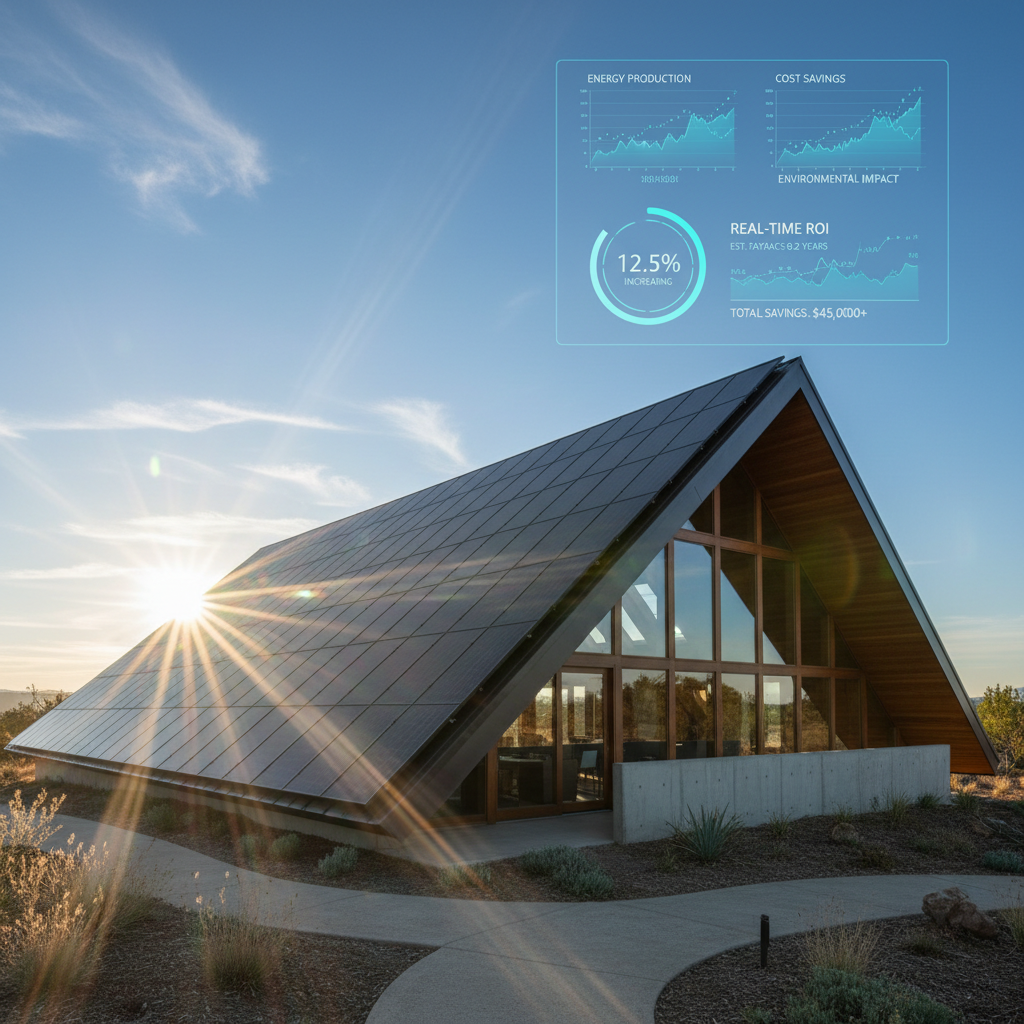
How AI Is Calculating the Exact ROI of Solar Before Installation
Updated for 2026 | 12-minute read
Key Takeaways
- The solar AI market has reached $1.21 billion in 2026, growing at a 15% CAGR since 2024, signaling a fundamental shift in how solar investments are evaluated.
- AI-driven design tools are increasing energy production projections by up to 30% through hyper-local shading and terrain analysis.
- Lifecycle ROI error margins have been reduced by 15% compared to traditional manual modeling, making pre-installation financial forecasts more bankable than ever.
- A new industry standard called "Auditable Outcomes" is replacing vague energy estimates, demanding transparent, verifiable financial projections before a single panel is installed.
- From digital twins to satellite-fused LiDAR, the tools available in 2026 have effectively eliminated the guesswork that made solar ROI projections unreliable for decades.
The End of the Educated Guess in Solar Finance
For most of solar energy's commercial history, the return-on-investment pitch followed a predictable and frustratingly imprecise script: an installer would visit your roof, take some measurements, punch numbers into a spreadsheet, and hand you a projection that was, at best, an educated guess dressed up in professional formatting.
Margins of error were wide. Shading from a neighbor's new tree, local utility rate fluctuations, degradation curves, and grid volatility were either ignored or averaged out into assumptions that rarely matched reality. Homeowners and commercial developers alike were asked to make 20-year financial commitments based on models that carried the accuracy of a weather forecast.
That era is definitively over.
As of 2026, artificial intelligence has moved from a peripheral curiosity in the solar industry to its financial backbone. AI is now calculating the exact ROI of a solar installation before a single permit is filed, with a precision that is reshaping how homeowners, developers, and institutional investors think about clean energy as an asset class.
"The era of the 'estimated guess' is over. AI provides a judgment-based precision that is now mandatory for proving solar's bankability." — Dr. Christoph Bergmeir, Lead Researcher at Monash AI Energy Lab
What "Exact ROI" Actually Means in 2026
When we say AI is calculating exact ROI, we are not talking about a slightly better spreadsheet. We are talking about a multi-layered financial model that accounts for variables that no human analyst could track simultaneously in real time. Modern solar AI platforms integrate:
- 25-year performance simulations using high-fidelity digital twin technology that models real-time grid volatility
- Hyper-local microclimate data fused from satellite imagery, LiDAR elevation mapping, and historical weather stations
- Time-of-Use (TOU) utility pricing optimization, shifting the calculation from how much energy is generated to how much revenue that energy actually produces
- Battery arbitrage modeling, incorporating imbalance market trading and peak-demand energy storage strategies into the initial financial algorithm
- Permitting risk scores that assess municipal opposition and approval timelines before a developer spends a dollar on site visits
The convergence of these capabilities into a single, auditable financial output represents one of the most significant leaps in solar project economics in the industry's history.
Geospatial AI: The Survey That Never Needs to Happen
One of the most immediate and visible ways AI is transforming pre-installation ROI accuracy is through the elimination of the manual site survey.
Historically, an accurate rooftop assessment required a technician on-site with measurement tools, a compass, and an inclinometer. Today, geospatial AI platforms fuse satellite imagery with LiDAR point-cloud data to generate a three-dimensional rooftop model accurate to within centimeters — without a single site visit.
The practical implications for ROI accuracy are enormous:
- Shading analysis now accounts for every neighboring structure, rooftop obstruction, and seasonal solar angle, not just the obvious ones a technician might note during a summer afternoon visit.
- Usable roof area is calculated with engineering-grade precision, eliminating the over-promising that plagued early residential solar quotes.
- Panel layout optimization is automated across thousands of configuration permutations, selecting the arrangement that maximizes not just kilowatt output but net financial return under the homeowner's specific utility rate structure.
The Q1 2026 launch of AI "Site Scout" tools has extended this capability further, allowing commercial developers to assess municipal opposition patterns, historical permitting denial rates, and zoning risk profiles for a site before ever scheduling a visit. For large-scale solar developers, this capability alone can save hundreds of thousands of dollars in aborted project costs annually.
Digital Twins and the 25-Year Financial Forecast
Perhaps the most sophisticated layer of AI-driven ROI calculation is the deployment of digital twin technology — virtual replicas of a proposed solar installation that simulate its performance across a full 25-year lifecycle.
Unlike static projections, digital twins continuously integrate real-time data inputs:
- Live grid volatility and frequency regulation events
- Panel degradation curves calibrated to specific manufacturer datasets rather than industry averages
- Evolving utility rate structures, including projected TOU pricing changes based on regional grid stress modeling
- Weather pattern anomalies drawn from 30+ years of historical climate data adjusted for current climate trajectory models
This marks a fundamental philosophical shift in how the solar industry thinks about system design. The objective is no longer maximum generation — it is maximum revenue. An AI-optimized system installed in 2026 is designed to produce the most financially valuable kilowatt-hours, not simply the most kilowatt-hours, by aligning discharge timing with peak TOU pricing windows and energy arbitrage opportunities in wholesale imbalance markets.
For commercial and utility-scale projects, this distinction can represent a 15–25% variance in projected 10-year returns — a difference that makes AI-optimized modeling not merely useful but financially essential.
AI-Automated Permitting: Closing the Gap Between Proposal and Payoff
Even the most accurate ROI projection loses value if the project stalls in a permitting queue for 14 months. Historically, permitting delays have been one of the most significant and least discussed destroyers of solar project returns.
AI-automated permitting platforms are addressing this directly. By 2025 and into 2026, AI-driven permitting tools have accelerated approval speeds by 60%, automating the preparation of jurisdiction-specific documentation packages, flagging likely objection points in advance, and routing applications through the fastest available approval pathways.
For ROI modeling purposes, this compression of the pre-revenue timeline has a direct financial impact: a project that begins generating returns four months sooner than a traditional timeline projects meaningfully better internal rates of return — particularly for commercial projects where financing costs accrue during the development period.
The "Auditable Outcomes" Standard: Why Transparency Is Now the Baseline
January 2026 industry reports have identified a landmark shift in how solar financial software is being evaluated by investors, lenders, and sophisticated buyers: the emergence of "Auditable Outcomes" as the new standard metric.
In practical terms, this means solar proposals are increasingly expected to provide not just a projected ROI figure but a traceable, verifiable methodology — one that a third-party auditor, a bank underwriter, or a commercial property buyer could interrogate and validate independently.
This standard has arrived for two converging reasons:
-
The expiration of the 30% Federal Solar Tax Credit in 2026 has shifted the economics of residential and commercial solar significantly. With the ITC no longer available to cushion less-than-perfect installations, the underlying financial model of each project must stand entirely on its own merits. Solar installers have responded by accelerating adoption of AI-optimized Power Purchase Agreement (PPA) and leasing models that restructure returns without relying on the tax credit subsidy.
-
European utility mandates requiring AI-integrated Home Energy Management Systems (HEMS) to manage grid congestion have established a regulatory precedent that intelligent, data-auditable energy systems are no longer optional infrastructure — they are a grid stability requirement.
The combined effect is a market that increasingly demands proof, not promises.
"By 2026, the inverter is no longer just a power converter; it is an AI-powered brain that turns hardware into an automated money-saving machine." — Sarah Jenkins, Director of Energy Analytics at SolarEdge
What This Means for Homeowners and Commercial Buyers
If you are evaluating solar in 2026, the AI revolution in ROI modeling translates into several concrete advantages you should expect from any credible installer or developer:
- Instant, satellite-generated roof quotes with documented accuracy parameters — not estimates based on a technician's memory of your roof pitch
- A 25-year financial model that shows year-by-year cash flow, not just a single payback period number
- TOU-optimized system design that accounts for your specific utility's rate schedule, including projected future rate changes
- Battery integration analysis showing whether adding storage improves your ROI — and by precisely how much, modeled against real arbitrage market data
- A permitting risk score that gives you realistic timeline expectations before you sign a contract
- Full methodology transparency so that the numbers in your proposal are not a black box — they are a documented, auditable financial instrument
If a solar proposal you receive in 2026 cannot provide most of these elements, it is not simply behind the times — it is asking you to make a 20-year financial commitment on incomplete information.
Challenges and Honest Caveats
AI-driven ROI modeling is more accurate than anything the solar industry has previously offered, but it is not infallible. Data quality remains a meaningful variable: AI models are only as good as the satellite imagery, utility rate data, and climate records they are trained on. In regions with limited historical data or rapidly shifting utility structures, projections carry wider confidence intervals.
Additionally, the transition from max-generation to max-revenue optimization requires homeowners and commercial buyers to engage more actively with their utility rate structures — a layer of complexity that many buyers are not yet prepared for. The industry's educational infrastructure has not yet fully caught up with its analytical capabilities.
Bottom Line
The solar industry's AI transformation is not a future promise — it is a 2026 reality reshaping how every financial stakeholder, from a homeowner in Phoenix to a commercial developer in Berlin, evaluates a solar investment. With a $1.21 billion AI market, 30% improvements in production projections, 15% tighter lifecycle ROI accuracy, and 60% faster permitting timelines, the tools to calculate exact solar returns before installation are not only available — they are rapidly becoming the minimum acceptable standard. The question is no longer whether AI can predict your solar ROI with confidence. The question is whether the installer you are speaking with is using it.
Ready to see what AI-powered solar analysis says about your specific property? Get your free, data-driven solar proposal today and find out exactly what your system will generate — financially and electrically — before you commit to anything.


