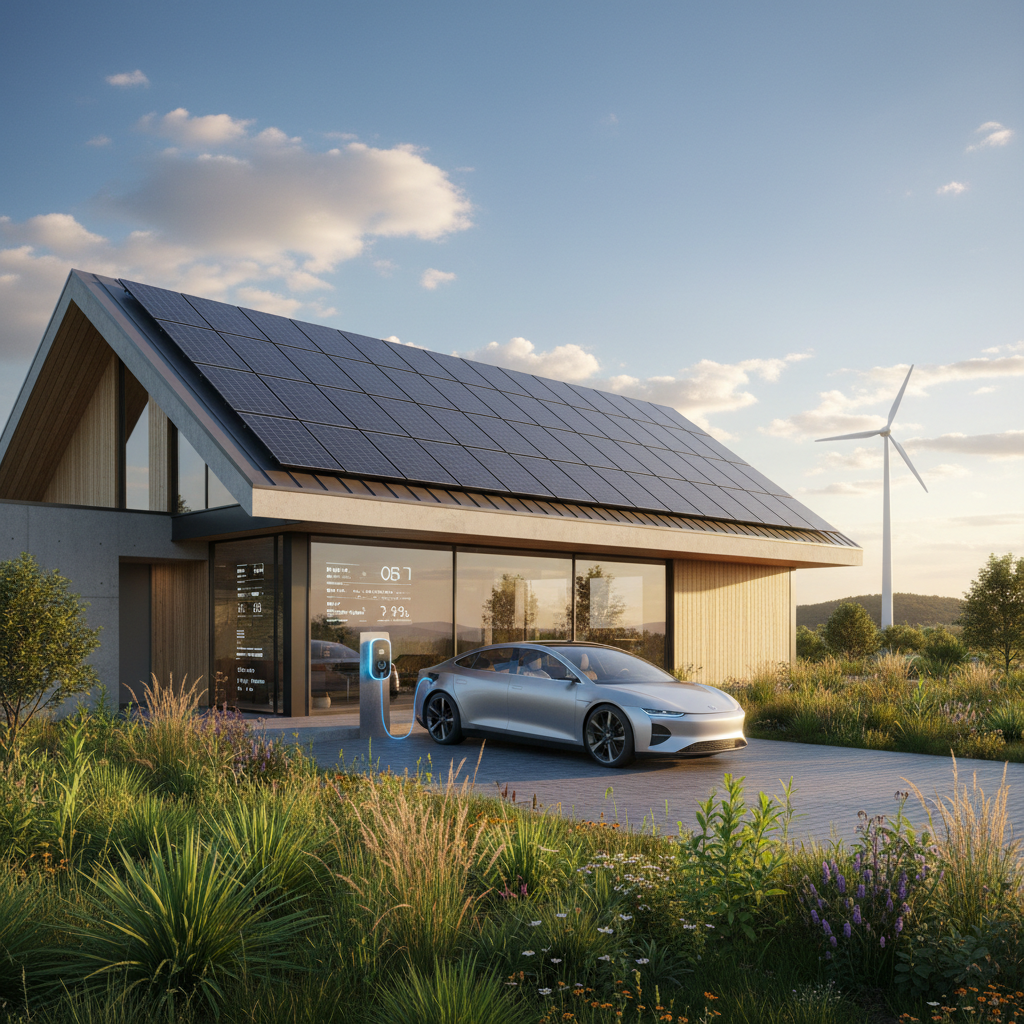
Solar + EV Charging: Designing the Perfect Home Energy System
Key Takeaways
- EVs now represent 30% of new global car sales, making home EV charging infrastructure a design priority, not an afterthought.
- DC-coupled solar + storage architectures eliminate 8–12% conversion losses and are rapidly becoming the residential standard.
- V2G and V2X technologies have crossed the mainstream threshold — your car can now serve as your home's primary backup battery.
- AI-driven Home Energy Management Systems (HEMS) are saving households up to $1,400 annually through automated energy arbitrage.
- California homeowners face unique design considerations under NEM 3.0 that make integrated solar + EV + storage systems dramatically more financially compelling than solar alone.
Electric vehicles were supposed to complicate the home energy equation. More load, bigger bills, strained panels. Instead, something unexpected happened: the EV became the smartest asset in the modern home energy stack.
As of Q2 2026, electric vehicles account for 30% of all new car sales globally, driving a projected 3.7% annual surge in residential electricity demand. But the households that planned ahead — pairing their solar arrays with batteries and bidirectional chargers — aren't watching their bills climb. They're watching them collapse. Some are even getting paid.
Designing that system correctly, however, requires more than buying panels and plugging in a charger. It requires understanding architecture, California utility dynamics, and a rapidly evolving technology landscape that is moving faster than most installers can track.
Why the EV Changes Everything About Your Solar Design
A conventional solar design optimizes for one thing: offsetting your historical electricity consumption. An EV demolishes that baseline. A typical EV adds 2,000–4,000 kWh of annual consumption to a household — roughly 30–60% on top of average California home usage. If your solar array was sized for your pre-EV load, you're now buying peak-rate electricity to charge your car.
But the EV is also a 60–100 kWh battery on wheels. And in 2026, that battery is increasingly bidirectional.
"The 2026 home energy system is no longer a collection of parts; it's an autonomous micro-utility where the electric vehicle is the largest and most flexible asset in the family's portfolio." — Dr. Elena Vance, Senior Energy Architect at FutureGrid Labs
This reframing is critical. Stop thinking of your EV charger as a load. Start thinking of your EV as a dispatchable storage asset that also happens to move you from point A to point B.
The Architecture Decision That Matters Most: AC vs. DC Coupling
Most residential solar installations built before 2024 used AC-coupled architecture: solar panels produce DC power, an inverter converts it to AC for the home, and then a separate charger converts it back to DC to fill your EV's battery. Every conversion costs you energy — typically 8–12% in combined losses.
The industry is rapidly moving away from this model.
DC-coupled architecture connects solar panels, home batteries, and EV charging within a unified DC bus, eliminating redundant conversions. Your solar electrons flow directly into your car with minimal loss. This isn't a marginal improvement — on a system sized for an EV household, it can mean recovering 800–1,500 kWh annually that would otherwise vanish as heat.
Key considerations when choosing your architecture:
- DC-coupled systems are more efficient but require careful component matching and are best designed from scratch rather than retrofitted
- AC-coupled systems are more flexible for retrofits and multi-inverter setups but carry that ongoing conversion penalty
- Hybrid inverters from leading brands now support both topologies, and April 2026's announcement of the industry "Energy Brain" standard means these devices can now synchronize solar production with your EV's state-of-charge and live utility tariffs in real time
For new construction or a full system replacement, DC-coupled is the clear choice. For homeowners retrofitting an existing solar array, a hybrid inverter with smart AC-coupling is often the pragmatic path.
Sizing the System: Solar, Storage, and Charging Together
The biggest mistake California homeowners make is sizing solar for the house and treating the EV charger as a separate purchase. A properly integrated system requires modeling all three loads simultaneously.
A practical sizing framework for a California EV household:
- Solar array: Size for 100–110% of combined home + EV consumption, accounting for your specific roof irradiance and shade profile. Under NEM 3.0, where export rates are substantially lower than import rates, maximizing self-consumption is paramount — oversizing for export revenue no longer works the way it did.
- Battery storage: The economics changed dramatically in late 2025 when battery cell prices dropped to a record $70 per kWh, making 20 kWh home-plus-EV storage systems financially viable for the average middle-market household. A 10–20 kWh home battery paired with your EV's bidirectional capability gives you a combined storage reserve that can carry most California households through a two-day grid outage.
- EV charger: Specify a bidirectional (V2G/V2H-capable) EVSE from day one, even if your current vehicle doesn't support it. The EU's January 2026 "Solar-Ready Garage" mandate — requiring pre-wired 22kW bidirectional infrastructure in all new residential builds — signals where the market is heading. California is not far behind.
NEM 3.0 and Why Storage + EV Is Now a Financial Necessity
California's NEM 3.0 framework, which took full effect in 2023, fundamentally altered the solar value equation. Export rates during peak solar production hours dropped significantly, making batteries — not net metering — the primary mechanism for capturing solar value.
For EV households, this creates a precise financial opportunity:
- Charge your EV and home battery during peak solar production (typically 10am–3pm), when your panels are generating more than your home consumes
- Draw from your battery and EV during evening peak rate hours (4pm–9pm under TOU tariffs like SCE's TOU-D-PRIME), avoiding the most expensive grid electricity
- Use V2G or V2H discharge to power your home overnight, potentially eliminating evening grid purchases entirely
This loop — solar in, stored in battery + EV, discharged during peak — is the core value engine of the 2026 California home energy system. Our team at Solanano models this precisely using satellite irradiance data and NEM 3.0-aware financial modeling, because a generic solar quote won't capture these dynamics accurately.
California homeowners should also investigate the Self-Generation Incentive Program (SGIP), which provides rebates for battery storage — rebates that become significantly more valuable when paired with an integrated V2G-capable system.
V2G and V2X: Your Car as the Grid's Best Friend (And Yours)
Vehicle-to-Grid (V2G) technology crossed a critical threshold in 2026. The North American residential V2G market hit $3.14 billion in 2025, with individual households capturing 55.25% of total sector value. The global V2G market has since surpassed $11.89 billion, with North America leading in bidirectional adoption.
The technology's real-world value was demonstrated dramatically in March 2026, when California's newest Virtual Power Plant project drew 500 MW of power from 50,000 residential EV batteries during a record heatwave — preventing grid failure without a single traditional peaker plant firing up.
For individual homeowners, V2X (Vehicle-to-Everything) unlocks several capabilities:
- V2H (Vehicle-to-Home): Your EV powers your house during an outage, typically providing 2–5 days of backup depending on vehicle battery size and home load
- V2G (Vehicle-to-Grid): Your EV discharges to the grid during peak demand events, earning you export credits under programs offered by utilities including SCE
- V2L (Vehicle-to-Load): Power tools, appliances, or critical loads directly from your car's battery during emergencies
V2X is now a standard feature in 2026 model year EVs across most major manufacturers. If you're buying a car and a solar system in the same year, coordinating these purchases is one of the highest-leverage decisions you can make.
The AI Layer: When Your Home Trades Energy Like a Portfolio
The final piece of the optimized system is intelligence. Home Energy Management Systems have evolved from simple time-of-use timers into predictive algorithms that treat your home's energy assets like a financial portfolio.
"We have reached the 'efficiency era' where AI-driven HEMS can predict a cloud passing over a roof 10 minutes in advance and adjust EV charging speeds to ensure 100% solar self-consumption." — Marcus Thorne, Chief Innovation Officer at Sol-Integrate
The results are tangible: households using AI-driven energy management systems in 2026 report annual savings of up to $1,400 by automating EV charging during periods of negative grid pricing — yes, there are hours when the grid pays you to consume electricity.
Modern HEMS platforms integrate:
- Hyperlocal weather forecasting to anticipate solar production 24–72 hours ahead
- Dynamic tariff monitoring to identify the cheapest (or negatively-priced) grid windows
- EV state-of-charge awareness to ensure departure readiness without unnecessary charging
- Grid signal response for automatic participation in utility demand response and VPP programs
For California homeowners on SCE, BWP, or other TOU rate structures, a properly configured HEMS pays for itself quickly — but only if it's been programmed with your actual utility's tariff structure, not a generic template.
Solar Carports and BIPV: When the Driveway Becomes a Power Plant
One emerging option worth considering, particularly for homes with limited south-facing roof space, is the solar carport. Building-Integrated Photovoltaics (BIPV) are increasingly deployed as carport canopies that generate power precisely where it's consumed — directly above the vehicle being charged.
A well-designed solar carport can:
- Generate 5–10 kW of dedicated EV charging capacity from otherwise unused airspace
- Reduce thermal load on the vehicle (cooler batteries charge more efficiently)
- Qualify for commercial ITC incentives in some configurations
- Eliminate roof penetrations entirely for homeowners with newer or complex roofs
BIPV carports represent a niche but growing solution that Solanano evaluates as part of a comprehensive site assessment — particularly for homes with shading constraints, east-west roof orientations, or high EV charging loads.
Bottom Line
The perfect home energy system in 2026 is an integrated whole: a properly sized solar array feeding a DC-coupled battery, charging an EV that talks back to the grid, all orchestrated by AI that monitors weather, tariffs, and your departure time simultaneously. California's NEM 3.0 environment makes storage and EV integration not just attractive but financially essential for maximizing solar ROI — and the technology to execute this elegantly has never been more accessible or affordable.
Getting there requires design expertise, not just installation quotes. The difference between a system assembled from individual parts and one engineered as a unified nano-grid can amount to thousands of dollars annually and the difference between energy independence and another rising utility bill.
Get your free solar + EV system assessment from Solanano — our independent advisors use hyperlocal irradiance modeling and NEM 3.0-aware financial analysis to match you with a pre-vetted installer who can build this system right, the first time.


