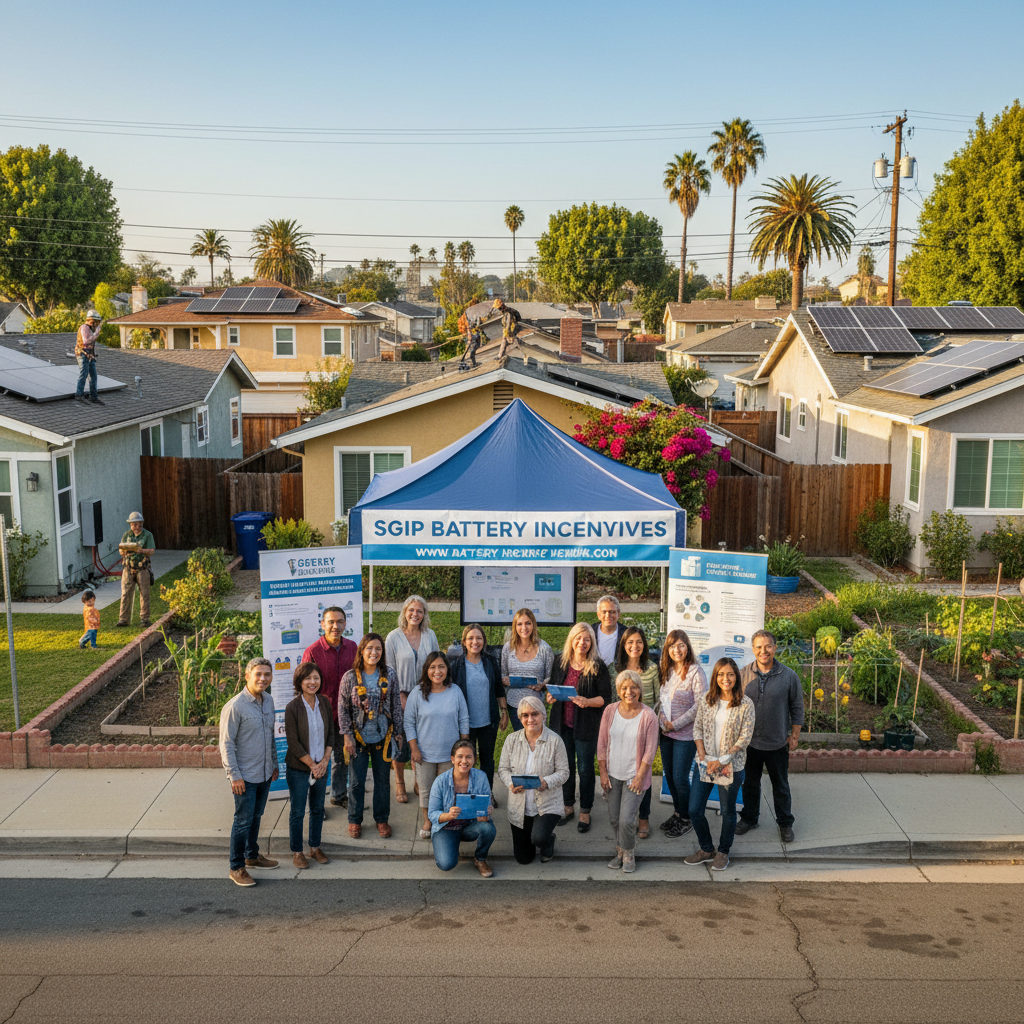
SGIP Battery Incentive California Low-Income: How to Qualify and Apply in 2026
Key Takeaways
- The Self-Generation Incentive Program (SGIP) Equity budget offers up to $1,100 per kWh for battery storage and $3,100 per kW for solar panels — enough to cover 100% of installation costs for qualifying households.
- Eligibility is primarily based on household income below 80% of Area Median Income (AMI) for your specific California county.
- The 2025–2026 Residential Solar and Storage Equity (RSSE) budget has over $280 million allocated specifically for low-income and disadvantaged community projects.
- A new 2026 rule requires all SGIP Equity recipients to enroll in a Virtual Power Plant (VPP) program.
- Waitlists in SCE and SDG&E territories are long — and the earlier you apply, the better your position.
If you're a lower-income California homeowner who's watched utility bills spiral upward while solar panels sit on rooftops across your neighborhood, 2026 may finally be the year the math works in your favor. Thanks to a major expansion of the Self-Generation Incentive Program (SGIP) — specifically its new Residential Solar and Storage Equity (RSSE) budget — qualifying households can access solar-plus-battery systems that cost little to nothing out of pocket.
This guide breaks down exactly who qualifies, how the application process works, what the new 2026 rules mean for you, and how to navigate the system without getting lost in the paperwork.
What Is the SGIP Equity Budget and Why Does It Matter?
SGIP is California's primary incentive program for behind-the-meter energy storage, administered through the state's investor-owned utilities (IOUs): PG&E, SCE, SDG&E, and SoCalGas. While SGIP has existed since 2001, its Equity and Equity Resiliency budget tiers were created specifically to address the energy access gap in low-income and frontline communities.
In June 2025, the CPUC officially opened the Residential Solar and Storage Equity (RSSE) budget under Decision 24-03-071, combining solar and storage incentives into a single, unified program for the first time. The result: eligible households can receive:
- Up to $1,100 per kWh for battery storage systems
- Up to $3,100 per kW for solar panel installations
- Combined incentives that, in many cases, cover 100% of total installation costs
"The 2026 budget shift toward 'Residential Solar and Storage Equity' has finally made energy resilience a reality for frontline communities who previously couldn't afford the upfront costs of battery backup," says Dr. Aris Thorne, Chief Energy Equity Analyst at the California Energy Commission.
As of Q1 2026, over $280 million has been allocated to the RSSE budget, making it one of the largest targeted clean energy equity programs in U.S. history. But demand is exceeding supply in several territories — which means timing your application correctly is critical.
Who Qualifies? Breaking Down the Eligibility Requirements
Income-Based Eligibility (Equity Budget)
The foundational eligibility requirement is straightforward: your total household income must be below 80% of the Area Median Income (AMI) for your specific California county, as outlined in the 2025 SGIP Handbook.
Because AMI varies significantly by location — the 80% AMI threshold in Los Angeles County is very different from that in Fresno County — you'll need to check the current figures for your area. The easiest proxy: if you're already enrolled in CARE (California Alternate Rates for Energy) or FERA (Family Electric Rate Assistance) programs through your utility, you're almost certainly income-eligible for SGIP Equity. The CPUC's June 2025 ruling explicitly aligned RSSE access with CARE/FERA participation.
Other qualifying income-based programs include:
- Medi-Cal
- CalFresh (SNAP)
- SSI/SSP
- National School Lunch Program
Equity Resiliency: An Enhanced Tier for the Highest-Need Households
The Equity Resiliency sub-budget provides even larger incentives for households that face compounding vulnerabilities. To qualify, you must meet the 80% AMI threshold and at least one of the following:
- Reside in a Tier 2 or Tier 3 High Fire-Threat District (HFTD) as designated by the California Public Utilities Commission
- Have experienced at least two Public Safety Power Shutoff (PSPS) events at your address
This tier was designed for households in fire-prone rural areas — particularly in SCE and PG&E territories — where outages are not an inconvenience but a genuine safety threat. If you or someone in your household depends on electricity for life-sustaining medical equipment, a new 2026 fast-track provision prioritizes your application processing under the Medical Baseline category.
The New 2026 Rules You Need to Know
Before you apply, understand that 2026 brings two significant program changes that affect how your system operates after installation.
1. Mandatory VPP Enrollment
New 2026 regulations require that all SGIP Equity recipients enroll in a Virtual Power Plant (VPP) program. In practical terms, this means your battery will occasionally be dispatched by a utility or grid operator during peak demand events — particularly extreme heat days — to help stabilize the grid. Your battery will still prioritize your home backup needs, but the VPP operator can draw on it during declared grid emergencies.
Elena Rodriguez, Director of Policy for CalSolar Advocates, frames this positively: "By requiring VPP participation for new SGIP batteries, we aren't just giving low-income families backup power; we're turning them into active contributors to the state's grid reliability."
In exchange for VPP participation, many programs offer additional demand response payments — meaning your battery could actually generate modest bill credits over time.
2. Performance Requirements
Systems funded under the 2026 SGIP rules must meet ongoing performance standards:
- 10-year permanency requirement: You must keep the system installed and operational for a decade
- Minimum 52 full discharge cycles annually: Your battery must be actively used to qualify for continued incentive retention
These rules are designed to prevent incentive abuse and ensure the grid benefits from funded systems. A qualified installer will configure your system to meet these thresholds automatically.
How SGIP Equity Stacks with Other Incentives
Smart applicants don't stop at SGIP. The real power of 2026 incentive stacking looks like this:
- Federal Investment Tax Credit (ITC): A 30% federal tax credit applies to solar and battery systems. For low-income households with limited tax liability, pairing with Solar for All grant funding can eliminate the last 5–10% of remaining costs.
- Solar for All: This federal program, administered through EPA grants to California, is increasingly being integrated with SGIP to achieve genuine zero-cost installations for the lowest-income households.
- LADWP Expanded Incentives: LADWP announced it will begin accepting applications for expanded 2026 SGIP low-income battery incentives starting Q1 2026, offering a parallel pathway for Los Angeles Department of Water and Power customers who sit outside the standard IOU structure.
- Zero-Down Leasing Models: A growing trend among certified installers is using the SGIP rebate as the primary project capital, offering homeowners a $0-down lease with no upfront costs — and no debt. This model is particularly powerful for households that don't qualify for the full tax credit benefit.
Battery-First: Why System Sizing Strategy Matters Under NEM 3.0
Here's something most guides won't tell you: how your system is sized matters enormously under California's current Net Energy Metering rules.
Under NEM 3.0 (now called Net Billing), the compensation rate for excess solar energy sent back to the grid has dropped significantly. This changes the calculus for system design entirely. The most financially optimal approach for SGIP Equity applicants in 2026 is a Battery-First philosophy — prioritizing sufficient battery storage capacity to capture your solar generation and consume it at home, rather than oversizing the solar array and exporting surplus power at low rates.
This is where hyperlocal financial modeling matters. A properly designed system accounts for:
- Your utility territory (SCE, PG&E, SDG&E, LADWP, or a community choice aggregator like BWP)
- Your specific time-of-use rate plan
- Satellite-based shade and irradiance analysis for your roof
- NEM 3.0-aware export compensation projections
Getting this modeling wrong means leaving thousands of dollars of savings on the table over a 10-year system life.
How to Apply: A Step-by-Step Overview
- Confirm income eligibility: Check your county's 80% AMI threshold, or verify your existing enrollment in CARE, FERA, Medi-Cal, or another qualifying program.
- Identify your utility territory: SGIP applications are filed through your IOU (PG&E, SCE, SDG&E) or, for LADWP customers, through LADWP's parallel program.
- Get on the waitlist early: As of late 2025, the RSSE waitlist in SCE and SDG&E territories is being managed via a "cancelled project attrition" queue due to record demand. Position matters.
- Select a pre-vetted, SGIP-registered installer: Only installers registered with the SGIP program can submit applications on your behalf. Verify your contractor holds a valid C-10 or C-46 license and carries the required insurance.
- System design and SGIP application submission: Your installer submits a reservation application before installation begins. Do not allow work to start before reservation confirmation.
- Installation, inspection, and VPP enrollment: After installation passes utility interconnection and local inspection, your installer completes VPP enrollment on your behalf.
- Incentive payment: SGIP incentives are typically paid directly to the installer and applied as a credit to your project cost.
Bottom Line
The 2026 SGIP Equity and Residential Solar and Storage Equity budgets represent a genuine, funded pathway for lower-income California households to achieve energy independence — not a theoretical one. With $280 million on the table, incentives that can cover 100% of costs, and new stacking opportunities through Solar for All and zero-down lease structures, the barriers are lower than they have ever been. But funding is limited, waitlists are real, and the new VPP and performance rules mean system design quality matters more than ever. Acting early, with the right guidance and the right installer, is the difference between getting in and getting left behind.
Ready to find out exactly what you qualify for? Get a free, no-obligation solar assessment from Solanano — our independent advisors use hyperlocal satellite modeling and NEM 3.0-aware financial analysis to match you with a pre-vetted, SGIP-registered installer at zero cost to you.


