SREC Markets Explained: Selling Your Solar Electricity Certificates
Key Takeaways
- Solar Renewable Energy Certificates (SRECs) are tradable credits generated when your solar system produces electricity — one SREC equals one megawatt-hour (MWh) of solar generation.
- SREC markets are state-specific; prices vary dramatically from under $10 in oversupplied states to $350+ in compliance-driven markets like Washington, DC and Massachusetts.
- California homeowners do not currently participate in a traditional SREC market — but understanding how certificate markets work is essential context for evaluating solar incentives under NEM 3.0.
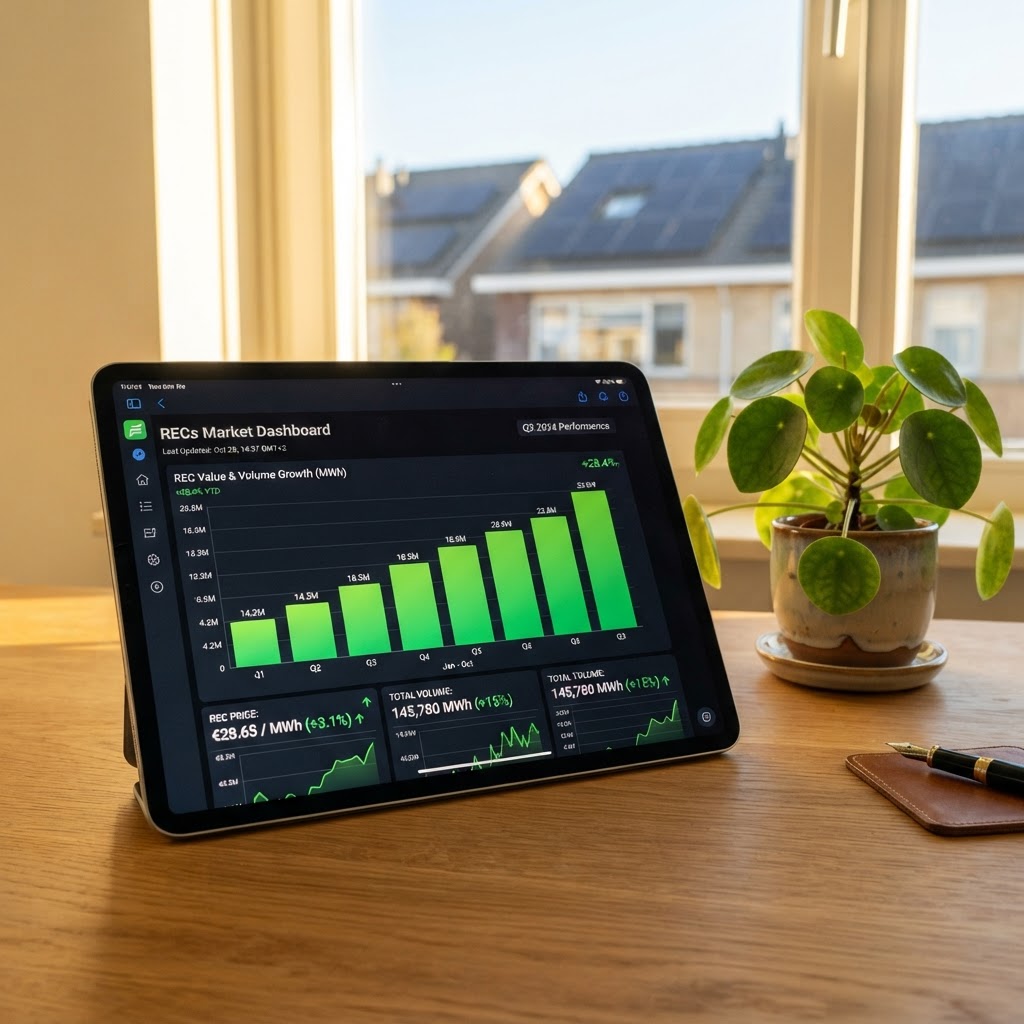
- The global Renewable Energy Certificate (REC) market is projected to grow from $23.2 billion in 2025 to $64.6 billion by 2035, driven largely by corporate ESG demand.
- Independent financial modeling — accounting for your specific utility, rate schedule, and local incentives — is the only reliable way to project your true solar return.
What Is an SREC, and How Does It Work?
When your rooftop solar system generates one megawatt-hour of electricity, it produces two things simultaneously: the physical electricity that flows into your home or the grid, and a Solar Renewable Energy Certificate — an SREC — that serves as a digital proof of that clean generation.
These certificates exist because of a policy mechanism called a Renewable Portfolio Standard (RPS). Under an RPS, utilities are legally required to source a defined percentage of their electricity from renewable sources. If a utility can't meet its solar carve-out through direct procurement, it must buy SRECs from solar owners — or pay a penalty known as the Solar Alternative Compliance Payment (SACP). That SACP effectively acts as a price ceiling for the market: no rational buyer will pay more for an SREC than the fine they'd pay for not having one.
The result is a compliance-driven marketplace where solar homeowners can register their systems with a state-approved tracking platform, accumulate SRECs as their panels generate power, and sell those certificates — either through brokers, spot markets, or long-term contracts — to utilities or electricity suppliers scrambling to meet their legal obligations.
Where Are SREC Markets Active?
SREC markets are not a national program. They are creatures of state policy, which means geography matters enormously.
The most active markets as of 2026 include:
- Washington, DC: One of the highest-value SREC markets in the country, with 2025, 2026, and 2027 vintage prices assessed at approximately $358–$360/MWh as of August 2026. DC's solar carve-out is aggressive, and eligible solar capacity in the district reached 373.7 MW by end of 2025, already exceeding its 293 MW program target — a dynamic that has introduced downward price pressure.
- Massachusetts: The state's Solar Massachusetts Renewable Target (SMART) program has largely replaced the older SREC II framework, but the state maintained a Solar Alternative Compliance Payment of $550/MWh in 2025, one of the most favorable compliance ceilings in the nation.
- New Jersey: A large and liquid SREC market backed by a mandate requiring 5.1% solar energy by 2026. New Jersey's market has historically rewarded early system owners, though increased supply has moderated prices over time.
- Maryland, Ohio, Pennsylvania: Secondary markets with lower but still meaningful SREC values, typically ranging from $10–$80/MWh depending on supply-demand conditions.
As Parag Nathaney, a Quantitative Engineer at a major electric utility, notes: "As solar supply has improved across the district, we are seeing SREC levels retreat from their historical highs, which were previously driven by extreme scarcity." That dynamic — early scarcity driving high prices, followed by supply growth compressing returns — is the defining cycle of every maturing SREC market.
Why California Is Different (and What You Have Instead)
Here is the critical California caveat: the state does not operate a traditional SREC market. California's grid operator and investor-owned utilities — SCE, PG&E, SDG&E, and community-owned utilities like Burbank Water and Power — compensate rooftop solar owners through net energy metering, not certificate trading.
Under NEM 3.0, which took effect for new applicants in April 2023, the compensation structure shifted significantly. Export rates are now tied to an Avoided Cost Calculator (ACC) model that varies by hour and season, rather than the retail rate that made NEM 1.0 and 2.0 so financially compelling. The practical consequence: battery storage has become almost essential for California solar owners who want to maximize self-consumption and reduce dependence on low-value midday export credits.
This is precisely the philosophy behind what we at Solanano call the nano-grid approach — designing solar-plus-battery systems that prioritize energy independence and resilience over grid export. When your home can store afternoon solar generation and deploy it during evening peak hours, NEM 3.0's complicated export rate structure becomes far less of a limitation.
California homeowners may also be eligible for the Self-Generation Incentive Program (SGIP), a state rebate for battery storage that can meaningfully reduce the cost of adding a system like a Tesla Powerwall or Enphase IQ Battery. That's a tangible, current incentive worth modeling carefully — and it's the kind of hyperlocal detail that generic solar calculators routinely miss.
The Bigger Picture: A $64.6 Billion Market on the Rise
Even if you're a California homeowner for whom SRECs aren't directly actionable, understanding the broader REC market matters — because it shapes where solar policy, utility procurement, and technology investment are heading.
The global Renewable Energy Certificate market is projected to expand from $23.2 billion in 2025 to $64.6 billion by 2035, representing a compound annual growth rate of 10.8%. The primary engine of that growth, according to Future Market Insights, is corporate net-zero demand. Fortune 500 companies, technology giants, and institutional investors are purchasing RECs at scale to meet ESG reporting requirements and science-based decarbonization targets — a demand signal that provides a floor of liquidity to certificate markets that state compliance alone couldn't sustain.
The market is also maturing structurally. Regulators are increasingly exploring cross-border trading capabilities and standardized digital traceability frameworks, with meaningful progress expected by 2031. As Dr. Elena Vance, Senior Analyst for Renewable Energy Markets, puts it: "The transition toward standardized, cross-border trading mechanisms is the next logical step to ensure liquidity and transparency in the maturing REC market."
For states currently operating SREC markets, that standardization could improve price discovery and reduce the transaction friction that has historically disadvantaged individual homeowners relative to large commercial sellers.
How to Sell SRECs: A Practical Overview
If you own a solar system in an active SREC state, here's how the process typically works:
- Register your system with your state's renewable energy tracking system (e.g., PJM-GATS for mid-Atlantic states, NEPOOL GIS for New England).
- Accumulate SRECs as your system generates electricity — typically reported monthly through your utility or a monitoring platform.
- Choose a sales method:
- Spot market: Sell SRECs immediately at current market prices. Higher potential return in strong markets, but zero price certainty.
- Broker-assisted sale: A broker aggregates certificates from multiple owners and sells in bulk, often taking a percentage commission.
- Long-term contract (SREC aggregator): Lock in a fixed price per SREC for 5–10 years. Lower potential upside, but predictable cash flow — often the smarter choice for residential owners who value certainty.
- Receive payment — typically quarterly, via ACH or check, depending on the platform.
Transaction costs, registration fees, and broker commissions can meaningfully affect net returns. In markets with SREC prices below $50/MWh, fees can consume a disproportionate share of revenue, making careful platform selection important.
Key Risks to Understand Before Banking on SREC Income
- Price volatility: SREC markets are policy-dependent. A legislative change, a compliance payment reduction, or a surge in new solar installations can compress prices rapidly — as DC's 2026 oversupply situation illustrates.
- Market sunset risk: States can restructure or terminate SREC programs. Massachusetts effectively replaced SREC II with the SMART program, and New Jersey has periodically adjusted its carve-out mechanics.
- Vintage expiration: SRECs have limited validity windows — typically two to three years depending on the state. Unsold certificates can expire worthless.
- Eligibility requirements: Systems must be certified and registered before generation. Retroactive registration is sometimes permitted but not guaranteed.
Bottom Line
SREC markets represent a genuinely valuable revenue stream for solar owners in compliance-driven states like New Jersey, Massachusetts, and Washington, DC — but they are not a static, guaranteed income source. Prices move with policy, supply, and corporate demand cycles, and the market sophistication required to optimize returns favors owners who engage proactively with brokers, contracts, and market timing. For California homeowners, the parallel opportunity lies in mastering NEM 3.0 economics, SGIP battery incentives, and time-of-use rate optimization — a different set of tools, but the same underlying goal: extracting maximum value from every kilowatt-hour your system produces.
The global REC market's trajectory toward $64.6 billion by 2035 signals that clean energy certificates — in whatever form your state offers — are becoming more sophisticated, more liquid, and more central to how society prices and values solar generation. Getting the financial model right from the start has never mattered more.
Ready to understand exactly what your California home solar system is worth under NEM 3.0 — including battery storage incentives, utility-specific rate analysis, and a vetted installer match? Get your free solar assessment from Solanano today.


