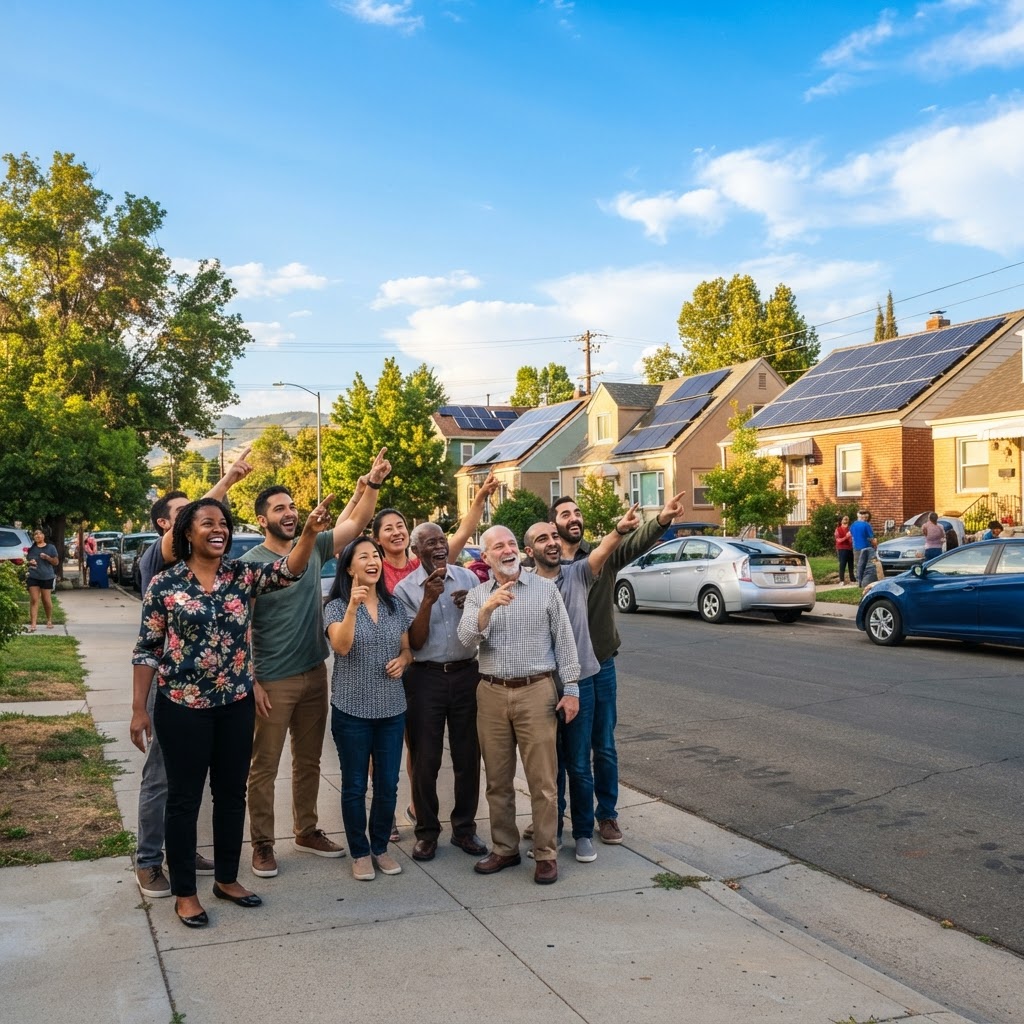
Solar Strategy for NEM 3.0 in Underserved Communities: The Guide No One Else Wrote
Key Takeaways
- NEM 3.0 fundamentally changes the solar math for low-income households — battery storage is now the non-negotiable centerpiece, not an upgrade.
- Federal "Solar for All" grants, California's SGIP Equity Resiliency tier, and new "Direct-Pay" mechanisms have stacked into a financing ecosystem powerful enough to drop average payback periods to 5.8 years in Disadvantaged Communities (DACs).
- California's 2026 Grid Fairness Act introduces a dedicated export premium for urban Heat Island zones — a quiet windfall many eligible households don't yet know they qualify for.
- Zero-Down Storage-as-a-Service models and community Energy Ambassador programs are dismantling the two biggest barriers: upfront cost and institutional distrust.
- The right strategy isn't just about saving money — it's about building household-level resilience in the zip codes most vulnerable to grid failure and extreme heat.
Why NEM 3.0 Changed Everything — Especially for Low-Income Households
When California's Net Energy Metering 3.0 took effect, the headline reaction from the solar industry was alarm. Export rates for excess rooftop solar dropped by roughly 75% compared to NEM 2.0. For households that had sized their systems to maximize grid exports, the business case collapsed almost overnight.
But here's what most coverage missed: NEM 3.0 didn't kill rooftop solar for underserved communities — it redirected the entire strategy. The old model of over-generating and selling back to the grid was always a better fit for higher-income households with flexible consumption patterns. For families in Disadvantaged Communities who run appliances around the clock out of necessity — medical equipment, cooling systems during extreme heat events, water heaters with no programmable timers — the self-consumption model that NEM 3.0 incentivizes is actually a closer match to real-life energy behavior.
The pivot? Stop treating battery storage as an optional add-on. Under NEM 3.0, you generate solar during the day and bank it rather than export it. That banking strategy is now economically dominant — and for the first time, it's financially accessible.
The Stacked Incentive Ecosystem: Where the Real Money Lives
The single most important development for LMI solar in the past three years is the convergence of multiple incentive streams that can be layered on top of each other. Understanding this stack is the difference between a project that pencils out and one that doesn't.
Federal Layer: Solar for All In June 2025, the EPA completed the final disbursement of its $7 billion "Solar for All" grant program, triggering a surge in LMI solar interconnections across California. These grants flow through state agencies and qualified nonprofits directly to low-income households and community solar projects, often covering 40–60% of total system cost. The result was immediate and measurable: battery attachment rates for CARE/FERA program households reached 84% in Q1 2026, up from just 12% in early 2023.
State Layer: SGIP Equity Resiliency California's Self-Generation Incentive Program (SGIP) has an Equity Resiliency tier specifically designed for households in high-fire-threat districts, those who rely on electricity for medical baseline needs, and customers in DAC zip codes. This tier offers rebates of up to $1,000 per kilowatt-hour of battery storage — significantly higher than the standard SGIP rate.
Utility Layer: Grid Fairness Act Export Premium California's 2026 Grid Fairness Act introduced a dedicated export premium for solar energy generated within designated urban Heat Island zones. Many of these zones overlap directly with historically underserved neighborhoods in Los Angeles, the Inland Empire, and the Central Valley. If your home sits within one of these boundaries, every kilowatt-hour you do export receives a bonus adder that materially improves your NEM 3.0 export value.
New Mechanism: Direct-Pay for Nonprofits Perhaps the most underreported development: new Direct-Pay tax credit mechanisms now allow 501(c)(3) organizations to receive the federal Investment Tax Credit as a direct cash payment rather than a tax offset. This has catalyzed 500 new community solar projects in rural California in early 2026 alone, bringing shared solar capacity to renters, mobile home residents, and anyone who can't install panels on their own roof.
"Under NEM 3.0, the solar panel is just the fuel collector; the battery is the bank. In underserved communities, we are finally seeing the 'Bank' become affordable through federal equity-based financing." — Dr. Aris Thorne, Chief Policy Analyst at Clean Energy Equity Institute
The Real-World Numbers: What Does This Actually Mean for a Family's Budget?
Let's move past policy abstractions and talk about dollars.
- Average monthly utility bill savings for underserved households enrolled in Equity Resiliency solar programs hit $145 per month during the 2025 summer peak season — a period when California utility rates were at their annual high and TOU (time-of-use) pricing was most punishing.
- Payback period for a solar-plus-storage system in a DAC, after stacking Solar for All grants, SGIP Equity Resiliency rebates, and the federal ITC, dropped to 5.8 years in 2025. Compare that to a 10–12 year payback for a market-rate NEM 3.0 system with no incentive stacking, and the equity math becomes strikingly clear.
- Grid resilience impact: A landmark 2025 Berkeley Energy Lab study found that battery-backed solar in underserved communities reduced local grid outage frequency by 30% during the summer 2025 heatwave — not just for individual homes, but measurably improving grid stability at the neighborhood level.
"By 2026, the strategy has shifted from 'selling solar' to 'providing resilience.' For a family in a heat-vulnerable zip code, a battery isn't a luxury; it's a life-saving appliance." — Sonia Rodriguez, Founder of SolarReach Urban Initiatives
Emerging Models Breaking Down the Final Barriers
Even with robust incentive stacking, two barriers have historically blocked underserved households from accessing solar: upfront cost and distrust of the sales process. New models are attacking both simultaneously.
Zero-Down Storage-as-a-Service Tailored specifically for renters and households with low credit scores, Storage-as-a-Service models remove the need for ownership entirely. A third-party provider installs and maintains the battery system; the household pays a fixed monthly fee — typically lower than their previous utility bill delta — and receives the resilience and savings benefits. This model is gaining traction in multi-family affordable housing across Los Angeles and the Inland Empire, where traditional solar financing has always been a structural mismatch.
Bidirectional EV Charging (V2H) in Multi-Family Housing As more low-income households gain access to electric vehicles through state rebate programs, Vehicle-to-Home (V2H) charging is emerging as a primary resilience strategy under NEM 3.0. In practice, a bidirectional EV charger turns a parked car into a multi-day backup power source — storing solar energy generated during the day and dispatching it to the unit at night. For multi-family affordable housing developers, this approach integrates resilience without requiring individual rooftop systems.
Community Energy Ambassadors Traditional door-to-door solar sales have historically performed poorly in underserved neighborhoods — and for good reason. Distrust of financial products, past exposure to predatory lending, and language barriers have all contributed to low conversion rates. The model replacing it: hyperlocal Energy Ambassador programs, where trusted community members — often residents themselves — are trained and compensated to serve as educational intermediaries. These programs report dramatically higher engagement and satisfaction outcomes than conventional outreach.
AI-Driven Load Shifting Apps Under NEM 3.0's time-of-use rate structure, the timing of appliance use matters as much as the appliances themselves. A new generation of AI-powered load management apps now automatically schedules dishwashers, water heaters, EV charging, and HVAC systems to maximize self-consumption during peak solar generation hours and avoid exporting power during low-value windows. For families who don't have the bandwidth to manually manage their energy — which is most families — this automation is the difference between capturing the strategy's full value and leaving money on the table.
What to Watch: The Virtual Power Plant Opportunity
One signal of where this sector is heading: as of mid-2026, over 1.2 gigawatts of Virtual Power Plant (VPP) capacity is sourced exclusively from affordable housing developments. Utilities and grid operators are compensating these aggregated battery networks for demand response services — payments that flow back to enrolled households as bill credits or direct payments.
For underserved households with battery systems, VPP enrollment is increasingly a fourth revenue stream layered on top of solar savings, SGIP rebates, and export premiums. California's SGIP program now explicitly supports VPP-enrolled systems, and utilities including SCE and BWP are actively recruiting DAC-area battery owners into dispatch programs.
The Strategy Checklist: What an LMI Household in California Should Do Right Now
- Verify your DAC status: Use California's CalEnviroScreen tool to confirm whether your zip code qualifies for equity-tier incentives.
- Apply for CARE or FERA before your solar application: Utility low-income rate programs affect your NEM 3.0 billing structure and unlock SGIP Equity Resiliency eligibility.
- Demand solar-plus-storage proposals only: Under NEM 3.0, a solar-only system in 2026 is an incomplete system. Any proposal that doesn't include storage and a self-consumption optimization strategy isn't built for today's rate environment.
- Ask about Solar for All and Direct-Pay pathways: If you're working with a nonprofit community solar program, confirm they are utilizing Direct-Pay mechanisms to maximize project funding.
- Check Heat Island zone eligibility: Your installer or advisor should be running hyperlocal irradiance and zone mapping to confirm whether you qualify for Grid Fairness Act export premiums.
- Explore VPP enrollment at contract signing: Don't wait until after installation to investigate demand response enrollment — negotiate it as part of your system commissioning.
Bottom Line
NEM 3.0 was never the death knell for solar in underserved communities — it was a forcing function that redirected the strategy toward something more durable: household energy resilience built on solar generation, local battery storage, and an unprecedented stack of equity-focused incentives. The households in California's most heat-vulnerable, grid-stressed zip codes now have access to a financial and technical pathway that — when properly navigated — delivers faster payback, lower bills, and genuine protection against the outages and climate extremes that disproportionately affect their neighborhoods. The math has changed. The tools exist. What underserved households need now is unbiased, hyperlocal expertise to put it all together correctly.
Ready to find out exactly what your household qualifies for under NEM 3.0? Get a free solar assessment from Solanano — California's independent solar advisory and installer vetting service, with no equipment to sell and no installers to push, just the analysis your family deserves.


