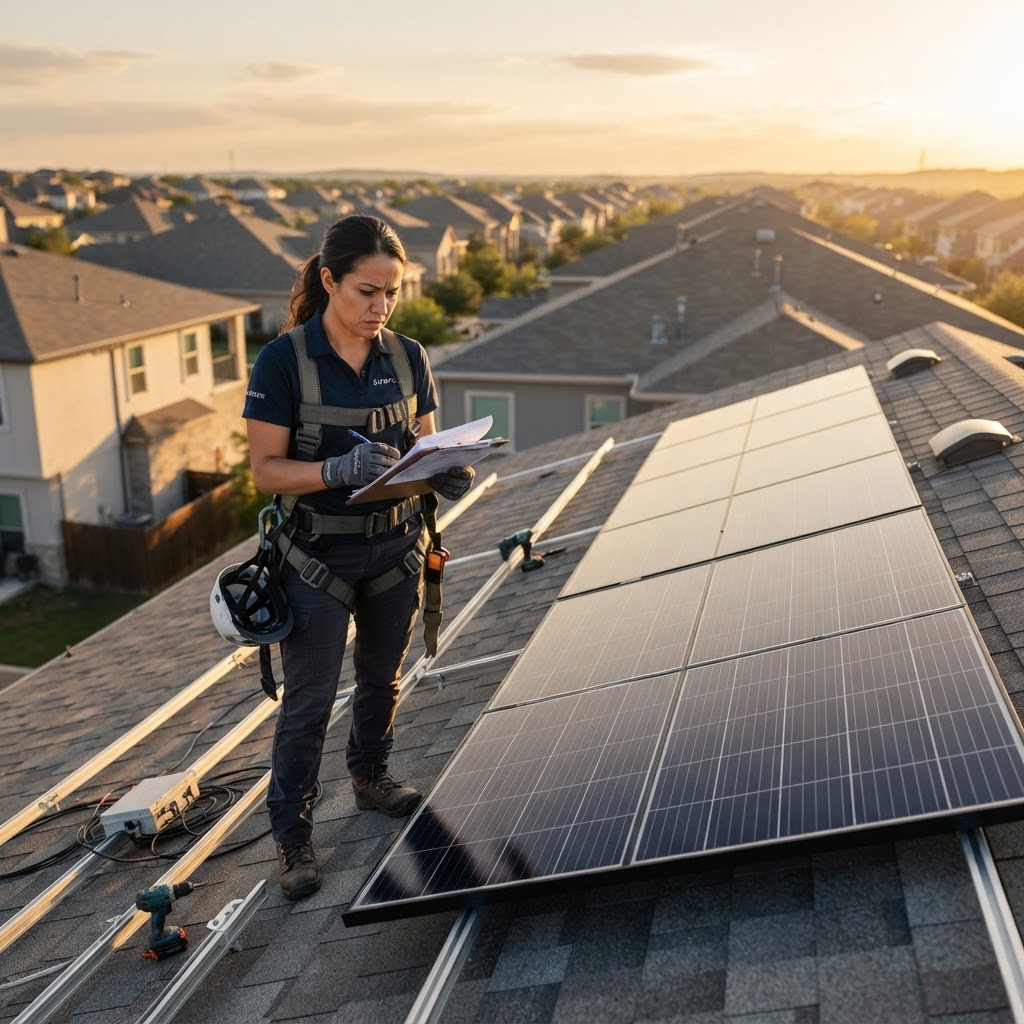
Why California's Nano-Grid Movement Is Outpacing Traditional Solar
Key Takeaways
- California homeowners are moving beyond simple rooftop solar toward integrated nano-grids — solar + battery systems designed for true energy independence.
- As of late 2025, approximately 5.3 million distributed solar and storage systems are installed across the U.S., signaling a structural shift away from centralized utility dependence.
- NEM 3.0, rising wildfire-related outages, and grid congestion are accelerating nano-grid adoption in California faster than anywhere else in the nation.
- AI-driven load balancing and emerging micro-modular reactor (MMR) technology are pushing nano-grids from a backup strategy into a primary energy architecture.
- Independent advisors like Solanano — not tied to any installer or equipment brand — are critical for navigating this rapidly evolving landscape with unbiased, hyperlocal guidance.
The Solar-Only Era Is Over
For most of the last decade, going solar in California meant one thing: mount panels on your roof, tie into the utility grid, and watch your monthly bill shrink. It was a clean, simple value proposition. Then came NEM 3.0.
California's Net Energy Metering 3.0 tariff, which took effect for new applicants in April 2023, slashed the export compensation rate for excess solar energy by roughly 75% compared to NEM 2.0. Overnight, the economics of a panels-only system weakened considerably for most California homeowners. The payback period for solar without storage stretched from 6–8 years under NEM 2.0 to potentially 10 years or more — unless you pair your system with a battery.
That policy shift didn't slow California down. It redirected the state's enormous solar momentum toward something more sophisticated: the residential nano-grid.
What Is a Nano-Grid, Exactly?
A nano-grid is a small-scale, self-contained energy system — typically a single home or small cluster of buildings — that can operate either connected to the utility grid or fully independently. At its core, a residential California nano-grid usually includes:
- Rooftop or ground-mount solar PV sized to household consumption
- Battery storage (Tesla Powerwall, Enphase IQ Battery, Franklin WH, or similar) sized for overnight use and outage resilience
- A smart inverter and energy management system that optimizes self-consumption in real time
- Optional EV charging integration to maximize use of self-generated solar
The key distinction from traditional grid-tied solar is intent. A nano-grid is designed to maximize energy independence, not merely reduce a utility bill. It treats the grid as a backup, not a primary partner.
"The transition to nano-grids is no longer just about solar panels; it is about creating a resilient, intelligent energy ecosystem that can survive the volatility of the traditional grid." — Dr. Elena Vance, Lead Researcher, Distributed Energy Systems Institute
Why California Is the Nation's Nano-Grid Laboratory
California has always been the testing ground for bold energy policy, and 2025 is no different. Several converging forces make the state uniquely primed for nano-grid leadership.
NEM 3.0 Rewrites the Math
Under NEM 3.0, the financial incentive has fundamentally shifted from exporting solar energy to storing and consuming it. Battery storage is no longer optional for an optimized system — it is the economic engine. Solanano's NEM 3.0-aware financial modeling, built on hyperlocal satellite irradiance data and real shade analysis, routinely shows California homeowners that a properly sized nano-grid can still deliver a 7–9 year payback even under the new tariff — but only when the system is designed correctly from the start.
Grid Reliability Is Deteriorating
PG&E's Public Safety Power Shutoffs (PSPS), SCE's rotating outages during heat events, and the systemic strain of California's aging transmission infrastructure have made grid reliability a genuine quality-of-life issue — not just an abstract concern. For homeowners in fire-prone zones of San Bernardino, Riverside, Los Angeles, and the foothills of the Sierra Nevada, a nano-grid is increasingly viewed as essential infrastructure, not a luxury upgrade.
SGIP Makes Battery Storage More Affordable
California's Self-Generation Incentive Program (SGIP) continues to offer meaningful rebates for battery storage, particularly for customers in high fire-threat districts or those who qualify under equity tiers. When SGIP rebates are stacked with the federal 30% Investment Tax Credit (ITC), the cost of adding storage to a solar system drops substantially — often bringing a 10 kWh battery system's net cost below $5,000 after incentives for qualifying customers.
The Numbers Tell the Story
The 2025 U.S. Distributed Solar and Storage Data update confirmed what California energy professionals have been observing on the ground: approximately 5.3 million individual distributed solar and storage systems are now installed across the United States, making 2025 a record-breaking year for decentralized energy system installations. California accounts for a disproportionate share of that growth, driven by the policy environment, high utility rates, and a homeowner base that has demonstrated consistent willingness to invest in energy technology.
"California is the testing ground for the next decade of energy. By moving toward nano-grids, we are effectively decentralizing the risk of blackouts while empowering individual consumers." — Marcus Thorne, Senior Policy Analyst, California Grid Modernization Taskforce
This decentralization isn't just good for individual homeowners. Life cycle assessments published in 2025 indicate that nano-grids integrated with photovoltaic plants carry a more sustainable environmental footprint than equivalent expansions of centralized grid infrastructure — accounting for transmission losses, land use, and material intensity of large-scale utility projects.
AI, Grid Congestion, and the Next Frontier of Nano-Grids
Perhaps the most unexpected driver of nano-grid adoption in California in 2025 is the artificial intelligence industry. The explosive growth of AI data centers — concentrated heavily in Southern California and the Bay Area — is placing unprecedented strain on regional grids. SCE and PG&E have both issued warnings about transmission capacity constraints in key service territories through the late 2020s.
This grid congestion is accelerating a trend already underway: the shift from large-scale utility dependence to localized nano-grid clusters that use AI-driven digital communication for real-time load balancing. Smart home energy management systems can now predict solar generation curves, anticipate household demand spikes, and pre-charge batteries during off-peak hours — all autonomously.
Looking further ahead, NANO Nuclear Energy is actively advancing its KRONOS MMR microreactor program — a micro-modular reactor (MMR) technology designed to provide consistent baseload power at a community or campus scale. While MMR technology is primarily targeting AI data centers and industrial users in its initial commercial phase, the trajectory points toward eventual integration with residential nano-grid clusters, solving solar's fundamental intermittency challenge with a zero-carbon baseload source.
For California homeowners today, this longer arc matters less than the immediate reality: the energy infrastructure around them is becoming less reliable, and the tools to build genuine home energy resilience have never been more accessible or more financially sensible.
What Separates a Good Nano-Grid from a Great One
Not all nano-grids are created equal, and this is where the quality of upfront design and installer selection becomes decisive. Common mistakes include:
- Undersizing battery storage relative to actual overnight consumption and outage duration goals
- Ignoring time-of-use (TOU) rate optimization — critical under NEM 3.0 with utilities like SCE, BWP, and PG&E
- Failing to account for shade from trees, neighboring structures, or seasonal sun angle changes that erode annual production
- Choosing installers based on price alone rather than verified NABCEP certification, licensing, and documented performance track records
This is precisely why Solanano operates as a fully independent advisory and vetting service. With no equipment to sell and no installation crews to deploy, Solanano's only product is objective expertise. The company's four-stage installer qualification process — verifying licensure and insurance, NABCEP certification, project track record, and ongoing performance scoring — ensures that every installer in its network has earned its position on merit, not margin.
Solanano's hyperlocal approach goes further: satellite irradiance modeling and precision shade analysis are applied to each property before any system is sized, and every financial model is built specifically around the homeowner's utility (SCE, PG&E, BWP, or others), rate schedule, and NEM 3.0 eligibility.
The Nano-Grid Philosophy: Independence as a Goal, Not a Bonus
There is a philosophical dimension to the nano-grid movement that purely financial analysis doesn't fully capture. Homeowners who invest in solar plus storage aren't just buying kilowatt-hours — they are buying autonomy. The ability to keep the lights on during a PSPS event, to charge an EV regardless of what the grid is doing at 7 p.m., to look at a utility bill and feel indifferent to it — these are meaningful life quality improvements that resonate deeply in California's current energy climate.
The nano-grid philosophy treats a home's energy system the way a sound financial planner treats a retirement portfolio: diversified, resilient, optimized for the long term, and not dependent on any single institution's continued good behavior.
Bottom Line
Traditional grid-tied solar served California homeowners well for a decade, but the combination of NEM 3.0, deteriorating grid reliability, rising TOU rates, and new battery incentives has moved the financial and practical calculus decisively toward integrated nano-grids. California isn't just adopting this model faster than other states — it is defining what residential energy independence looks like for the rest of the country. The homeowners who act now, with properly designed and vetted systems, will be the ones who are most insulated from whatever grid volatility the next decade delivers.
Ready to find out what a nano-grid could look like for your home? Get a free solar assessment from Solanano — independent advice, no sales pressure, and hyperlocal financial modeling built specifically for your California utility and property.