Solar Loans vs. Leases vs. PPAs: The Numbers Side by Side (2026 Guide)
Last Updated: Q2 2026 | Written for California homeowners navigating the post-ITC solar landscape
Key Takeaways
- The "One Big Beautiful Bill" Act eliminated the Section 25D residential tax credit on January 1, 2026 — permanently changing which financing model wins on paper
- Third-Party Ownership (TPO) models — leases and PPAs — now command 69% of new residential installations, up from 42% in 2024
- Over 25 years, cash purchase delivers the highest net savings ($70,302), but for homeowners who can't or won't pay cash, the gap between a loan and a PPA is now measurably narrower than it was two years ago
- Hidden dealer fees in "buy-down" solar loans can inflate your system cost by $6,000–$8,000 — transparency rules issued in March 2026 are helping, but homeowners still need to read the fine print
- California-specific programs — NEM 3.0, SGIP battery incentives, and SCE/BWP rate structures — dramatically affect which model pencils out best for your specific address
The Rule That Changed Everything: The End of the Residential ITC
Before you compare a single number, you need to understand the regulatory earthquake that reshaped residential solar finance in 2026.
The "One Big Beautiful Bill" Act, which took full effect January 1, 2026, terminated the Section 25D residential tax credit — the 30% federal Investment Tax Credit (ITC) that homeowners could claim when purchasing a solar system outright or through a loan. That single policy change detonated the assumptions behind almost every solar financing comparison published before 2025.
Here's the critical nuance: the 30% ITC didn't disappear. It simply became exclusively available to commercial entities — meaning solar leasing companies and PPA providers can still claim it on your behalf and pass a portion of those savings back to you through lower rates. Individual homeowners buying or financing their own systems can no longer access it directly.
"In 2026, we are seeing the 'TPO Renaissance.' Because homeowners can no longer personally claim the 30% tax credit, the financial math has flipped to favor the PPA model for almost anyone not paying in cash." — Dr. Julian Vane, Senior Energy Analyst, VoltMetrics Group
This is not a minor footnote. It is the foundational context for every number in this article.
The Four Financing Models: A Plain-English Breakdown
💵 Cash Purchase
You pay the full system cost upfront. Simple, clean, maximum long-term value. The ITC loss hurts cash buyers less than loan buyers because the savings calculation was always strongest here — but it does meaningfully reduce the financial advantage over leases and PPAs that cash buyers previously enjoyed.
🏦 Solar Loan
You borrow the full system cost and repay it over time. You own the system. With the ITC now unavailable to individual homeowners, the loan's value proposition is narrower — and the quality of the loan terms matters more than ever.
📋 Solar Lease
A TPO provider owns the system on your roof. You pay a fixed monthly lease payment — typically escalating 1–3% annually — in exchange for the electricity it produces. No ownership, but also no ITC headache.
⚡ Power Purchase Agreement (PPA)
Similar to a lease, but instead of paying for the system, you pay only for the electricity it generates — at a contracted per-kWh rate. In 2026, PPA rates typically run $0.17–$0.27 per kWh for an 8kW system, compared to California's blended utility rates that continue to climb past $0.30/kWh in many SCE and PG&E territories.
The Numbers Side by Side: 25-Year Net Savings
This is the comparison that matters most. Based on 2026 analysis for a typical California residential system:
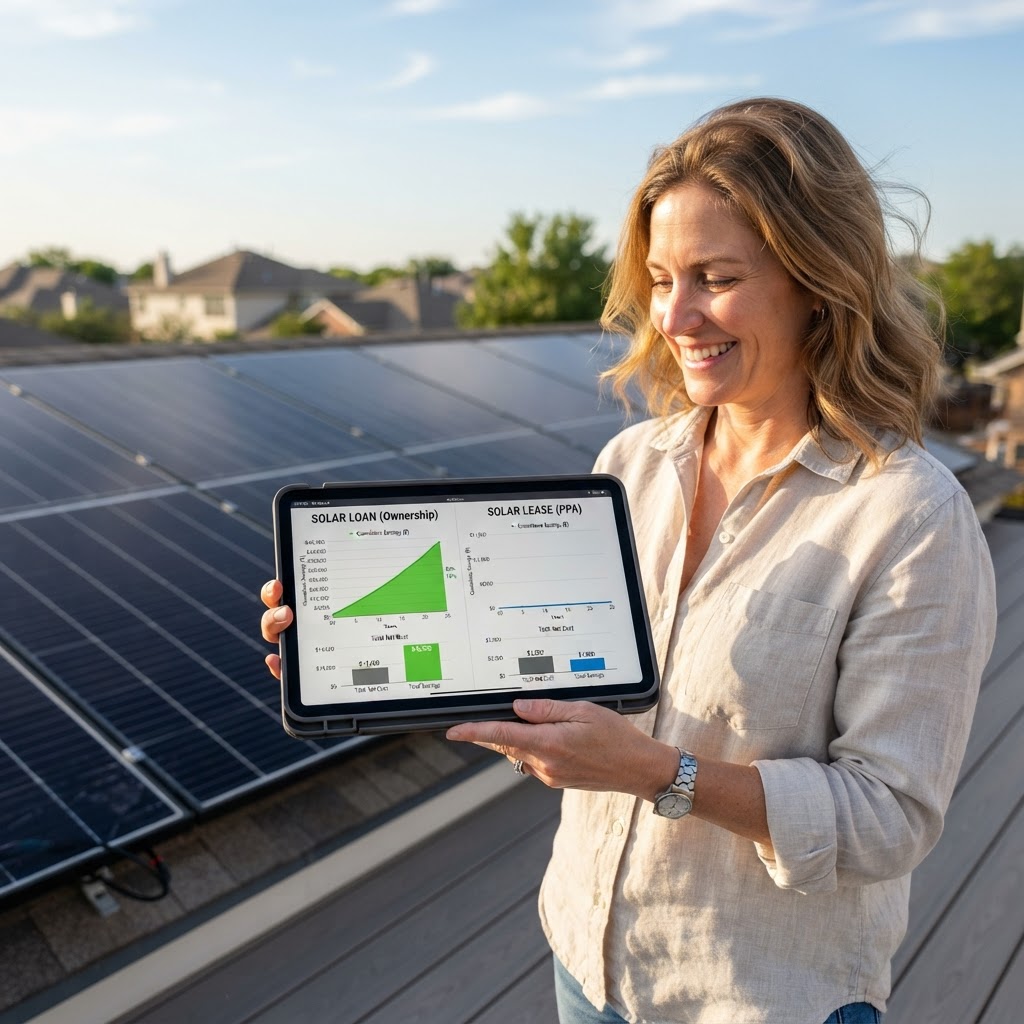
| Financing Model | 25-Year Net Savings | Owns the System? | ITC Benefit? | |---|---|---|---| | Cash Purchase | $70,302 | ✅ Yes | ❌ No longer | | Solar Loan | $59,734 | ✅ Yes | ❌ No longer | | Lease | $31,367 | ❌ No | ✅ Via provider | | Standard PPA | $24,630 | ❌ No | ✅ Via provider |
Source: Green Power Energy 2026 Side-by-Side Analysis
The gap between loan and lease — roughly $28,000 over 25 years — represents the value of ownership. But the gap has narrowed since 2024, and for homeowners who couldn't claim the ITC anyway (due to low tax liability or AMT situations), the real-world delta is often smaller than this table suggests.
The Hidden Cost Killing Solar Loan ROI: Dealer Fees
If you walk away from this article with one actionable insight about solar loans, let it be this: the advertised APR is not the whole story.
For years, lenders offered headline rates of 1.99% or 2.99% using a structure called a "buy-down" loan — where the solar installer paid the lender an upfront fee to subsidize that artificially low rate. The installer recovered that fee by inflating the system price, often by 22–30% of total system cost. On a $35,000 system, that's a hidden markup of $7,700–$10,500.
Federal regulators addressed this in March 2026 by issuing new transparency requirements mandating disclosure of "all-in" APRs — but the rules are new, enforcement is ongoing, and not every lender is fully compliant yet.
Today's honest loan market looks like this:
- Prime borrower APRs: 6.74%–7.75% (2026 market rate)
- Loan terms: Shifting from 25-year to 15–20 year terms to manage lender risk in a post-ITC environment and build homeowner equity faster
- The smart benchmark: A transparent 7% loan with zero dealer fee will often outperform a 3.99% loan with a 25% dealer fee baked into your system price
"The era of the 1.99% 'low-interest' solar loan is effectively over. In the current market, homeowners are realizing that a transparent 7% loan with no dealer fee is actually a better deal than the complex buy-down structures of the previous decade." — Sarah K. Thorne, Director of Residential Strategy, SunPath Financial
One practical implication: in the first five years, a financed loan system requires monthly payments approximately 15–20% higher than your current utility bill — before any tax credit offset that no longer exists. Homeowners need to budget for this breakeven timeline honestly.
Three Trends Reshaping the PPA and Lease Market in 2026
1. The Prepaid PPA: A Compelling Middle Ground
A fast-growing option in 2026, the Prepaid PPA allows homeowners to pay approximately 70% of the system cost upfront — capturing the benefit of the TPO provider's 30% ITC without committing to 20+ years of monthly payments. It's not ownership, but it eliminates ongoing payment risk and can deliver savings closer to the loan model with less financing complexity.
2. Domestic Content Bonus Credit: Up to 12% Lower PPA Rates
Major TPO providers have successfully integrated the 10% Domestic Content Bonus Credit in 2026, applying it to systems built with qualifying U.S.-manufactured components. The result: PPA rates that are up to 12% lower than they would be using imported hardware — a meaningful difference when you're contracting a rate for 20 years.
3. VPP Credits Inside PPA Contracts
California's Virtual Power Plant (VPP) ecosystem is maturing rapidly, and forward-thinking TPO providers are now embedding grid-service credits directly into PPA agreements. Homeowners who allow their battery storage to participate in utility demand-response events receive bill credits that further reduce their effective per-kWh cost. For SCE and SGIP-eligible customers with storage, this can meaningfully tilt the long-term math toward a PPA-plus-battery structure.
What California Homeowners Specifically Need to Model
California isn't just another state when it comes to solar finance — it's a different planet. Variables that don't exist elsewhere include:
- NEM 3.0: California's current net metering rules reward self-consumption and battery storage over simple grid export. This structurally favors systems designed around a nano-grid philosophy — solar paired with batteries — over basic grid-tied systems, regardless of financing model
- SGIP (Self-Generation Incentive Program): California's battery storage rebate can offset $200–$1,000+ per kWh of battery capacity, materially improving the economics of any financing model that includes storage
- Utility-specific rate structures: SCE, PG&E, SDG&E, and smaller utilities like Burbank Water & Power (BWP) have meaningfully different time-of-use rate structures. A PPA rate of $0.21/kWh looks very different against an SCE TOU-D-PRIME customer than it does for a flat-rate customer
- Shade and irradiance: A system underproducing by 15% due to unmodeled shading will underperform every financial projection in this article — making pre-contract satellite shade analysis a non-negotiable step, not an optional one
Which Model Is Right for You? A Decision Framework
Choose Cash if: You have the capital, want maximum 25-year return, and plan to stay in the home long-term. Even without the ITC, cash remains the strongest performer at $70,302 in net savings.
Choose a Loan if: You want to own the system, have strong credit, and can secure a transparent loan with no dealer fee. Prioritize 15–20 year terms and demand an all-in APR disclosure.
Choose a PPA if: Your tax liability is low (making the old ITC less useful anyway), you want predictable energy costs without ownership complexity, or you're interested in VPP credit opportunities. The Domestic Content Bonus makes 2026 PPA rates more competitive than they've ever been.
Choose a Prepaid PPA if: You have significant upfront capital but aren't ready to commit to full ownership or want to capture the TPO's ITC advantage without a long monthly payment obligation.
Bottom Line
The post-ITC solar market has genuinely reshuffled the deck. The right financing model in 2026 depends on your tax profile, your utility territory, your storage plans, and — critically — the quality of the financial modeling you receive before you sign anything. A loan with hidden dealer fees will underperform a PPA. A PPA without shade analysis will underperform its projections. The numbers only work when they're built on honest, hyperlocal data.
Get a free, independent solar assessment from Solanano — including satellite irradiance modeling, NEM 3.0-aware financial projections, and a side-by-side financing comparison built on vetted installer quotes with no conflicts of interest — and know exactly which model wins for your home before you commit to a single dollar.


