How to Verify a Solar Contractor's CSLB License in California (2026 Guide)
Key Takeaways
- Every legitimate solar contractor in California must hold an active CSLB license — specifically a C-46 Solar Contractor classification or a valid B (General Building) license with solar experience.
- You can verify any contractor's license status in minutes using the free CSLB online portal at cslb.ca.gov.
- Always check for active bond status, complaint history, and disciplinary actions — not just whether a license number exists.
- Home Improvement Salesperson (HIS) registration is a separate, often-overlooked requirement that the salesperson who knocks on your door must also carry.
- Unlicensed solar work voids manufacturer warranties, can trigger utility interconnection denials, and leaves you with zero legal recourse.
California has more residential solar installations than any other state in the nation — and, unfortunately, more solar scams. With the ongoing transition to NEM 3.0 reshaping the economics of rooftop solar, homeowners are under pressure to move quickly, lock in favorable rates, and sign contracts before fully vetting who they're hiring. That urgency is exactly what bad actors count on.
The single most powerful thing you can do before signing anything is verify your contractor's license with the California Contractors State License Board (CSLB). It takes less than five minutes. This guide will walk you through exactly how to do it — and what to look for beyond the basic license number.
Why CSLB Licensing Matters More Than Ever in 2026
The CSLB currently manages approximately 285,596 total licensed contractors across California, of which 231,261 hold active licenses and 54,335 are inactive. With a net increase of only 914 new licensed contractors over the trailing 12-month period, the licensed contractor pool is growing slowly — while demand for solar installations continues to surge.
That gap between supply and demand creates fertile ground for unlicensed operators. In 2026, the CSLB has continued its aggressive consumer protection posture, running sting operations targeting unlicensed contractors in regions like Bakersfield and Visalia, and joining a multi-agency state effort to crack down on fraudulent contracting activity. The CSLB Licensing Committee also convened a notable regulatory meeting in April 2026 to address evolving industry standards — a signal that oversight of this space is tightening, not loosening.
"Verifying a CSLB license is the single most important step a homeowner can take to protect their solar investment," says Marcus Thorne, Senior Consumer Advocate at the California Solar Safety Bureau. "If the license isn't active and in the correct classification, you have no recourse if the installation fails."
That's not hyperbole. Without a licensed contractor, you cannot:
- Obtain a valid permit from your local building department
- Pass utility interconnection inspection with SCE, PG&E, LADWP, or BWP
- File a valid complaint with the CSLB if work is defective
- Claim protections under California's contractor bond system
Step 1 — Get the Contractor's CSLB License Number
Before you start any verification, ask every contractor you speak with for their CSLB license number in writing. This should appear on their:
- Business card or company website
- Any written estimate or proposal
- Their vehicle signage (required by California law for contracts over $1,000)
If a contractor hesitates to provide their license number, or gives you one verbally but refuses to put it in writing, treat that as an immediate red flag.
Step 2 — Run the Verification on cslb.ca.gov
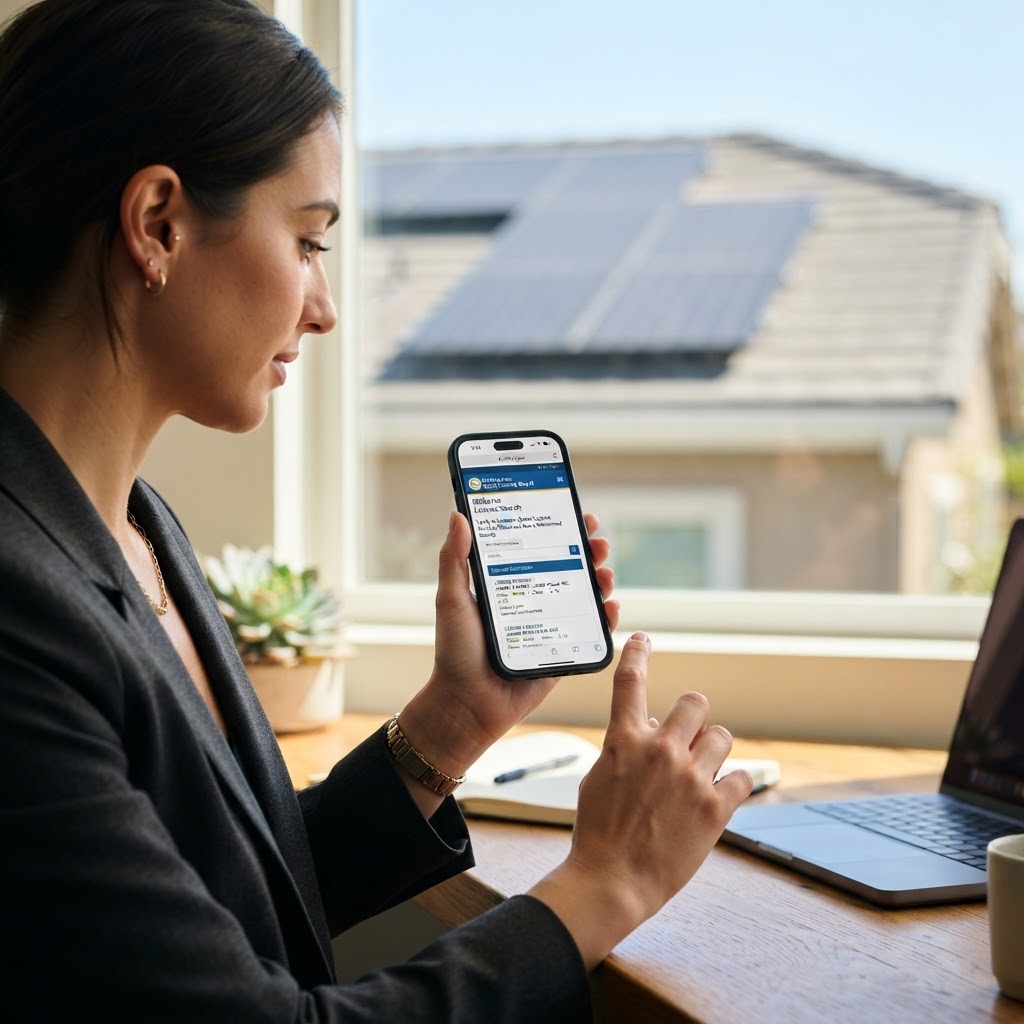
Navigate to cslb.ca.gov and click on "Check a License" from the homepage. Enter the license number and review the results carefully. Here is exactly what you are looking for:
License Status
The status must read "Active." An "Inactive," "Suspended," or "Revoked" license means the contractor cannot legally perform work in California. Do not accept explanations like "it's being renewed" or "there was a paperwork issue" — active means active.
License Classification
The CSLB oversees 45 distinct license classifications. For residential solar, you want to see one of the following:
- C-46 — Solar Contractor: The dedicated classification for solar energy system installation. This is the gold standard.
- B — General Building Contractor: Permitted to perform solar work when solar is not the primary scope, but C-46 is preferable for dedicated solar installers.
- C-10 — Electrical Contractor: Required if significant electrical panel work is involved; often held in addition to C-46.
"We are seeing a shift where savvy homeowners are not just checking for an active license, but are specifically looking for the C-46 classification and checking the bond status on the CSLB portal before any money changes hands," notes Elena Rodriguez, Director of Regulatory Compliance at the Western Renewable Energy Association.
Bond Status
California law requires licensed contractors to carry a contractor's bond — currently set at $25,000. The CSLB portal will display whether the bond is active and its expiration date. New digital verification tools now allow real-time bond status checks, so there's no excuse for not confirming this before signing a contract. An expired bond means you have no financial backstop if the contractor walks off the job or causes damage.
Workers' Compensation Insurance
If the contractor has employees, they must carry active workers' compensation coverage. Verify this on the portal. An on-roof injury at your home without valid workers' comp could expose you to serious personal liability.
Complaint and Disciplinary History
This is where most homeowners stop looking — and where the most important information often lives. The CSLB portal displays any filed complaints, citations, and disciplinary actions on record. A single resolved complaint may not be disqualifying, but a pattern of complaints related to unfinished work, poor installations, or contract disputes is a serious warning sign. Scrutinizing complaint disclosures is now a central focus of the CSLB's "Solar Smart" consumer education initiative.
Step 3 — Verify the Home Improvement Salesperson (HIS) Registration
This is one of the most overlooked verification steps in residential solar. In California, any individual who solicits or sells a home improvement contract — including solar — on behalf of a contractor must be individually registered as a Home Improvement Salesperson (HIS) with the CSLB. This requirement applies to door-to-door solar sales reps, call center closers, and anyone taking signatures on a contract.
You can verify HIS registration directly on the CSLB portal by searching the salesperson's name or registration number. If the person who sold you your solar system was not a registered HIS, the contractor is operating out of compliance — and your contract may be voidable under California law.
Step 4 — Cross-Check with NABCEP Certification
A CSLB license confirms legal authorization to work. NABCEP (North American Board of Certified Energy Practitioners) certification confirms technical competency. These are two different things, and the best solar professionals carry both.
Look for the NABCEP PV Installation Professional (PVIP) credential, which requires documented field experience, passing a rigorous technical exam, and ongoing continuing education. You can verify NABCEP credentials at nabcep.org/find-a-certified-professional.
Contractors who hold both an active C-46 license and current NABCEP certification represent the highest tier of verified professionals operating in California today.
What to Do If Something Doesn't Check Out
If a license comes back inactive, or the classification doesn't match, or you find an unexplained complaint history — stop. Do not proceed. Do not sign. Do not pay a deposit.
Your options include:
- Request clarification in writing and give the contractor 48 hours to provide documentation resolving the discrepancy
- File a complaint with the CSLB at cslb.ca.gov if you believe you've been misled about licensing status
- Contact the California Attorney General's office if you suspect active fraud
- Move on to a different contractor — this is always your simplest and safest option
Why Independent Vetting Changes the Equation
Most homeowners go through this verification process alone, under time pressure, without knowing exactly what they're looking for. That's why Solanano built its 4-stage installer qualification process specifically around these checkpoints — license and insurance verification, NABCEP credentialing, track record analysis, and ongoing performance scoring.
Because Solanano is completely independent — not selling equipment, not earning installation commissions — every recommendation is built purely on verified merit. Combined with hyperlocal satellite irradiance modeling, shade analysis, and NEM 3.0-aware financial modeling calibrated for California utilities including SCE, BWP, and PG&E, Solanano gives homeowners the full picture before a single contract is signed.
Bottom Line
Verifying a CSLB license is not optional, and it's not complicated — but it does require knowing what to look for beyond a simple license number. Check that the status is active, confirm the C-46 classification, validate the bond, review complaint history, and don't forget to verify the salesperson's HIS registration. Then cross-reference with NABCEP. Five minutes of verification can save you from a five-figure nightmare.
Ready to skip the guesswork entirely? Get a free solar assessment from Solanano and let our independent experts match you with a fully vetted, California-licensed solar professional — no pressure, no conflict of interest, just the right installer for your home.