The Rise of Community Solar: What It Means If Your Roof Isn't Suitable
By the Solanano Editorial Team | Updated July 2026
Key Takeaways
- Nearly 42% of U.S. households cannot host rooftop solar due to shading, structural issues, or renter status — community solar exists specifically to serve them.
- U.S. cumulative community solar capacity surpassed 10.1 GWdc in Q4 2025, and the market is projected to grow another 12% in 2026.
- California's newly finalized Community Renewable Energy (CRE) Program opens meaningful bill-relief pathways for renters and multifamily residents for the first time.
- Modern community solar is evolving fast: battery storage pairing, subscription portability, and agrivoltaic land use are redefining what the product looks like in 2026.
- If your roof is suitable, rooftop solar with battery storage still delivers superior long-term economics — but community solar is a legitimate, valuable alternative for everyone else.
The Roof Problem Is Bigger Than You Think
For years, solar's promise came with an asterisk: if you own the right kind of roof. Steep shading from nearby trees, south-facing orientation requirements, aging tile or flat-roof structures, HOA restrictions, and — most significantly — renter status have quietly locked millions of households out of the clean energy transition.
The numbers are striking. According to NREL's Sharing the Sun 2026 report, approximately 42% of U.S. households and 44% of businesses are unable to host traditional rooftop solar. That's not a fringe edge case. That's nearly half of the country sitting on the sidelines while electricity bills climb.
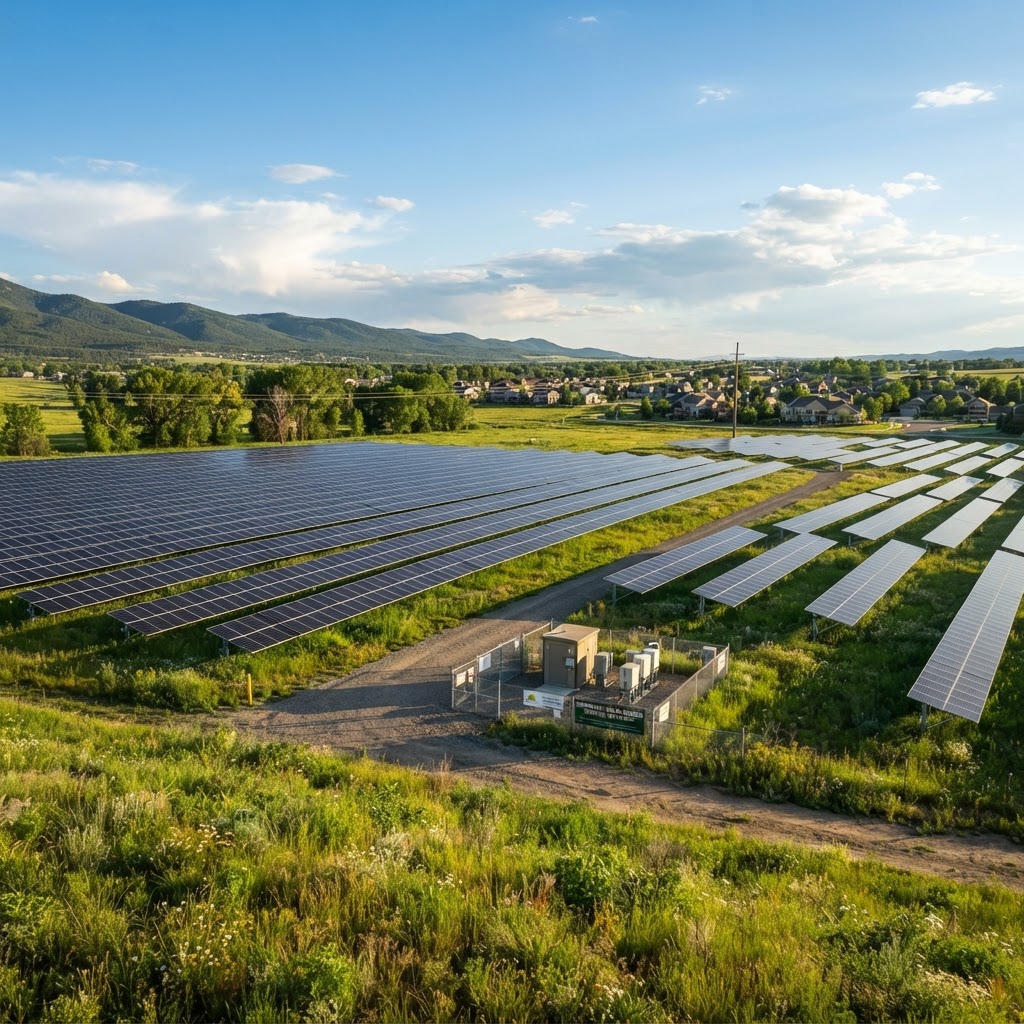
Community solar — sometimes called "solar gardens" or shared solar — was built to solve exactly this problem. Instead of panels on your roof, you subscribe to a share of a larger, offsite solar array. The electricity that array generates flows to the grid, and your utility bill receives a proportional credit. No installation. No roof assessment. No long-term equipment ownership headaches.
How Big Has This Market Actually Gotten?
The short answer: very big, very fast.
According to Wood Mackenzie and SEIA data, cumulative U.S. community solar capacity officially crossed 10.1 GWdc in Q4 2025 — a milestone that would have seemed ambitious just five years ago. To put that in perspective, 10 GWdc is enough to power approximately 1.9 million average American homes.
The market did experience turbulence in 2025. A 25% contraction hit mature markets like New York and Maine, largely due to market saturation and interconnection bottlenecks rather than weakening demand. But Wood Mackenzie's Q2 2026 analysis projects a 12% rebound in new installations through the remainder of the year as pipeline projects clear regulatory queues and new states step in to fill capacity.
New York is an instructive case study. Despite the 2025 slowdown, state officials confirmed in early 2026 that solar now accounts for 6.56% of New York's total electricity generation — a figure driven substantially by upstate community-scale solar gardens. The infrastructure is built. The model works.
Meanwhile, SEIA's July 2026 data shows that solar and storage combined provided 91% of all new U.S. electricity-generating capacity added in Q1 2026. Community solar is a major reason that number is as high as it is.
What's Happening in California Right Now
California has historically lagged behind states like New York, Maryland, and Minnesota in community solar deployment — a gap driven largely by utility resistance and regulatory complexity. That is beginning to change in a meaningful way.
In June 2026, the California Public Utilities Commission (CPUC) finalized implementation rules for the new Community Renewable Energy (CRE) Program, specifically designed to deliver bill relief to renters and multifamily housing residents. This is a pivotal development for a state where roughly 45% of residents rent their homes and have historically had no viable path to solar savings.
The CRE Program is still in its early rollout phase, which means the details — which utilities are participating, how credits appear on bills, income-qualification thresholds — are still becoming clear. At Solanano, we're monitoring this closely because California's layered utility landscape (PG&E, SCE, SDG&E, plus community choice aggregators and municipal utilities like BWP) means the fine print will vary significantly by where you live. This is exactly the kind of hyperlocal complexity that requires careful navigation.
One important note for California homeowners who do have suitable roofs: NEM 3.0 fundamentally changed the calculus of rooftop solar economics in the state. The shift to avoided-cost export rates makes battery storage nearly essential to maximize returns. Community solar, by contrast, sidesteps NEM 3.0 export rate issues entirely — credits are calculated at the project level, not your individual meter. For some Californians, that's actually a feature, not a limitation.
The Equity Dimension: Who Community Solar Is Really For
The conversation around community solar has matured well beyond early-adopter enthusiasm. As Marcus Thorne, Director of Policy at the National Community Solar Partnership, put it:
"Community solar is no longer a niche product for early adopters; it is the primary engine for energy equity in the 2026 landscape, finally giving renters the same economic benefits as homeowners."
The equity stakes are significant. The now-terminated federal "Solar for All" program — a $7 billion initiative intended to fund solar connections for 900,000 low-income households — was cancelled in 2025, prompting a federal lawsuit by a coalition of 23 states against the EPA in 2026. That legal battle is ongoing, and its outcome will shape federal low-income solar policy for years.
In the interim, state-level programs are picking up the slack — and some are setting a high bar. Maryland Governor Wes Moore announced $43 million in funding for 69 new community solar projects in June 2026, with requirements that developers deliver at least 15% of project capacity to low-income households and guarantee a minimum 12% reduction in electricity bills for those subscribers. That's a meaningful, enforceable consumer protection standard.
California's CRE Program is expected to incorporate similar income-targeting provisions, though final income thresholds and savings guarantee requirements are still being published as of this writing.
The 2026 Community Solar Product Is Not What You Remember
If your mental image of community solar is a simple "pay a subscription, get a credit" transaction, the 2026 product has evolved considerably. Here's what's actually new:
-
Dispatchable community solar with battery storage: New projects are increasingly pairing large-scale battery systems with solar arrays. This means the community solar project can dispatch stored energy during evening peak hours — when grid electricity is most expensive under time-of-use rates — rather than only generating mid-day credits that may be worth less to subscribers.
-
Consolidated billing: A persistent friction point has been the two-bill problem — one from your utility, one from your community solar provider. More utilities are now adopting single-bill systems where credits appear directly on your standard utility statement. This dramatically simplifies the subscriber experience and reduces churn.
-
Subscription portability: This is a genuine game-changer for renters. 2026 market standards now allow subscribers to maintain their community solar subscriptions when they move, provided they stay within the same utility territory. You're no longer locked into a subscription tied to a specific address — you're subscribed to a share of a project, period.
-
Agrivoltaics: Community solar farms are increasingly being developed alongside active agriculture — pollinator-friendly wildflower habitats, sheep grazing between panel rows, vegetable cultivation under elevated arrays. This dual land-use approach is helping projects overcome rural opposition and deliver genuine biodiversity co-benefits beyond the energy output.
As Dr. Elena Vance, Lead Energy Analyst at the CleanGrid Institute, observed:
"The paradigm has officially shifted from 'solar on every roof' to 'solar for every utility bill.' By 2026, the roof-suitability barrier has effectively been dismantled by the scale of community-shared assets."
Community Solar vs. Rooftop Solar: How to Think About the Choice
These two pathways are not competing products — they serve genuinely different situations. Here's a practical framework:
Community solar makes sense if you:
- Rent your home or apartment
- Own a home with significant shading, north-facing roof sections, or structural limitations
- Want clean energy savings with no upfront capital commitment
- Are in a multifamily building where rooftop installation is logistically impractical
- Plan to move within the next few years and don't want to manage an installed system sale
Rooftop solar (with storage) makes sense if you:
- Own your home with a structurally sound, well-oriented roof
- Want to maximize long-term energy independence and resilience
- Are prepared to optimize your system design for NEM 3.0 economics
- Value the grid-independence benefits of a home battery system during outages
- Want to build equity in a fixed asset that increases home value
The Solanano nano-grid philosophy — solar plus battery storage as a path to genuine energy resilience — applies specifically to that second category. A properly designed rooftop system with storage gives you something a community solar subscription fundamentally cannot: the ability to keep your lights on when the grid goes down. In wildfire-prone California, that's not a theoretical benefit.
Bottom Line
Community solar has grown from a well-intentioned policy experiment into a mature, rapidly innovating industry that is solving a real problem for nearly half of American households. California's CRE Program, subscription portability standards, battery-paired projects, and a renewed equity focus are making the 2026 product genuinely compelling — particularly for renters and multifamily residents who have been waiting years for a fair path into clean energy economics.
If your roof isn't suitable, community solar deserves serious consideration. And if your roof is suitable, the calculus of rooftop solar in the NEM 3.0 era is more nuanced than ever — which is exactly the kind of analysis that requires independent, conflict-free expertise.
Get a free solar assessment from Solanano — whether you're exploring community solar eligibility, evaluating rooftop solar under NEM 3.0, or just trying to understand what your options actually are, our team provides independent guidance with no equipment to sell and no installer commissions influencing the advice.


