The Rise of Community Solar: What It Means If Your Roof Isn't Suitable
Key Takeaways
- U.S. community solar capacity crossed the 10 gigawatt milestone in late 2025, with 12% growth projected for 2026.
- Nearly 44% of U.S. households cannot install rooftop solar — community solar is their primary clean energy pathway.
- 25 states plus Washington D.C. now have enabling legislation for third-party community solar programs.
- Major 2026 legislation in New Jersey, Virginia, and Montana is reshaping access, equity, and program structure.
- Emerging trends like consolidated billing, battery storage integration, and agrivoltaics are making community solar smarter and more accessible than ever.
The Rooftop Problem Nobody Talks About Enough
You want to go solar. You've done the research, you understand the long-term savings, and you're ready to cut your dependence on fossil fuels. Then reality hits: your roof faces the wrong direction, you rent your apartment, your HOA restricts panel installation, or your rooftop is simply too shaded or structurally compromised to support a solar array.
You are far from alone.
According to the latest industry data, approximately 44% of U.S. households and 42% of businesses are currently unable to install rooftop solar. That's not a fringe minority — that's almost half the country locked out of the most celebrated clean energy transition in a generation.
Community solar exists to close that gap. And in 2026, it has never been more capable of doing so.
What Exactly Is Community Solar?
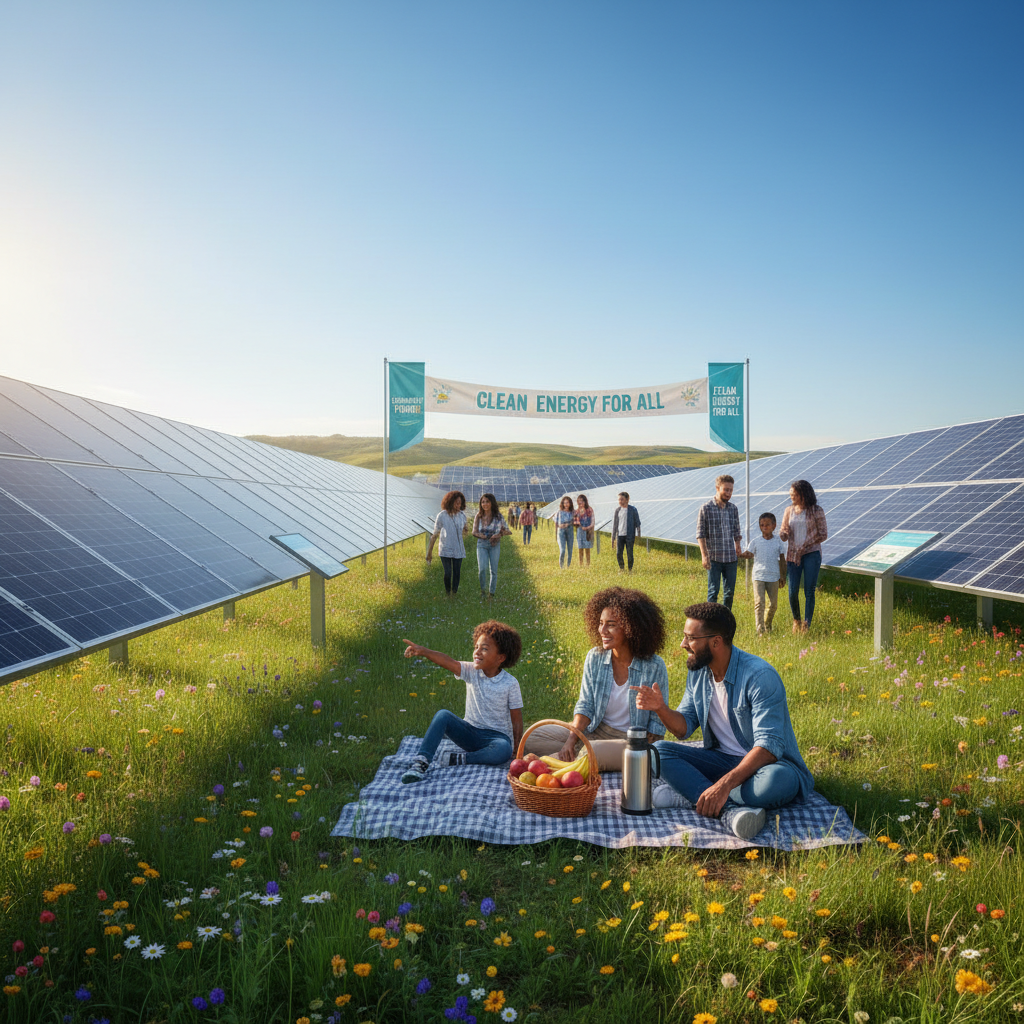
Community solar — sometimes called a solar garden or shared solar — is a model where a large solar array is installed off-site, typically on open land, a commercial rooftop, or agricultural property. Subscribers — homeowners, renters, businesses, and nonprofits alike — purchase or lease a share of that array's output and receive credits on their utility bill that offset their electricity costs.
You don't need to own your home. You don't need a south-facing roof. You don't even need to live near the installation. All you need is a utility account in an eligible service territory.
It sounds simple because, increasingly, it is.
"Community solar is the primary bridge to energy equity; by 2026, it has become a necessary financial hedge for the millions of Americans who rent or have unsuitable roofs." — Dr. Aris Thorne, Lead Researcher at the Urban Energy Equity Institute
The Numbers Tell a Powerful Story
The scale of community solar's growth in the United States is difficult to overstate. In late 2025, cumulative U.S. community solar capacity officially surpassed 10.1 gigawatts (GWdc) — a landmark milestone that reflects more than a decade of policy wins, market development, and consumer demand.
After a temporary contraction in mature markets like New York during 2025 — largely the result of interconnection delays and market saturation — the sector is rebounding. National community solar installations are projected to grow by 12% in 2026, fueled by fresh legislation, new market entrants, and a surging demand for electricity driven by AI data center expansions across the Sun Belt and Mid-Atlantic regions.
To meet that demand, developers are increasingly turning to community-scale assets up to 20 MWdc — larger than the traditional 5 MW garden but still distributed enough to qualify for shared solar frameworks. This isn't just a technical adjustment; it's a philosophical one, signaling that decentralized power is scaling up to meet 21st-century electricity loads.
The 2026 Legislative Wave: State-by-State Momentum
If you want to understand where community solar is heading, watch the statehouses. The policy momentum in early 2026 has been extraordinary.
New Jersey: A $3 Gigawatt Equity Commitment
In March 2026, the New Jersey Board of Public Utilities approved a record-breaking 3 GW expansion of its Community Solar Energy Program (CSEP), with a specific mandate to prioritize low-income and environmental justice communities. This isn't just capacity growth — it comes with teeth. Low-income households enrolled in CSEP programs are now guaranteed utility bill discounts of 20% to 25%, ensuring that the people who stand to benefit most from energy cost relief are the ones who receive it.
Virginia: Raising the Cap and Consolidating Billing
In April 2026, Virginia's Governor signed bills SB 254 and SB 255, raising the state's community solar cap to 725 MW and — crucially — mandating consolidated billing for all providers. This means subscribers across Virginia will now receive their solar credits and utility charges on a single monthly statement, eliminating one of the most common friction points that has historically deterred participation.
Montana: The Solar Shares Act Goes Live
Montana's Solar Shares Act (S.B. 188) reached full implementation in 2025, legalizing community solar facilities up to 5 MW for third-party ownership. For a state not traditionally associated with progressive clean energy policy, this represents a meaningful shift — and opens the door to rural and agricultural solar development across Big Sky Country.
Pennsylvania and Michigan: The "Plug-In Solar" Frontier
Perhaps the most forward-thinking development of 2026 is the introduction of "Plug-in Solar" bills in Pennsylvania and Michigan in early 2026. These proposals would allow renters to use DIY balcony solar kits — small, portable panels that plug into a standard outlet — in conjunction with community solar credits. It's a hybrid model that bridges individual empowerment with shared infrastructure, and it could fundamentally change what solar access looks like in dense urban environments.
"The 2026 legislative wave proves that decentralized power is no longer a pilot project. We are seeing a fundamental shift where solar access is becoming a portable consumer right." — Elena Rodriguez, VP of Strategy at GridConnect Systems
Key Trends Reshaping Community Solar in 2026
The policy environment is only part of the story. On the technical and market side, several converging trends are making community solar more efficient, more equitable, and more economically compelling.
1. Consolidated Billing Is Becoming the Standard
One of the historic barriers to community solar adoption has been the complexity of managing two separate billing relationships — one with your utility, one with your solar provider. The mass adoption of consolidated billing is solving this. Subscribers now increasingly receive a single statement that integrates solar credits directly into their monthly utility bill. Virginia's legislative mandate is just one example of states codifying what the market was already demanding.
2. Battery Storage Integration for Smarter Grids
Leading community solar developers are now pairing their arrays with 4-hour battery storage systems, allowing projects to store surplus daytime generation and dispatch it during evening peak demand periods. This not only maximizes subscriber value — it turns community solar arrays into active grid assets capable of peak shaving and frequency regulation. As summer heat waves drive electricity demand to record highs, this storage-integrated model is rapidly becoming best practice.
3. Agrivoltaics: Farming and Solar on the Same Land
Dual-use land development — known as agrivoltaics — is one of the most exciting frontiers in community solar. By installing solar panels above crops, grazing land, or pollinator habitats, developers can generate clean energy while preserving agricultural productivity. In many cases, the shade provided by panels actually reduces crop water stress, improving yields. The U.S. market for solar-integrated farming is projected to hit $721 million by 2031, and community solar developers are increasingly incorporating agrivoltaic designs into their project pipelines.
4. Community-Scale Sizing to Meet AI-Driven Demand
The explosion of AI data centers — facilities that consume extraordinary amounts of electricity around the clock — is creating new demand signals that community solar is uniquely positioned to serve. Developers are scaling projects toward the 20 MWdc range, large enough to sign meaningful off-take agreements with data center operators and utilities while still qualifying under shared solar regulatory frameworks. This commercial demand is, counterintuitively, creating more capital and more capacity that ultimately benefits residential subscribers too.
Is Community Solar Right for You?
If your roof is unsuitable, you rent your home, or you've simply been waiting for a solar option that doesn't require a major home modification, here's what to consider:
- Check state eligibility. As of Q1 2026, 25 states plus Washington D.C. have enacted enabling legislation. If you live in one of these states, you almost certainly have access to at least one community solar program.
- Understand your subscription model. Most programs offer either a fixed monthly subscription or a per-kilowatt-hour credit rate. Compare both against your current utility rate to model your actual savings.
- Ask about low-income qualifications. Programs like New Jersey's CSEP offer guaranteed discounts of 20–25% for qualifying households. Income-qualified tiers exist in many states and are worth investigating.
- Look for consolidated billing. Choose a provider that offers a single bill integration if available in your state — it dramatically simplifies the subscriber experience.
- Confirm contract length and portability. Most community solar subscriptions run 10–25 years, but reputable providers offer transfer or cancellation options if you move within the same utility service territory.
Bottom Line
Community solar has graduated from a promising experiment to a foundational pillar of America's clean energy infrastructure. With 10.1 gigawatts of cumulative capacity, legislation advancing across the country, and innovations like battery storage and agrivoltaics raising the value proposition for every subscriber, 2026 represents a genuine inflection point. For the nearly half of American households and businesses that cannot access rooftop solar, this is not an alternative pathway — it is the pathway. Whether you're a renter in Newark, a farmer in Montana, or a small business owner in Virginia, the community solar market is actively building a program designed for you.
Ready to explore your solar options — rooftop or community? Get a free solar proposal today and find out which program delivers the best savings for your specific situation.


