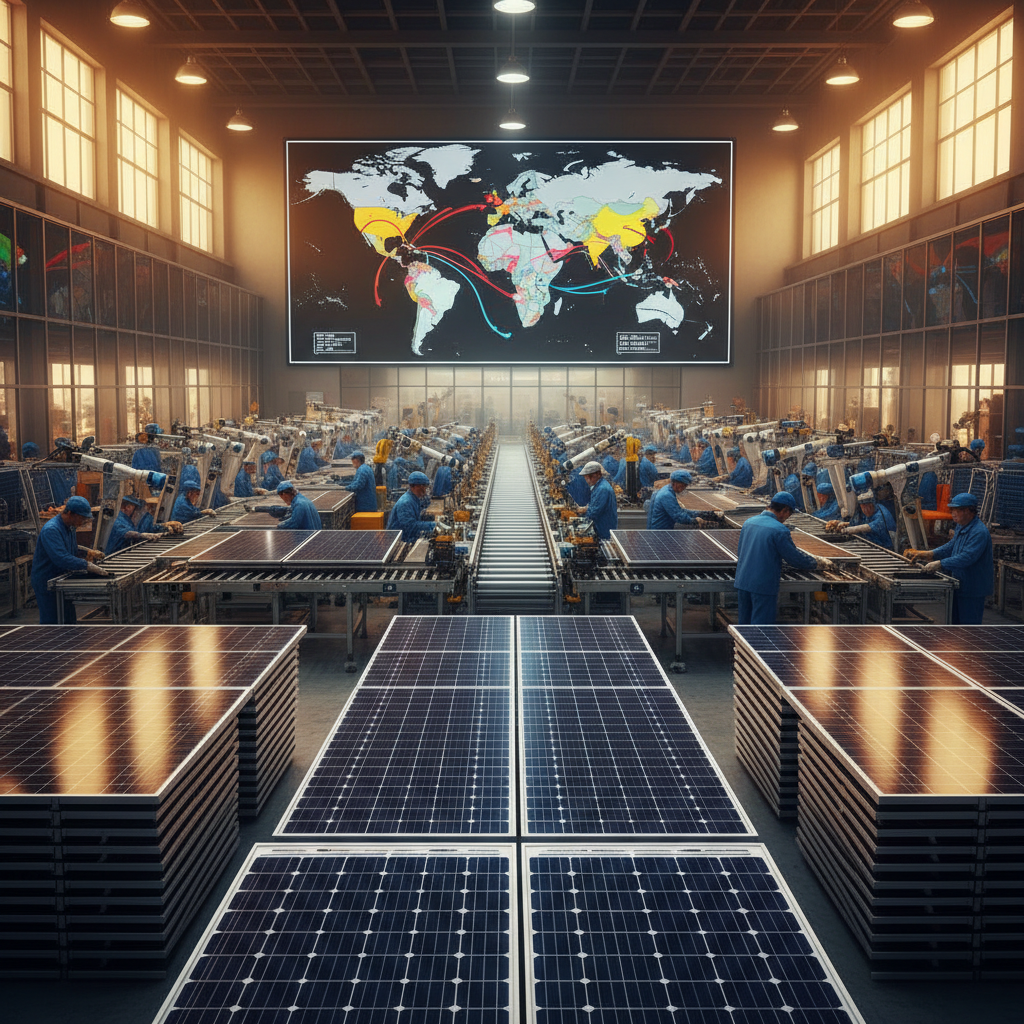
China's New Panel Tariffs and What They Mean for US Solar Prices in 2026
Last Updated: April 2026 | Reading Time: ~7 minutes
Key Takeaways
- US solar module prices rose to $0.28/watt in Q1 2026, up from $0.25 in early 2025, as new trade enforcement layers stack on top of one another.
- Section 301 tariffs on Chinese solar cells, wafers, and polysilicon are locked in at 50%, with new antidumping duties targeting India, Indonesia, and Laos closing historic loopholes.
- Domestic manufacturing capacity has exploded to 65 GW, a 700% surge since 2022 — but a critical cell-production bottleneck threatens to slow further progress.
- Modules with US-made cells now command $0.46/watt, nearly double the fully imported equivalent, creating a bifurcated pricing market with profound implications for project economics.
- 86 GW of new utility-scale solar and battery storage is still projected to come online in 2026 — proving the industry is adapting, not retreating.
The Trade Policy Earthquake Reshaping US Solar
The US solar industry in 2026 is not operating in the same tariff environment it navigated just 18 months ago. What began as targeted Section 301 duties on Chinese-origin goods has evolved into a comprehensive, multi-layered trade enforcement architecture — one that is simultaneously accelerating domestic manufacturing and complicating near-term project costs for developers.
At the center of this transformation are China's deeply embedded solar supply chains. For more than a decade, Chinese manufacturers supplied the world with extraordinarily cheap panels, often by routing production through third countries in Southeast Asia. That era is now definitively ending, and the ripple effects are landing directly on US solar pricing, project timelines, and investment strategies.
Understanding what these tariffs actually mean — for utility-scale developers, commercial installers, and residential homeowners — requires cutting through the noise and looking at the hard numbers.
Breaking Down the Current Tariff Landscape
The trade enforcement environment facing US solar importers in 2026 is arguably the most complex in the industry's history. Here's what's actually in effect:
Section 301 Tariffs on Chinese Goods
- Solar cells, wafers, and polysilicon from China face a steady 50% tariff, implemented through 2025 actions and showing no signs of rollback.
- These duties were specifically designed to target upstream components — the critical building blocks that Chinese manufacturers had long dominated.
The Section 122 Import Duty
- In February 2026, a 10% broad-based import duty (the so-called "Section 122" duty) replaced the previous reciprocal tariff regime after legal challenges successfully dismantled the IEEPA-based emergency orders.
- This floor-level duty now applies across a wide range of solar imports, adding baseline cost pressure even on supply chains that had largely decoupled from China.
New Antidumping Determinations: The "Whack-a-Mole" Crackdown
- On April 21, 2026, the US Department of Commerce released preliminary antidumping (AD) determinations targeting solar imports from India, Indonesia, and Laos — the three countries that had become primary beneficiaries of Chinese supply chain migration.
- Preliminary countervailing duty (CVD) rates are staggering: as high as 125.87% for Indian imports and 143.30% for Indonesian imports.
- Commerce officials explicitly framed these actions as targeting "whack-a-mole" sourcing shifts — a direct acknowledgment that enforcement is now designed to follow Chinese capital, not just Chinese geography.
The cumulative effect of these overlapping duties is a fundamentally repriced import market. Projects that underwrote their economics on sub-$0.25/watt modules in late 2024 are now navigating a structurally different cost environment.
What's Happening to US Solar Panel Prices Right Now
The pricing data tells a clear story: median US solar module pricing reached $0.28 per watt in Q1 2026, up from $0.25 in early 2025. That 12% increase, while modest in isolation, represents the leading edge of a larger repricing cycle as tariff enforcement convergence works its way through supply chains.
But the more consequential story is the bifurcation happening within the market itself:
- Fully domestic modules (assembled in the US using domestically produced cells): ~$0.46/watt
- US-assembled modules with imported cells: ~$0.36/watt
- Imported modules (subject to full tariff stacks): increasingly difficult to source competitively at any price point
This spread isn't just a pricing curiosity — it reflects the federal tax credit architecture baked into the Inflation Reduction Act. Projects that can document domestic content (including US-made cells) qualify for bonus Investment Tax Credit (ITC) adders that can meaningfully offset the premium. For utility-scale developers, the math increasingly favors paying up for fully domestic supply chains.
The Manufacturing Boom — and Its Critical Bottleneck
The domestic manufacturing numbers are genuinely remarkable. US module assembly capacity has surged to 65 GW in early 2026, representing a 700% increase from 2022 levels — a manufacturing expansion that would have seemed implausible just five years ago.
As SEIA President and CEO Abigail Ross Hopper put it: "This growth is a testament to the power of American innovation. We're building factories, hiring American workers, and showing that solar energy means made-in-America energy."
The headline capacity number, however, obscures a critical vulnerability upstream. Domestic solar cell production capacity sits at only 3.2 GW — a fraction of the 65 GW module assembly base. The US can assemble panels at world-class scale, but it remains almost entirely dependent on imported cells to feed those assembly lines.
This gap has profound implications:
- IRA Domestic Content bonus credits require US-made cells to qualify at the highest tier — meaning the 3.2 GW of cell capacity is heavily oversubscribed.
- FEOC (Foreign Entity of Concern) compliance rules are tightening rapidly, forcing developers to demonstrate that cells and wafers don't trace back to Chinese-owned entities anywhere in the supply chain — even when manufactured in third countries.
- Developers are shifting procurement strategies from simple module sourcing to securing long-term cell and wafer supply agreements, a fundamental change in how the industry approaches project finance.
As trade attorney Tim Brightbill, lead counsel for the American Alliance for Solar Manufacturing Trade Committee, argued: "If we want to have the manufacturing here, we have to have the cell manufacturing here, because that's the most difficult step and where the innovation happens."
One facility that may change this equation: Qcells has confirmed its Cartersville, Georgia plant is on track to become the first fully integrated US manufacturing site — covering ingots, wafers, cells, and modules — by late 2026. If that timeline holds, it represents a genuine inflection point for domestic supply chain credibility.
Upstream Migration: How Developers Are Adapting
The strategic response from project developers and EPCs has been rapid and telling:
- Long-term cell supply agreements are becoming as important as module procurement contracts — developers are locking in domestic cell supply years in advance.
- Supplier due diligence has expanded to include full supply chain mapping for FEOC compliance, adding legal and logistical complexity to procurement processes.
- Technology standardization is accelerating: the price gap between mature Mono PERC and high-efficiency TOPCon modules has nearly disappeared as the industry consolidates around newer architectures, removing one traditional variable from procurement decisions.
- Project finance models are being restructured to account for ITC adder eligibility as a core underwriting assumption, not an upside scenario.
The EIA's April 2026 projections suggest this adaptation is working: 86 GW of new utility-scale solar and battery storage capacity is forecast to be added to the US grid this year — a figure that would represent a record-breaking deployment year even in the face of significant cost headwinds.
What This Means for Residential and Commercial Solar Buyers
For homeowners and commercial buyers evaluating solar today, the tariff landscape translates into several practical realities:
- Panel prices are higher than their 2024 lows, but the cost of a complete solar installation remains historically competitive when accounting for ITC credits, net metering, and declining soft costs.
- Ask your installer about module origin: fully domestic modules may qualify for higher ITC adders that your installer can factor into project financing.
- Don't wait for prices to fall back to 2024 levels — the structural repricing driven by tariff enforcement is unlikely to reverse, and utility rates continue to climb.
- Battery storage economics remain compelling: with 86 GW of combined solar-plus-storage projected for 2026 deployment, battery costs are benefiting from continued scale and competition.
The Bottom Line
The tariff regime reshaping US solar in 2026 is not a temporary disruption — it is a deliberate, bipartisan industrial policy designed to rebuild a domestic supply chain that was systematically offshored over two decades. The short-term cost is real: module prices are up, procurement is more complex, and developers face a genuinely bifurcated market where the premium for domestic content can approach 30% or more.
But the long-term trajectory is becoming clearer. With 65 GW of module capacity already established, the first fully integrated US manufacturing facility coming online later this year, and enforcement mechanisms finally sophisticated enough to close the "whack-a-mole" loopholes that allowed Chinese supply chains to reroute through Southeast Asia, the foundations of a credible domestic solar industry are being laid in real time.
The cell manufacturing bottleneck remains the single most important challenge to address — and the policy, investment, and legal communities all appear to understand it. The next 24 months will determine whether the US can close that gap before trade enforcement costs create significant drag on deployment targets.
For now, solar remains one of the most cost-effective energy investments available to American homeowners and businesses — and locking in today's pricing and incentives is still a sound decision before the next wave of policy adjustments arrives.
Ready to see what solar actually costs for your home or business in today's market? Get a free, no-obligation solar proposal and find out exactly what you'd save — tariffs, incentives, and all.


