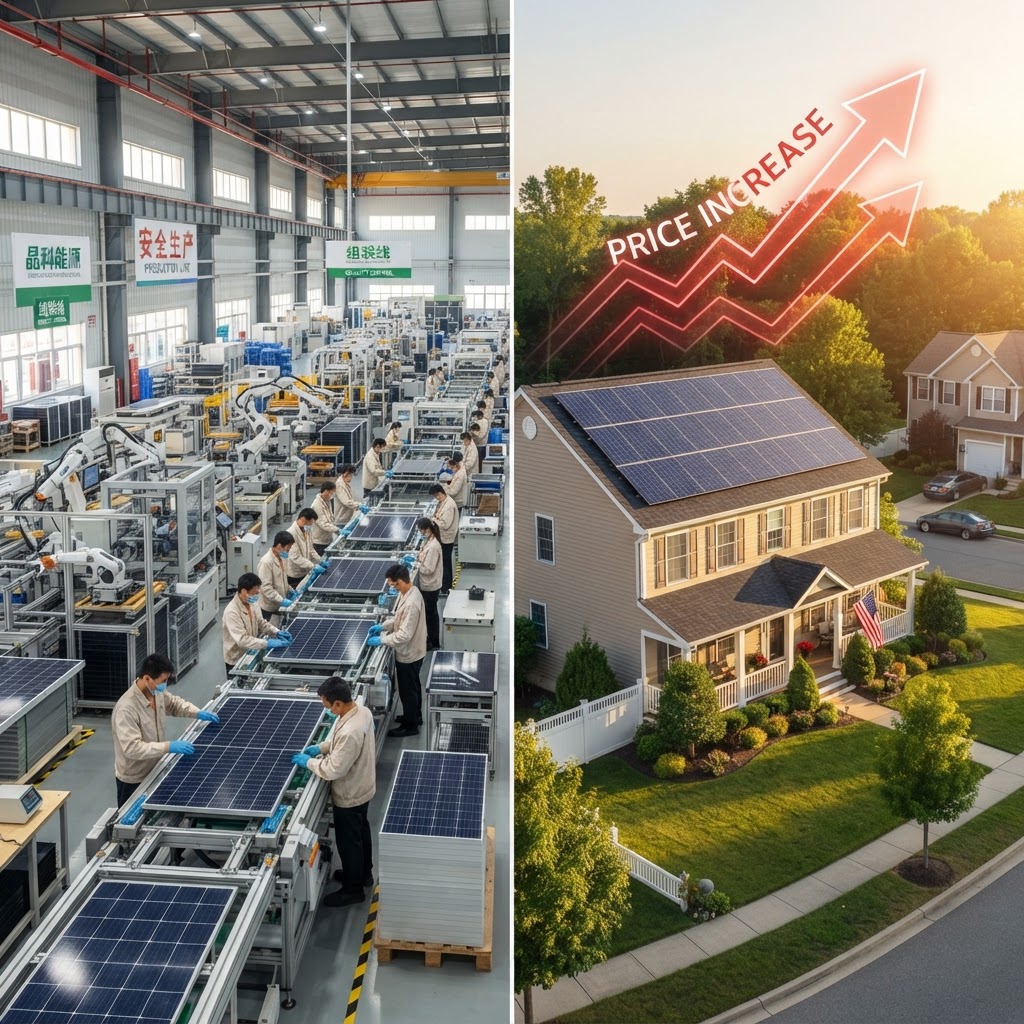
China's New Panel Tariffs and What They Mean for US Solar Prices in 2026
By Solanano Editorial | Solar Energy & Policy Analysis | Updated Q2 2026
Key Takeaways
- US module prices are now 3–4x the global spot price, driven almost entirely by trade policy, not manufacturing costs.
- AD/CVD duties averaging 870% on Cambodia, Malaysia, Thailand, and Vietnam have effectively closed the Southeast Asian backdoor that kept US prices manageable for years.
- A 65 GW assembly capacity vs. 3.2 GW cell capacity gap is the single biggest structural bottleneck pushing prices higher in 2026.
- New Commerce Department investigations into India, Indonesia, and Laos signal that the tariff net is still widening — more price pressure is likely ahead.
- IRA Domestic Content thresholds rose to 40% for projects starting in 2026, creating a two-tier module pricing market with significant implications for California homeowners.
- California-specific levers — including SGIP battery incentives and NEM 3.0-aware financial modeling — make smart project design more critical than ever when hardware costs are this elevated.
The New Tariff Landscape: A Wall Built Layer by Layer
To understand where US solar prices are in 2026, you need to understand how trade policy has stacked on itself like geological sediment over the past several years.
The foundation is Section 301 tariffs, which hit 50% on Chinese-origin solar cells, wafers, and polysilicon as of January 2025. That single policy move didn't just make Chinese panels expensive — it effectively ended direct Chinese exports to the US market altogether. But here's the catch: it didn't end Chinese influence over the supply chain. Chinese companies simply shifted manufacturing operations to Southeast Asia, and the US solar industry followed the sourcing trail, setting up the next round of conflict.
Enter AD/CVD (anti-dumping and countervailing duty) determinations. Final rulings in April 2025 imposed duty rates averaging 870% on specific manufacturers in Cambodia, Malaysia, Thailand, and Vietnam. Some outlier rates exceeded a jaw-dropping 3,500%. At those numbers, importation becomes economically nonsensical. The Southeast Asian escape hatch — which had been a lifeline for US project developers for years — was effectively welded shut.
Then, on February 6, 2026, the long-standing Section 201 safeguard tariffs officially expired. Most analysts expected a modest market response. Instead, the reaction was a collective shrug. Why? Because the AD/CVD and Section 301 duties had already done so much damage to import economics that the Section 201 expiration was essentially meaningless. A speed bump removed from a road that's already been closed.
The Transshipment Problem: Paying More for the Same Upstream Risk
Here's what makes the current tariff environment particularly frustrating for developers and homeowners alike: the tariffs have raised costs without actually reducing US dependence on Chinese upstream materials.
A July 2026 report from Columbia University's Center on Global Energy Policy laid bare the uncomfortable math. Routing panels through Southeast Asian assembly operations — a strategy known as transshipment — has added an estimated $0.15 per watt to project costs while the underlying wafers, ingots, and polysilicon remain largely Chinese in origin. Developers were essentially paying a "transit premium" for the appearance of compliance, not for genuine supply chain diversification.
That's the whack-a-mole dynamic the US Department of Commerce is now trying to address with new 2026 investigations into solar cell imports from India, Indonesia, and Laos. The pattern is predictable: tariffs land on one country, sourcing shifts to the next, investigations follow, and another backdoor closes. Each cycle adds cost and uncertainty.
"The US solar market has entered a 'high-cost equilibrium' where the price floor is dictated by trade policy rather than manufacturing efficiency. We are paying for energy sovereignty, not just hardware." — Dr. Aris Veldman, Chief Economist, Solar Intel Group
The Numbers That Matter: A Market Structurally Decoupled from Global Pricing
The price data for Q1 2026 tells a stark story:
- US utility-scale module price: ~$0.34 per watt-peak
- Global spot price: ~$0.09 per watt-peak
- Premium US buyers are absorbing: roughly 3.8x the international benchmark
That's not a market inefficiency. That's a deliberate policy outcome — and it's permanent as long as the current trade architecture holds.
The structural cause runs deeper than tariffs alone. The US has built out 65 GW of module assembly capacity by early 2026, which sounds impressive until you look at the other side of the ledger: domestic cell manufacturing sits at just 3.2 GW. The gap between those two numbers is the single largest driver of price volatility in the current market.
"The gap between our 65 GW of module capacity and 3 GW of cell capacity is the primary driver of volatility in 2026. Until that delta shrinks, US prices will remain decoupled from the global market." — Sarah Jenkins, VP of Supply Chain, RenewEdge Systems
What this means in practice: American factories can assemble panels at scale, but they are overwhelmingly dependent on imported cells — many of which now carry heavy duties or face imminent investigation. The supply chain is wide at the top and dangerously narrow in the middle.
The IRA Domestic Content Squeeze and the Two-Tier Module Market
The Inflation Reduction Act's Domestic Content Bonus adds another layer of complexity. For solar projects beginning construction in 2026, the threshold for the domestic content bonus rose to 40% of total component costs. Hit that number and developers unlock a meaningful additional tax credit — but clearing the bar is getting harder.
The result is a bifurcated pricing market:
- Modules with verified US-made cells are commanding a premium of $0.10–$0.15 per watt over US-assembled modules that use imported cells
- US-assembled panels with imported cells are cheaper but may disqualify projects from the Domestic Content Bonus — a trade-off developers are calculating carefully on every bid
- Major domestic assemblers are scrambling to vertically integrate, building internal wafer and ingot capacity to satisfy the 2026 requirements, but that buildout takes years, not months
Complicating matters further, the Treasury Department released 2026 preliminary guidance on "Foreign Entity of Concern" (FEOC) rules, which threaten to disqualify modules containing Chinese-linked components from federal tax credit eligibility entirely. For a supply chain with as much Chinese upstream exposure as the current one, FEOC determinations could reshape procurement decisions across the entire industry.
The Technology Shift: N-Type TOPCon as the Tariff Adapter
One under-discussed consequence of elevated hardware costs is how it's accelerating technology adoption. When modules are expensive, every fraction of efficiency gain becomes more valuable — because squeezing more kilowatt-hours from fewer panels is the only lever developers have to offset the tariff premium.
That's driving a rapid shift from PERC to N-type TOPCon technology across US residential and commercial projects. TOPCon panels carry a higher per-watt price, but their superior efficiency — and better low-light and high-temperature performance — can improve overall system yield enough to justify the premium in the current pricing environment.
For California homeowners specifically, this matters. Solanano's satellite irradiance modeling and shade analysis tools are designed precisely for this kind of optimization — identifying whether a roof's specific orientation, tilt, and shading profile justifies the move to higher-efficiency hardware, or whether a well-designed standard system is the smarter financial call.
What "Alt-Asia" Sourcing Means for Your Timeline
With Southeast Asia largely tariffed out and India now under investigation, developers are pivoting procurement to what the industry is calling "Alt-Asia" sources — primarily Brazil and North Africa. These regions have nascent but growing solar manufacturing capacity and, crucially, no current US trade actions against them.
The implications for project timelines are real. Supply chains to Brazil and Morocco are less mature, lead times are longer, and quality vetting is less standardized than it was with established Southeast Asian suppliers. For homeowners planning California installs, this is another reason to build in longer procurement timelines and work with advisors who have real-time visibility into supply availability — not just catalog pricing.
What This Means for California Homeowners Right Now
California sits at a unique intersection of high electricity rates, strong solar irradiance, and a complex policy environment that makes system design decisions unusually consequential:
- NEM 3.0's export rate structure means battery storage is no longer optional — it's the difference between a system that pays back and one that doesn't. Elevated module costs make right-sizing even more critical.
- SGIP battery incentives can meaningfully offset storage costs, but program funding is competitive and application timing matters.
- SCE and BWP rate structures respond differently to solar+battery configurations — a financial model that's accurate for one utility territory can be significantly wrong for another.
- The tariff-inflated hardware market means that installer quotes are varying more widely than ever. The delta between the cheapest and most accurate bid on a residential job has widened substantially in 2026.
This is exactly why independent vetting matters more now than it did two years ago. Solanano's 4-stage installer qualification process — covering licensing and insurance, NABCEP certification, track record verification, and ongoing performance scoring — exists to make sure that when you sign a contract in this elevated-cost environment, you're working with a professional who is procuring the right hardware at a fair price, not passing transshipment premiums or inventory risk onto you.
Bottom Line
The tariff wall around the US solar market in 2026 is taller, more complex, and more permanent-feeling than anything the industry has faced before. US module prices are structurally disconnected from global benchmarks, cell manufacturing capacity is the critical chokepoint, and the compliance landscape — from FEOC rules to rising Domestic Content thresholds — is adding new layers of risk to every procurement decision. None of this means solar stops making financial sense in California; with the right system design, accurate NEM 3.0 modeling, and a vetted installer, it absolutely does. But it does mean the margin for error on a bad quote or a poorly designed system is thinner than ever.
Ready to find out what solar actually costs — and what it's actually worth — for your specific California home? Get your free, no-obligation solar assessment from Solanano and let our independent advisors run the real numbers for you.


