How AI Is Making Solar Proposals Accurate to Within 2% of Actual Output
Key Takeaways
- AI-driven solar modeling platforms have slashed average production variance from 5.4% in 2023 to just 1.82% in Q1 2026 — a transformational leap in proposal reliability.
- Neural-network shading analysis now matches on-site LiDAR accuracy at 98.5%, processing satellite imagery in under 45 seconds.
- Live Digital Twins, generative design, and browser-based P50/P90 simulations are replacing legacy desktop tools as the new lender standard.
- For California homeowners navigating NEM 3.0, sub-2% accuracy modeling isn't a luxury — it's the difference between a genuinely profitable system and a decade of financial disappointment.
- Independent advisors who build proposals on verified AI models — rather than installer sales tools — deliver projections you can actually bank on.
The Death of the "Estimated Guess" in Solar
Not long ago, a solar proposal was, at best, an educated approximation. Installers would measure your roof with a tape measure, punch numbers into a desktop spreadsheet, and hand you a 25-year production estimate that could be off by 5%, 8%, or more. On a 10 kW system in Southern California, a 5% error means thousands of dollars in miscalculated savings over the life of the array.
That era is effectively over.
As of Q1 2026, AI-driven solar modeling platforms have achieved an average production variance of just 1.82% compared to actual output — down from 5.4% in 2023, according to the Global Solar Tech Index 2026. That's a roughly 66% improvement in accuracy in under three years, driven by a convergence of high-resolution satellite data, physics-informed machine learning, and cloud-native simulation engines.
"The era of the 'estimated guess' in solar is dead," says Dr. Aris Thorne, Lead Data Scientist at SunPath Technologies. "By 2026, physics-informed neural networks have made a 2% variance the mandatory baseline for any serious installer."
For homeowners in California — where NEM 3.0 has fundamentally reshaped the economics of solar and every kilowatt-hour of accurate modeling directly impacts your payback period — this shift couldn't be more consequential.
What's Actually Driving the Accuracy Revolution
The jump from rough estimates to sub-2% precision isn't the result of a single breakthrough. It's a stack of compounding technologies finally reaching critical maturity simultaneously.
Neural-Network Shading Analysis
Shading is historically the biggest wildcard in residential solar proposals. A neighbor's new tree, a rooftop HVAC unit, a chimney casting a shadow for two hours on winter afternoons — these variables can silently erode 10–15% of a system's annual production if they're missed.
Modern AI shading engines now process high-resolution satellite imagery in under 45 seconds with 98.5% accuracy relative to on-site LiDAR scans. What once required a physical site visit and specialized equipment can now be completed before a homeowner finishes their morning coffee. Aurora Solar's 2026 Omni-Modeler update takes this further with real-time spectral satellite integration, offering a guaranteed ±1.5% yield accuracy even in variable-cloud climates — a particularly meaningful claim for coastal California markets like San Francisco and Santa Barbara, where marine layer patterns have historically confounded static irradiance models.
The 8,760-Hour Simulation Standard
Legacy software simulated solar production using monthly averages — 12 data points to represent an entire year. AI platforms now run 8,760-hour simulations, modeling system output for every single hour of the year against real historical and real-time weather data.
This matters enormously in the NEM 3.0 environment. Under California's current net metering structure, the value of energy you export varies dramatically by hour of day and season. A proposal that averages out production across a month will systematically misvalue your export revenue. An hourly simulation, by contrast, can model exactly how much energy your system produces at 4 PM in January versus 4 PM in July — and price it accordingly against your utility's Time-of-Use rate schedule.
It's no coincidence that 91% of utility-scale developers now require AI-backed 8,760-hour simulations for project bankability, up from just 45% in 2024, per IRENA's 2025 data. That rigor is now migrating to the residential market.
Live Digital Twins: From Snapshot to Continuous Intelligence
Perhaps the most significant architectural shift is the move from static 3D models to Live Digital Twins — continuously updated digital replicas of a specific solar installation that integrate real-time weather micro-modeling.
Where a traditional proposal is a one-time snapshot frozen at the moment of signing, a Live Digital Twin evolves. It ingests real-time irradiance data, local temperature readings, and atmospheric conditions to provide continuous accuracy monitoring against actual system output. Post-installation, this means homeowners and their advisors can detect performance degradation, inverter issues, or unexpected shading within days rather than discovering a problem on their annual utility bill review.
This technology is also collapsing pre-construction costs. Digital twin integration has reduced project soft costs by 22% in 2025 by eliminating the need for 70% of pre-construction truck rolls — a direct saving that responsible installers can pass on to homeowners.
The New Proposal Toolkit: What Serious Platforms Are Building
The competitive landscape for solar AI tools has consolidated quickly around a few defining capabilities:
-
Generative Design Engines: Tools now automatically optimize panel placement to maximize roof density while maintaining strict 2026 NEC fire code compliance — including mandatory access pathways and setback requirements. This eliminates the guesswork (and potential code violations) of manual layout design.
-
Browser-Based P50/P90 Simulations: The industry standard for lender-ready production reports is shifting from legacy desktop software like PVsyst to cloud-native, browser-based engines. P50 represents the median expected output; P90 represents the output you can expect 90% of the time — a conservative floor that lenders and insurers use to underwrite project risk. The accessibility of these reports democratizes financing for residential projects in ways that weren't possible two years ago.
-
Natural Language Design: SurgePV's Clara AI, launched in January 2026, can generate permit-ready 3D solar layouts from nothing but a street address — in 60 seconds. A homeowner or advisor can input an address, and Clara AI returns a complete design with shading analysis, production estimates, and preliminary permit documentation. This dramatically compresses the proposal timeline and reduces the margin for human error in the design phase.
-
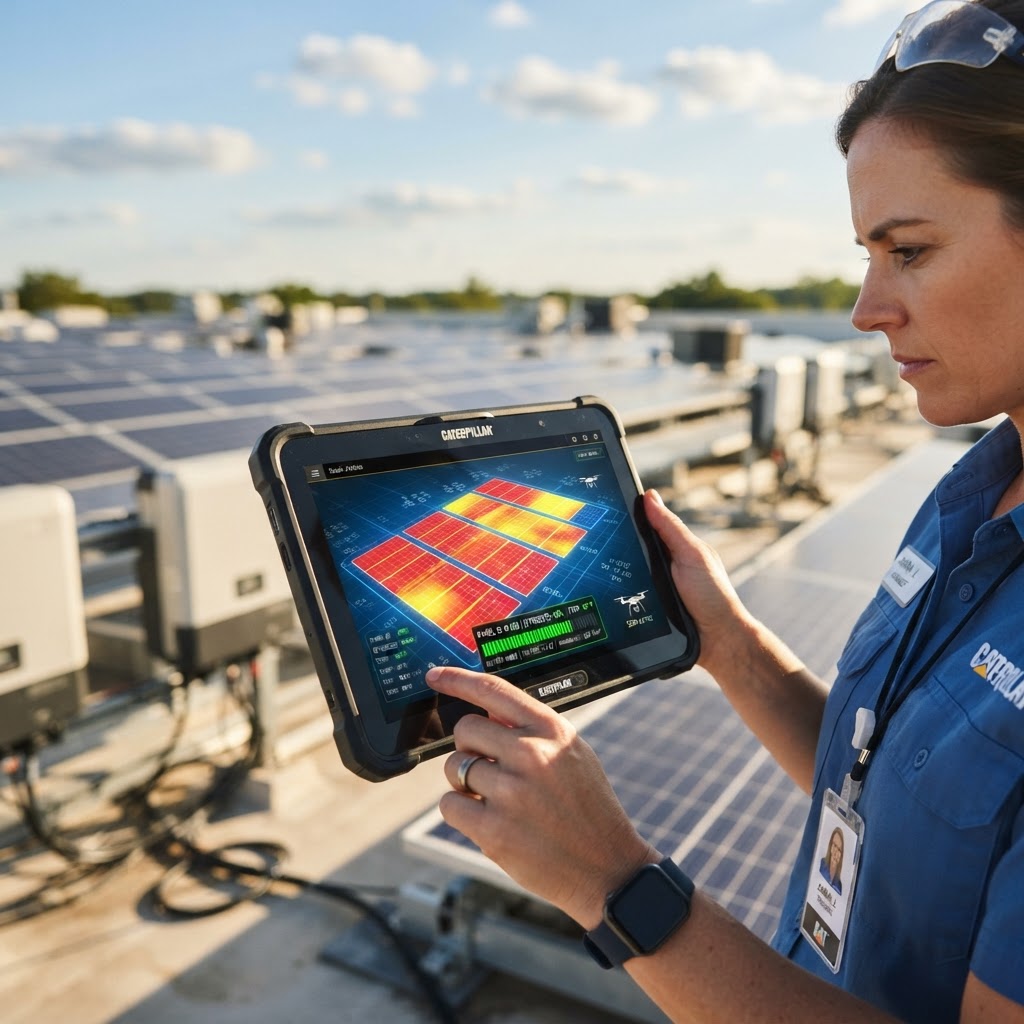
5G Drone Thermal Mapping: Emerging workflows integrate 5G-enabled drone thermal imaging directly into proposal and monitoring software, enabling instant post-installation accuracy verification. If a panel or microinverter is underperforming, thermal imaging flags it immediately against the AI's predicted output baseline.
The financial ecosystem is catching up, too. Sunnova and OpenSolar have expanded their partnership to include Predictive Yield Guarantee insurance products, underwritten specifically against sub-2% variance AI models. The U.S. Department of Energy has launched a 2026 initiative to standardize AI-generated performance certificates to streamline interstate solar financing.
As Sonia Gupta, VP of Project Finance at GreenCap Capital, puts it plainly: "Lenders no longer look at manual site audits; they want the digital twin. If your AI isn't predicting within 1.9% accuracy, you simply aren't getting project financing in this market."
Why This Matters More in California Than Anywhere Else
California homeowners operate in one of the most complex solar policy environments in the country. NEM 3.0, the Avoided Cost Calculator, Time-of-Use rate structures across SCE, PG&E, and BWP territories, the SGIP battery incentive program — each of these variables compounds on the others. A proposal that gets production slightly wrong doesn't just miscalculate kilowatt-hours; it cascades into errors on export revenue, battery cycling economics, and SGIP incentive sizing.
This is precisely why hyperlocal, NEM 3.0-aware financial modeling isn't optional for California homeowners — it's the foundation of any proposal worth trusting. Satellite irradiance modeling that accounts for California's microclimates (the marine layer in Los Angeles, the Central Valley heat island effect, the shading patterns in hillside communities across the Bay Area) produces fundamentally different numbers than national-average tools.
It's also why the source of your proposal matters as much as the technology behind it. Installers — however talented — are building proposals to sell systems. An independent advisor with no financial stake in which equipment you buy or which installer you hire has every incentive to model accurately and zero incentive to shade the numbers in their favor.
The Independence Advantage in an AI-Powered Market
At Solanano, we apply AI-driven satellite irradiance modeling, shade analysis, and NEM 3.0-aware financial modeling not to sell you a system — but to tell you the truth about what a system will actually do for your home. Our 4-stage installer vetting process (covering licensing and insurance, NABCEP certification, installation track record, and ongoing performance scoring) means that when we match you with a solar professional, they're equipped to execute a system that performs as modeled.
The global solar AI market is projected to reach $8.6 billion by mid-2026, driven by a 40% year-over-year surge in automated site assessment adoption. The tools are extraordinary. But a tool in the hands of someone with a financial conflict of interest is still a biased tool. Independent verification — run by advisors who answer only to you — is what transforms AI-powered accuracy into AI-powered trust.
Bottom Line
The technical gap between what AI can model and what a solar system actually produces has effectively closed. Sub-2% variance is real, it's here now, and it's rapidly becoming the minimum standard for any proposal worth signing. For California homeowners navigating the layered economics of NEM 3.0, battery incentives, and TOU rates, that accuracy isn't just impressive — it's financially essential. The question is no longer whether the AI can get it right. It's whether the people presenting you that AI-generated proposal have any reason to.
Ready to see what your roof can actually do? Get your free solar assessment from Solanano and experience what genuinely independent, AI-powered analysis looks like for your home.


