How Retail Chains Are Standardizing Solar Across 100+ Locations — And What It Means for the Future of Commercial Energy
By the Solanano Editorial Team | Solar Engineering & Project Intelligence
Key Takeaways
- Commercial solar across the top 100 U.S. retailers hit 12.4 GW in Q1 2026, a 22% year-over-year jump, driven largely by standardization strategies.
- Modular racking and factory-assembled solar units have slashed onsite labor costs by 34% compared to 2023 levels.
- The Federal Solar Permitting Act of 2025 created an Express Lane for commercial entities deploying identical solar configurations across 100+ locations, dramatically accelerating timelines.
- Fleet-level Virtual Power Plants (VPPs) are turning retail solar arrays into active grid assets — and new revenue streams.
- California retailers operating under NEM 3.0 have unique financial modeling needs that make strategic solar-plus-storage design more critical than ever.
The Standardization Shift: From Pilot Projects to Platform Thinking
Not long ago, a national retail chain rolling out solar across dozens of stores meant dozens of separate engineering projects — unique roof assessments, one-off permitting battles, bespoke equipment specifications, and vendor negotiations at every turn. That era is effectively over.
Today, the most sophisticated retail energy teams are treating solar infrastructure the way they treat store fixtures or point-of-sale systems: as a standardized SKU, replicable at scale with precision and speed.
"The focus for 100-plus location chains has shifted from how do we do this to how fast can we replicate it," says Dr. Elena Varez, Chief Sustainability Officer at RetailCore. "It's about treating energy infrastructure like any other standardized store SKU."
This philosophy shift is producing measurable results. According to the SEIA 2026 Outlook, commercial solar installations across the top 100 U.S. retailers reached 12.4 gigawatts in Q1 2026, representing a 22% year-over-year increase — a figure that would have been unthinkable without the operational efficiencies that standardization has unlocked.
The Regulatory Accelerant: Federal Solar Permitting Act of 2025
No single policy development has done more to accelerate retail solar standardization than the Federal Solar Permitting Act of 2025. Signed into law last year, the Act introduced an Express Lane permitting pathway specifically for commercial entities installing identical solar configurations across 100 or more locations.
In practical terms, this means a retail chain that has engineered and certified a single reference design — specifying inverter models, mounting systems, structural load parameters, and interconnection specs — can submit that template for federal-level review once and apply the approval across its entire portfolio. Local jurisdictions participating in the program are required to honor the federal certification, reducing permitting timelines from months to weeks in many cases.
For California-based retailers and property owners, this intersects meaningfully with existing state-level frameworks. California's Title 24 building codes and utility interconnection requirements through SCE, PG&E, and community utilities like Burbank Water and Power (BWP) still apply, but the Express Lane removes a significant layer of redundant administrative friction that previously plagued multi-site rollouts.
Modularization: Solar as a Factory Product
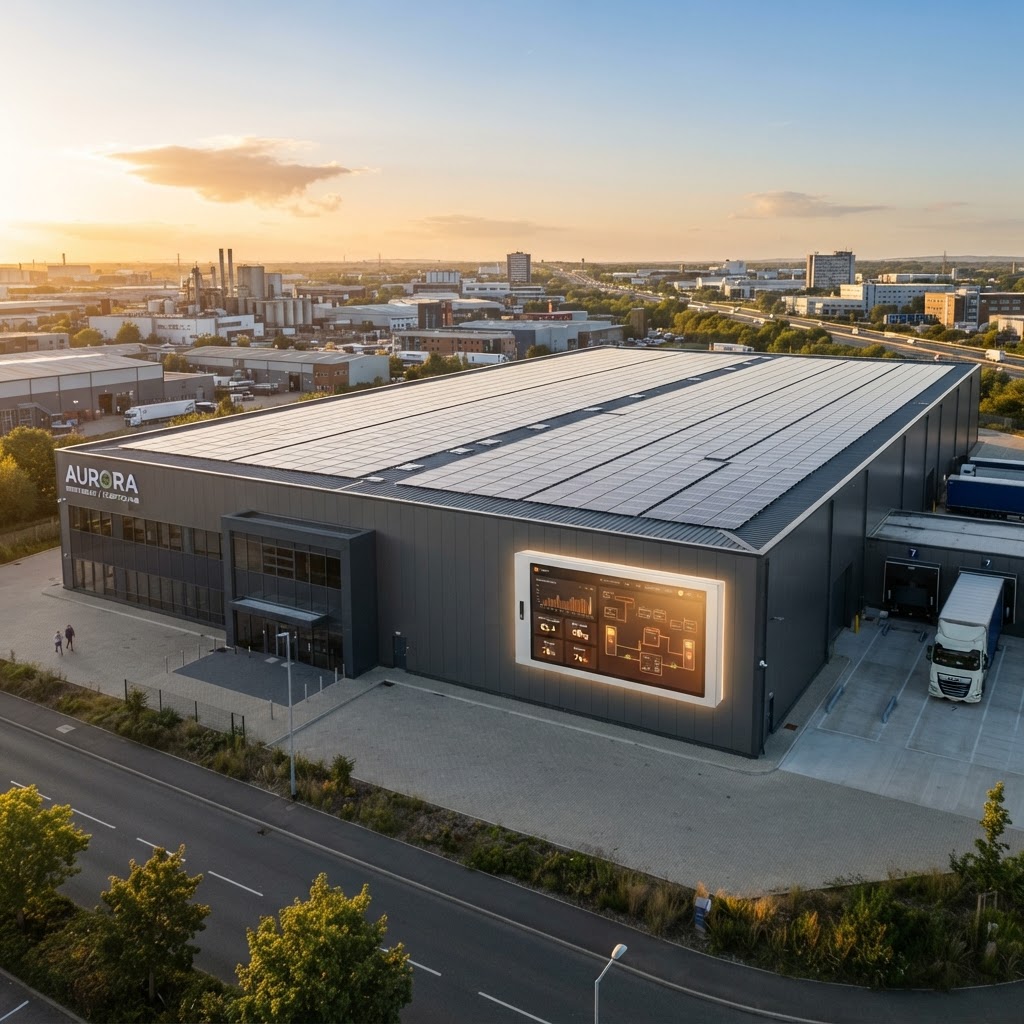
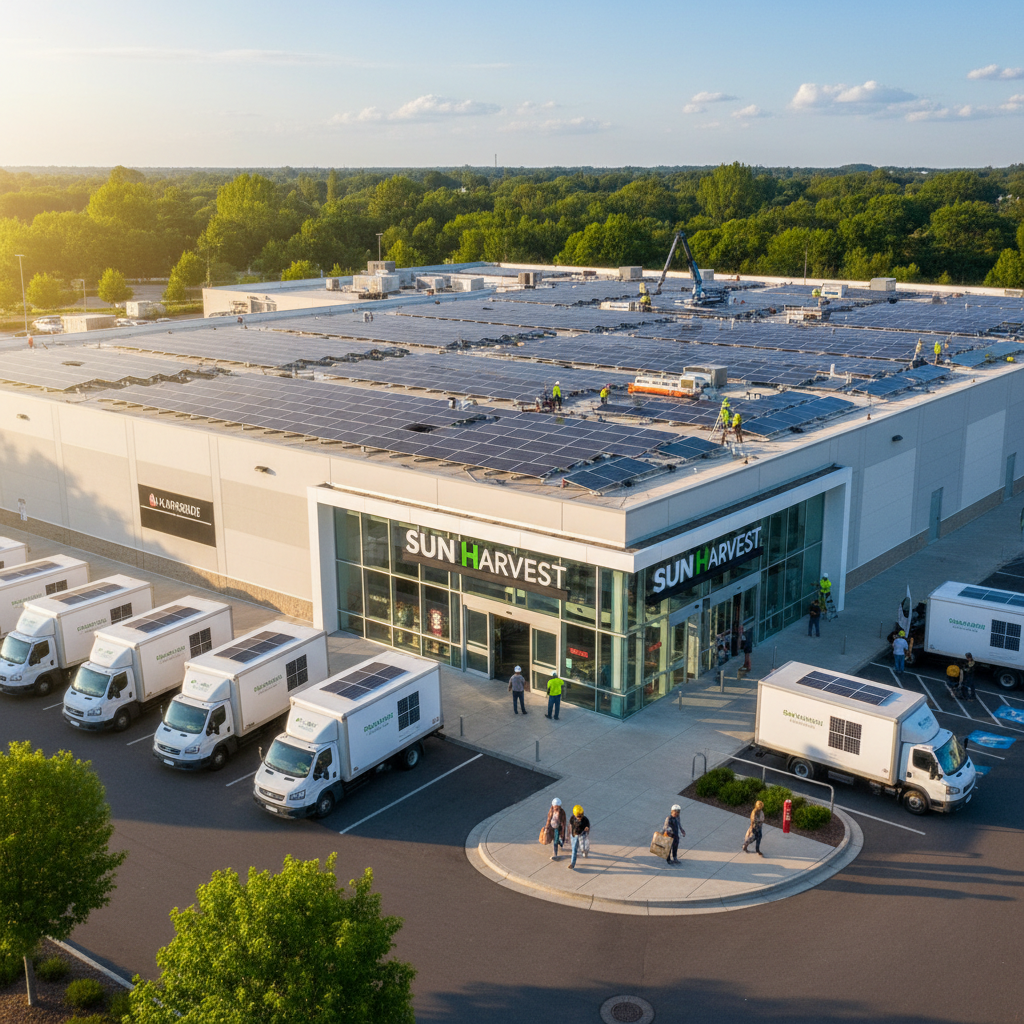
The engineering backbone of this standardization wave is modularization — the design of factory-assembled, containerized solar power units engineered to deploy onto a retail roof in under 48 hours.
Think of it as the IKEA-ization of commercial solar. Instead of field engineers improvising solutions on each rooftop, a standardized kit arrives on-site: pre-wired racking assemblies, pre-configured inverter skids, and pre-tested battery enclosures. Installation crews follow a repeatable playbook rather than reinventing the process at every location.
The Retail Renewables Institute reports that these standardized modular racking systems have reduced onsite labor costs by 34% compared to 2023 levels — a staggering efficiency gain that compounds across a fleet of hundreds or thousands of locations.
The headline example is GlobalMart, which announced in February 2026 the completion of its 500th solar-plus-storage site, achieving full standardization across its entire North American fleet. That milestone wasn't just symbolic — it demonstrated that a single engineering specification, refined over time, could be executed reliably at continental scale.
Meanwhile, a major discount chain has announced a partnership with Tesla to equip 1,200 stores with standard Solar Roofs and Megapacks by the end of 2026. The Tesla Megapack, in particular, is engineered for exactly this kind of fleet deployment: a consistent form factor, remote monitoring capability, and a well-documented integration pathway with both the grid and on-site loads.
Fleet-Level VPPs: When Retail Rooftops Become Grid Infrastructure
Perhaps the most consequential evolution in retail solar standardization is what happens after the panels are installed. Leading chains are now aggregating their hundreds of solar-plus-storage sites into Virtual Power Plants (VPPs) — coordinated networks of distributed energy assets that can respond to grid signals as a unified block.
The economics are compelling. A retailer with 300 locations, each carrying a 500 kWh battery system, has 150 MWh of dispatchable storage capacity sitting on rooftops across the country. Enrolled in a VPP program, that capacity can be bid into wholesale energy markets or contracted directly with utilities to provide demand response, frequency regulation, or peak capacity services — generating secondary revenue streams that were simply unavailable to the retail industry five years ago.
For California retailers specifically, this is an area of acute strategic importance. The state's NEM 3.0 framework, which took effect in 2023, significantly restructured the economics of grid-tied solar by reducing export compensation rates and making battery storage the essential financial complement to any rooftop system. Under NEM 3.0, a retailer that can optimize when it draws from and exports to the grid — using AI-driven battery management within a VPP framework — captures dramatically more value than one operating each site in isolation.
This is a nuance that generic energy consultants often miss. At Solanano, our NEM 3.0-aware financial modeling is built specifically to account for these time-of-use dynamics and VPP participation opportunities when evaluating multi-site solar-plus-storage strategies in California.
AI-Powered Operations: Managing Thousands of Assets at Once
Standardization creates another powerful advantage that only becomes apparent at scale: predictive operations and maintenance (O&M).
When every site in a 500-location fleet uses the same inverter model, the same racking system, and the same battery chemistry, the degradation patterns, failure modes, and maintenance intervals become predictable. That predictability is the fuel for AI-powered O&M platforms that are rapidly becoming standard practice among large retail operators.
The current state of the art combines drone-based thermal imaging — capable of identifying underperforming cells, hotspots, and soiling patterns across an entire rooftop in a single automated flight — with predictive AI algorithms that analyze performance data from every site simultaneously. When the AI detects that a particular inverter brand is trending toward a fault condition across 12 locations in the Southeast, a maintenance team can be dispatched proactively before a single site goes offline.
The result: higher uptime, lower reactive maintenance costs, and the ability to manage thousands of standardized assets with a lean central team. Marcus Thorne, VP of Facilities at MegaStore Inc., captures the operational logic succinctly: "Standardization is the only path to 100% renewable targets. By using the same inverter and mounting specs in every city, we cut procurement and maintenance costs by nearly 40%."
The California Dimension: Unique Challenges, Unique Opportunities
While retail solar standardization is a national story, California presents a distinct operating environment that deserves its own consideration.
Key California-specific factors for retail solar operators:
- NEM 3.0 economics require every system to be modeled with battery storage to optimize against time-of-use rates — a standard commercial-only solar system without storage leaves significant value on the table.
- SGIP (Self-Generation Incentive Program) offers substantial battery storage rebates that can materially improve project ROI, but program funds are allocated in tranches and require strategic timing.
- SCE and BWP interconnection queues can create timeline variability that must be factored into multi-site rollout schedules; a standardized configuration with pre-approved interconnection templates can help, but utility engagement remains site-specific.
- Title 24 compliance and California's evolving commercial building codes mean that any "standard" design imported from a national template must be audited against current state requirements.
- Fire setback and access requirements under California Fire Code are more stringent than many other states, affecting usable rooftop area calculations and racking layout in ways that a purely generic design may not anticipate.
These nuances are exactly why independent, hyperlocal expertise matters — even for sophisticated national operators deploying proven standardized designs.
What This Means for Independent Property Owners and Smaller Commercial Operators
The standardization wave in retail solar carries important lessons beyond the Fortune 500. The modular systems, AI O&M tools, and VPP aggregation platforms being proven out at retail scale are progressively becoming accessible to smaller commercial property owners, multi-tenant portfolios, and even residential prosumers.
For California homeowners and small business owners, the trajectory is clear: solar-plus-storage is rapidly becoming the baseline expectation, not the premium option. The nano-grid philosophy — treating your property as an independent energy node capable of operating resiliently during grid outages and participating in demand response programs — is the same fundamental logic that GlobalMart is executing at continental scale.
The key is ensuring that the system design, financial modeling, and installer selection are calibrated to your specific location, utility territory, roof characteristics, and load profile. That's where independent advisory services like Solanano provide a function that no standardized national template can replace.
Bottom Line
Retail chains are proving that solar at scale is an engineering and logistics challenge, not a fundamental barrier — and the standardization strategies they're pioneering are compressing timelines, slashing costs, and unlocking entirely new revenue models through VPPs and AI-driven operations. The 12.4 GW already installed across top U.S. retailers is just the opening act. As the Federal Solar Permitting Act accelerates deployment and battery economics continue to improve under frameworks like California's NEM 3.0 and SGIP, the question is no longer whether large-scale commercial solar makes financial sense — it's whether you have the right expertise in your corner to capture the full value of what's now possible.
Ready to understand exactly what solar-plus-storage can do for your California property? Get your free solar assessment from Solanano — independent experts with no equipment to sell and every reason to get your project right.