Solar Carports: The Commercial Property Upgrade Paying for Itself
Key Takeaways
- The global commercial solar carport market hit $1.18 billion in 2025 and is accelerating fast, driven by tax policy, EV mandates, and asset optimization thinking
- A 100-space California commercial lot can generate a triple-stream revenue of $75,000+ annually from energy savings, EV charging fees, and carbon credits
- Combined federal ITC and Domestic Content Bonus credits are compressing payback periods to as little as 4.2 years
- Emerging technologies — bifacial albedo enhancement, V2G, and AI load balancing — are pushing carport ROI well beyond original projections
- California property owners face a uniquely favorable environment: SGIP incentives, NEM 3.0 self-consumption optimization, and a grid under peak-hour strain all align perfectly with solar carport economics
The Parking Lot Is No Longer Dead Space
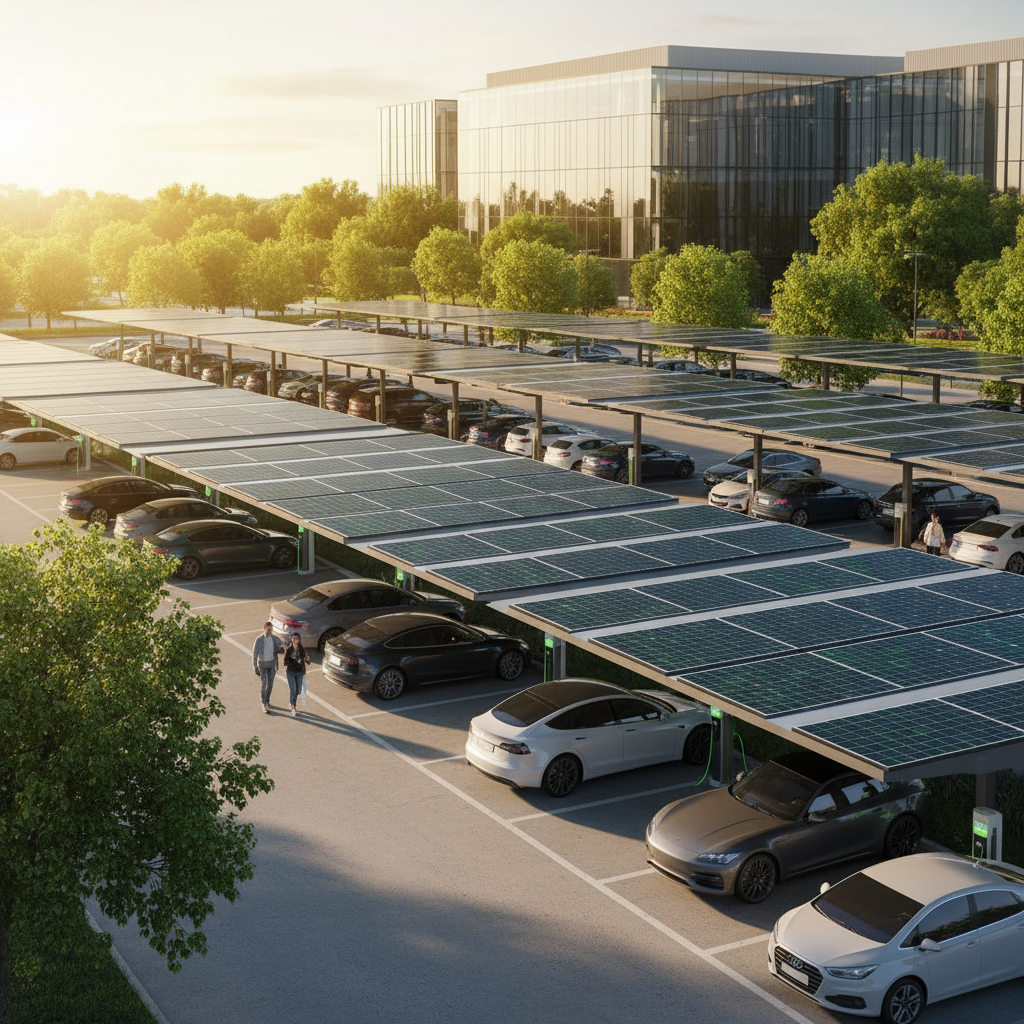
Walk through any commercial property assessment in 2025 and the conversation has changed dramatically. Where parking lots were once viewed as unavoidable infrastructure costs — asphalt to maintain, liability to manage, heat islands to tolerate — forward-thinking developers and property managers are now seeing them as untapped generating assets.
"By 2026, the discussion for commercial landlords has shifted from ESG compliance to pure asset optimization," says Sarah Jenkins, Chief Sustainability Officer at Crestview Real Estate Holdings. "Every square foot of unshaded asphalt is now viewed as lost revenue."
She is not speaking metaphorically. The numbers back it up.
The global commercial solar carport market reached a valuation of $1.18 billion in 2025, with projections placing it at $1.29 billion by mid-2026 — a 9.1% year-over-year increase according to Fortune Business Insights. That growth is being driven not by environmental sentiment but by something simpler: commercial solar carports are now financially superior to doing nothing with a parking lot.
What Does a Solar Carport Actually Cost in 2026?
Commercial solar carport installation costs have stabilized significantly in 2026, falling in the range of $2.50 to $5.50 per watt. High-efficiency bifacial systems — which are quickly becoming the commercial standard — average around $4.10 per watt fully installed, including structural steel framing and electrical balance-of-system components (Super Solar PV Industry Report, 2026).
For a typical 100-space commercial parking lot, that translates to a gross project cost in the range of $400,000 to $600,000 before incentives. That figure sounds significant until you stack the incentive layers available right now:
- 30% Federal Investment Tax Credit (ITC): Baseline under the Inflation Reduction Act
- 10% Domestic Content Bonus: For projects using qualifying American-manufactured components — now increasingly achievable with expanded domestic supply chains
- 10% Energy Communities Bonus: Following the US Treasury's January 2026 updated guidance, commercial lots adjacent to brownfield sites or qualifying energy communities are seeing a 30% surge in permit applications specifically because this bonus stacks on top of the base ITC
- California SGIP (Self-Generation Incentive Program): Battery storage paired with carport solar qualifies for additional rebates, further compressing payback
With ITC plus the Domestic Content Bonus alone, that $500,000 gross project becomes roughly $300,000 net. Property developers are reporting average payback periods of just 4.2 years for 100-space lot upgrades under this incentive stack (Wanhos Energy Financial Analysis, 2025).
"The convergence of the 40% federal tax credit and the mandatory shift to EVs has turned the humble parking lot into the most profitable square footage on a commercial property's balance sheet," notes Dr. Robert Chen, Lead Renewable Energy Analyst at Global Property Insights.
The Triple-Stream Revenue Model
What makes commercial solar carports genuinely different from rooftop solar installations is the revenue diversification they enable. A 2026 analysis by Xiamen Wanhos Tech breaks down the annual revenue potential for a standard 100-space commercial carport across three distinct streams:
| Revenue Stream | Annual Value | |---|---| | Energy savings (offset utility costs) | $45,000 | | EV charging station fees | $22,000 | | Carbon credit trading | $8,000 | | Total | $75,000 |
That $75,000 annual return against a net project cost of roughly $300,000 is what produces those compelling sub-5-year payback figures. And this is before accounting for property value appreciation, tenant attraction premiums, or the avoided cost of future utility rate increases — all of which are particularly meaningful in California, where commercial electricity rates from utilities like SCE regularly breach $0.30–$0.40/kWh during peak hours.
For California property owners operating under NEM 3.0, the self-consumption angle is especially critical. NEM 3.0 dramatically reduced the value of exported solar energy, which means installations designed to maximize on-site consumption — exactly what a carport feeding EV chargers and a building simultaneously does — are now architecturally superior to legacy export-focused systems. This is precisely why Solanano's hyperlocal NEM 3.0-aware financial modeling matters: a carport system sized and designed without accounting for California's current export compensation structure can underperform projections significantly.
Four Technologies Reshaping Carport Economics in 2026
The engineering landscape for solar carports has evolved rapidly. Four trends in particular are materially improving project returns:
1. Albedo-Enhanced Bifacial Yields
Bifacial solar panels — which capture light from both their front and rear faces — have become the default choice for commercial carport projects. What's new in 2026 is the widespread adoption of high-reflectance white ground coatings beneath these panels. By increasing the albedo (reflectivity) of the surface under the array, operators are capturing 12–15% more energy output without expanding the physical footprint. For a project already producing 500,000 kWh annually, that's an additional 60,000–75,000 kWh — essentially free generation added through a relatively low-cost surface treatment.
2. Vehicle-to-Grid (V2G) Integration
Commercial carports are evolving from passive generators into active grid-stabilization assets. V2G-enabled charging infrastructure allows EV batteries parked under the canopy to discharge stored energy back to the building or grid during peak price windows. In California, where grid stress events are frequent and demand response programs are financially rewarded, this transforms a parking lot into a dispatchable energy resource — a core element of what Solanano calls the nano-grid philosophy: solar and battery working together as a path to genuine energy independence.
3. Rapid-Deploy Prefabricated Structures
2026 engineering standards increasingly favor pre-wired, modular cantilever carport structures that reduce on-site construction time to under 48 hours for small-to-midsize commercial lots. This is significant for commercial property owners who cannot afford extended parking lot closures. The UK and EU have already seen market launches like Solarport's PowerPark PRO Series, featuring modular steel designs built to new 2026 safety and parking width mandates — design philosophies that are informing projects globally.
4. AI-Driven Load Balancing
New energy orchestration platforms are being integrated directly into carport management systems to prioritize solar-to-EV charging over grid-to-EV charging. These systems optimize when vehicles charge, when batteries store, and when energy flows back to the building — continuously maximizing self-consumption rates. For California commercial properties under time-of-use rate structures, this AI layer can shift a meaningful portion of energy costs out of peak-rate windows entirely.
The Global Policy Signal Is Impossible to Ignore
Commercial property owners sometimes wonder whether solar carport investment is a trend or a permanent shift. The policy environment in 2026 provides a clear answer.
France's national mandate for large parking lots entered its final compliance phase in November 2025, requiring all commercial lots over 1,500 square meters to be at least 50% covered by solar canopies. While California has not yet enacted a direct equivalent, the regulatory direction is consistent — and California has historically led U.S. adoption of policies that originate in European markets.
More immediately relevant: the US Treasury's updated January 2026 guidance on Energy Communities bonuses triggered a 30% surge in commercial carport permit applications for brownfield-adjacent retail centers in the months that followed. Permitting pipeline activity is one of the clearest leading indicators of where commercial capital is moving.
For California property owners in the SCE or BWP service territories, the combination of high retail electricity rates, aggressive EV adoption targets, SGIP battery incentives, and NEM 3.0's self-consumption premium creates a project environment more favorable than almost anywhere else in the country.
What to Watch Out For: Where Projects Go Wrong
Not every solar carport project delivers on its pro forma. Common failure points include:
- Structural over-engineering or under-engineering: Carport canopy loads differ substantially from rooftop loads. Wind uplift calculations must be site-specific and permit-compliant for California's seismic and wind exposure zones
- Shade analysis gaps: Carport geometry, adjacent trees, and building shadows interact in ways that flat-roof shade analysis does not capture. Satellite irradiance modeling with true 3D shade simulation is essential
- NEM 3.0 misalignment: Systems sized for export rather than self-consumption will significantly underperform in California's current utility rate environment
- Installer vetting failures: Carport projects involve structural engineering, electrical design, and utility interconnection simultaneously — a skill set that not all solar installers possess
This is why independent oversight matters. Solanano's 4-stage installer qualification process — verifying license and insurance, NABCEP certification, project track record, and performance scoring — exists specifically to match commercial property owners with contractors who have demonstrated competence across all three disciplines simultaneously.
Bottom Line
The solar carport is no longer a premium amenity or a sustainability checkbox. In 2026, it is a revenue-generating infrastructure asset with documented sub-5-year payback periods, multiple income streams, and a policy tailwind that is only strengthening. For California commercial property owners sitting on acres of sun-drenched asphalt, the question is no longer whether a solar carport pencils out — it's whether waiting another year is leaving real money on the table.
If you own or manage a commercial property in California and want to understand exactly what a solar carport could generate for your specific lot — with hyperlocal shade analysis, NEM 3.0-aware financial modeling, and access to pre-vetted, licensed installers — get your free solar assessment from Solanano today.