Agricultural Solar: How Farms Are Generating a Second Income Stream
Key Takeaways
- Global agrivoltaic capacity hit 18.4 GW in Q1 2026 — a 42% year-over-year surge fueled by EU and U.S. federal subsidies
- U.S. farmers in dual-use solar programs averaged $1,450 per acre in secondary income in 2025, per the USDA Rural Energy Report
- The USDA's new "Harvesting the Sun" grant program is putting $1.2 billion on the table for qualifying installations
- Vertical bifacial panels, dynamic shading systems, and on-farm battery storage are redefining what agricultural solar looks like in 2026
- California landowners face a uniquely favorable — and uniquely complex — regulatory landscape that rewards those who do their homework
The Farm Is Becoming a Power Plant — Without Sacrificing the Harvest
For generations, the American farm operated on a single economic engine: grow something, sell it, repeat. That model has never been more vulnerable — to drought, to commodity price swings, to input cost inflation. In 2026, a fast-maturing technology is quietly rewriting the farm's balance sheet.
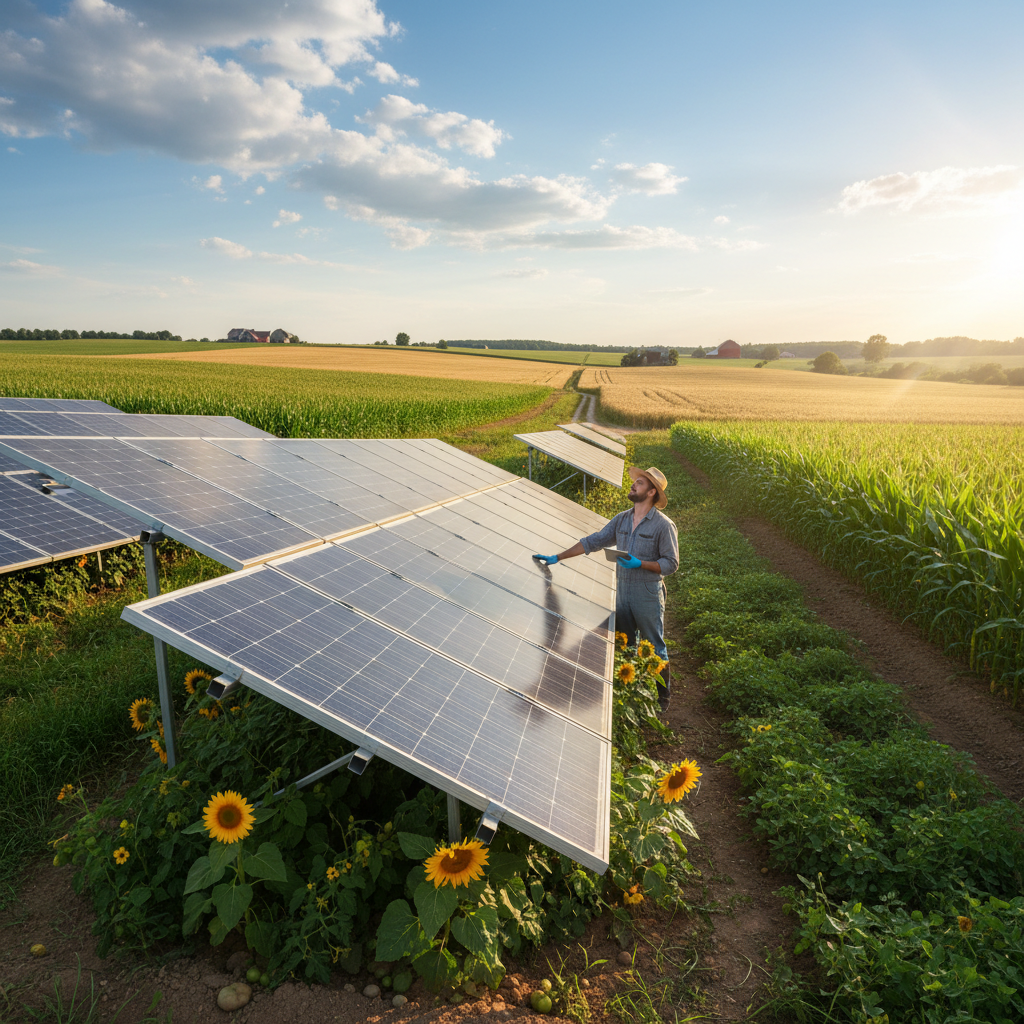
Agrivoltaics — the co-location of solar energy production with active agricultural land use — has graduated from academic experiment to mainstream practice. Global capacity reached 18.4 GW in Q1 2026, representing a stunning 42% year-over-year increase driven by coordinated subsidies across the EU and United States. That isn't a niche trend. That is an industrial shift.
"The modern farm is evolving into a hybrid energy-food hub. In 2026, the question isn't whether solar fits on a farm, but which crops thrive best in its shade." — Dr. Aris Veldhuis, Chief Researcher, Institute for Sustainable Agronomy
The financial case is no longer theoretical. According to the USDA Rural Energy Report, U.S. farmers participating in dual-use solar programs reported an average secondary income of $1,450 per acre in 2025. For a 200-acre operation, that's $290,000 a year in revenue that arrives regardless of what corn prices are doing in Chicago.
How Agrivoltaics Actually Works: The Science Behind the Shade
The foundational insight of agrivoltaics is deceptively simple: most crops don't need — and often can't tolerate — full, unfiltered sunlight all day. Partial shade from elevated solar arrays can actually improve growing conditions for a wide variety of crops while simultaneously generating clean electricity from the same acreage.
Recent 2026 trials in the American Midwest demonstrated a 28% reduction in irrigation needs for leafy greens grown under semi-transparent solar modules. The panels reduce evapotranspiration by limiting direct solar exposure on soil and plant surfaces — a finding with enormous implications for California's water-stressed Central Valley and drought-prone agricultural regions across the state.
The crops that tend to benefit most from agrivoltaic shade canopies include:
- Leafy greens (lettuce, spinach, kale) — sensitive to heat stress and bolting
- Root vegetables (carrots, beets) — benefit from soil moisture retention
- Berries and soft fruits — reduced sunscald, extended harvest windows
- Shade-tolerant herbs — basil, cilantro, parsley
- Livestock pasture — grazing sheep and cattle under panels is now mandated in over 15% of new utility-scale California solar permits
That last point matters enormously for California landowners. As of early 2026, over 15% of all new utility-scale solar permits in California include mandatory "beneficial grazing" or "pollinator habitat" clauses — meaning regulators are actively pushing dual-use models, not just tolerating them.
The Equipment Revolution: Panels Designed for Farmers, Not Just Engineers
One of the biggest practical barriers to agrivoltaic adoption has been equipment clearance. Standard horizontal solar arrays sit too low for tractors, combines, and other machinery to pass beneath them — forcing operators to choose between farming and solar. That barrier is collapsing.
Vertical bifacial panels — mounted east-west in vertical rows rather than angled south-facing — have seen adoption increase by 210% since 2025. These systems generate power from both faces of the panel, capturing morning energy peaks from the east and evening peaks from the west. Critically, they allow standard agricultural equipment to pass between rows without modification or compromise.
The momentum is now attracting heavy equipment manufacturers directly. In February 2026, both John Deere and Case IH announced electric tractor models specifically optimized for the narrow row clearances typical of agrivoltaic arrays — a clear signal that mainstream agriculture is treating this as a permanent infrastructure shift, not a pilot program.
Meanwhile, two additional technological trends are accelerating the value proposition:
- Dynamic shading systems: Next-generation tracking arrays don't just follow the sun for maximum energy yield — they can tilt panels specifically to protect crops from extreme heat events. During a heat dome, panels rotate to cast shade on crops rather than optimize power output, functioning as a climate buffer for vulnerable plants.
- On-farm battery storage: Integrating localized battery storage allows producers to capture solar energy during peak generation hours and discharge it to the grid during peak demand periods, when utility buyback rates are at their highest. Under California's NEM 3.0 framework, this time-of-export strategy is no longer optional — it's essential for maximizing the financial return on any solar investment.
The Federal and State Money Flowing Into Farm Solar Right Now
This is where the financial picture becomes genuinely compelling for American landowners.
In May 2026, the USDA announced the "Harvesting the Sun" grant program, committing $1.2 billion toward solar installations that maintain at least 90% of baseline crop productivity. This isn't a loan — it's a grant, structured to make agrivoltaic adoption financially accessible for small and mid-size family operations that couldn't otherwise absorb the upfront capital requirement.
The scale of what's being built is equally striking. In April 2026, a 500 MW "Solar-Corn" hybrid facility in Iowa became the world's largest agrivoltaic site, deploying AI-driven panel tracking that dynamically adjusts light exposure to optimize both crop growth and energy generation simultaneously. This technology will filter down to smaller installations within the next two to three years as unit costs fall.
California landowners have additional layers of incentive to evaluate:
- SGIP (Self-Generation Incentive Program): California's flagship battery storage rebate program provides meaningful per-kWh incentives that directly support the on-farm storage model
- NEM 3.0 financial modeling: The new net metering structure rewards batteries and time-of-export strategies — understanding when your system exports is now as important as how much it generates
- Utility-specific programs: SCE and BWP each have distinct tariff structures, interconnection timelines, and agricultural rate schedules that materially affect project economics
The Financial Architecture: Understanding Your "Second Income"
"Agrivoltaics has effectively stabilized the family farm economy by providing a fixed, weather-independent check every month, insulating them from commodity price swings." — Sarah Montgomery, Director, Rural Solar Alliance
Sarah Montgomery's observation cuts to the heart of why this model is resonating so deeply with agricultural communities. Commodity farming is inherently volatile. A solar lease or a Power Purchase Agreement (PPA) is not. Energy revenue arrives on a schedule that has nothing to do with rainfall, frost dates, or soybean futures.
The financial structure of an agrivoltaic project typically combines several streams:
- Direct energy sales or net metering credits from utility-scale or behind-the-meter generation
- Solar lease income if a developer leases a portion of the land for a larger installation
- Federal tax credits (ITC) and applicable depreciation schedules for owned systems
- Grant funding via programs like USDA's "Harvesting the Sun"
- Avoided input costs: on-site energy reduces irrigation pump electricity costs, cold storage energy bills, and operational overhead
The rise of specialized agrivoltaic insurance products — covering risks like crop damage during panel maintenance windows or panel degradation from dust accumulation in dry California conditions — is further professionalizing the market and making lenders more comfortable financing these projects.
What California Farmers Specifically Need to Know
California sits at the intersection of the country's most ambitious renewable energy mandates and its most productive agricultural land. That creates both extraordinary opportunity and genuine complexity.
The state's unique regulatory environment means that a solar project designed for a farm in the Central Valley, the Salinas Valley, or the Coachella Valley isn't interchangeable with one designed for Iowa. NEM 3.0's export rate structure, the specific interconnection queues at SCE versus other utilities, SGIP step eligibility, and local county permitting overlays all affect what a project actually pencils out to.
Getting that analysis wrong — or relying on an installer with a financial incentive to oversell system size — can mean the difference between a project that transforms a farm's economics and one that underdelivers for 25 years.
This is precisely where independent advisory expertise pays for itself.
Bottom Line
Agricultural solar in 2026 is not a speculative bet — it is a proven, federally-supported income diversification strategy backed by $1.2 billion in new grants, validated by real USDA income data, and increasingly embedded in California's own permitting requirements. The farms that move thoughtfully and strategically now will lock in fixed energy income that their operations will benefit from for decades. The farms that wait, or that move without independent guidance through California's complex regulatory landscape, risk leaving significant money on the table.
Ready to find out what agrivoltaic solar could mean for your California property? Get a free, no-obligation assessment from Solanano — independent advisors who work for you, not for an equipment manufacturer, and who bring hyperlocal financial modeling, NEM 3.0 expertise, and a rigorous 4-stage installer vetting process to every project.