Agricultural Solar: How Farms Are Generating a Second Income Stream
Key Takeaways
- The global agrivoltaics market is on track to hit $20.29 billion by 2026, growing at over 30% annually.
- U.S. farmers received an estimated $3.2 billion in solar land lease payments in 2025 alone, providing a critical buffer against crop market volatility.
- Solar lease offers are increasingly exceeding $1,000–$2,000 per acre annually, often outperforming net returns from traditional row crops.
- New technologies — from vertical bifacial arrays to AI-driven solar tracking — are making it easier to grow crops and generate electricity on the same land simultaneously.
- Policy momentum is accelerating, with USDA's REAP program reopening for FY 2026 and multiple states adding financial incentives for dual-use solar projects.
Farmers have always been natural energy producers. They manage weather, water, and land with extraordinary precision to turn sunlight into food. Now, a growing number of them are taking that relationship with the sun one step further — and getting paid directly for it.
Agrivoltaics, the practice of co-locating solar energy production with active agricultural operations, has rapidly evolved from a niche research concept into a mainstream income strategy. In 2026, it represents one of the most significant financial opportunities available to farm operators across the United States and beyond. Here is a comprehensive look at how it works, what the numbers say, and where the sector is heading.
What Is Agricultural Solar, and Why Is It Taking Off?
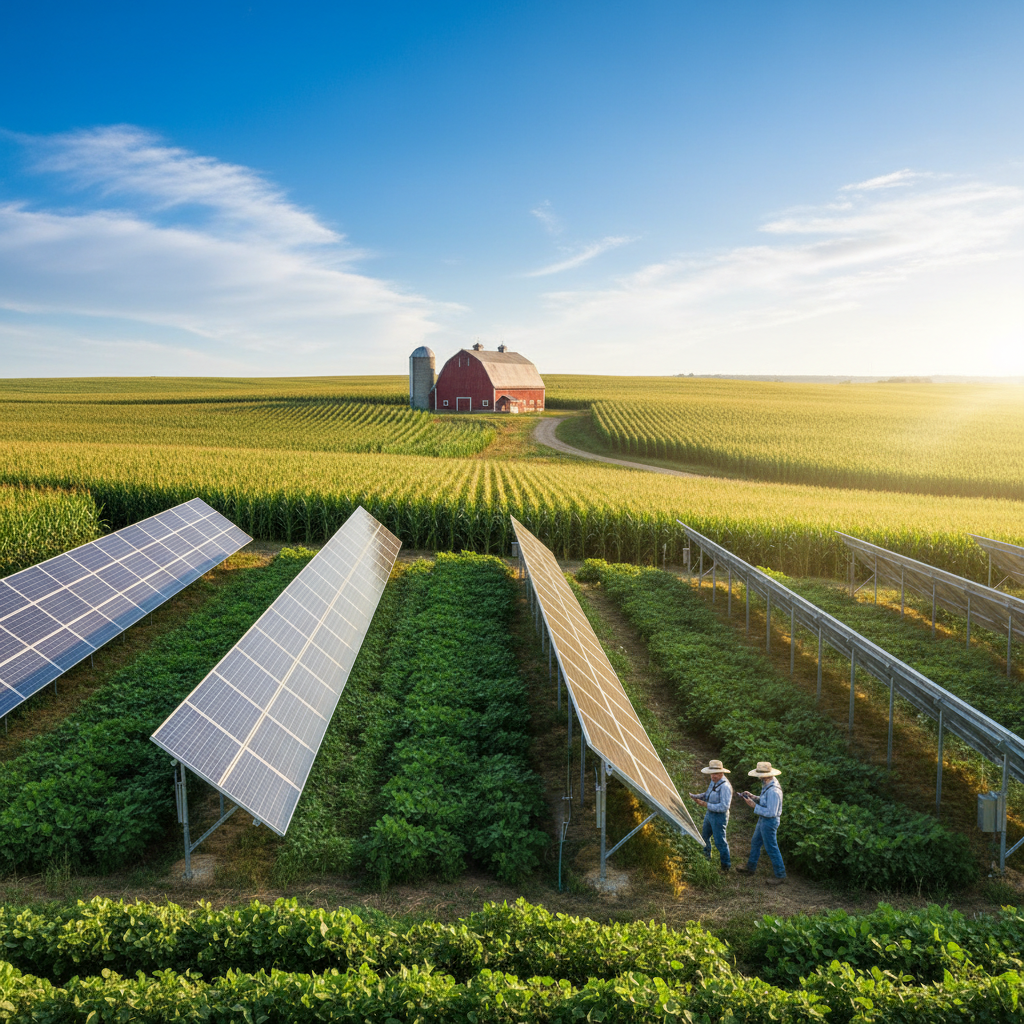
Agricultural solar encompasses two broad models: solar land leasing, where developers install utility-scale arrays on farmland in exchange for annual payments to the landowner, and agrivoltaics, where crops or livestock are actively managed beneath or alongside solar panels on the same parcel.
The distinction matters because the economics and operational complexity differ significantly. A straightforward land lease is largely passive income — a developer handles everything and writes the farmer a check. True agrivoltaic integration requires thoughtful system design, but it unlocks deeper financial and agronomic benefits.
The momentum behind both models is undeniable. The global agrivoltaics market is projected to reach approximately $20.29 billion by the end of 2026, growing at a compound annual rate of over 30% from its 2025 valuation. That growth is being driven by converging forces: record-low solar hardware costs, rising grid electricity demand, aggressive state and federal policy support, and a farming community that is, frankly, under serious financial pressure.
"In 2026, we have moved past the proof-of-concept phase; agrivoltaics is now a standard de-risking strategy that ensures family farms can survive economic volatility without losing their land to non-agricultural development." — Dylan Kezele, Policy Manager, SEMA Coalition
The Income Numbers: What Farmers Are Actually Earning
Let's talk dollars. Clean power developers in the U.S. paid an estimated $3.2 billion in land lease payments to farmers and ranchers in 2025, making solar one of the most significant sources of non-commodity rural income in the country. That figure is expected to climb substantially as project pipelines continue to expand.
For individual operators, the per-acre economics are increasingly compelling. Recent surveys indicate that over 50% of U.S. farmers engaged in solar leasing discussions are being offered annual payments of $1,000 to $2,000 per acre — payments that frequently exceed the net returns from growing corn, soybeans, or wheat on the same ground once input costs, land taxes, and market fluctuations are accounted for.
Key financial advantages for landowners include:
- Income stability: Solar lease contracts typically run 20–30 years with built-in escalator clauses, providing a predictable revenue floor regardless of commodity prices.
- Reduced operating risk: Solar income doesn't require planting, harvesting, or exposure to drought, pests, or trade policy shocks.
- Land retention: Rather than selling distressed parcels to developers or corporate agriculture, solar leasing allows families to retain ownership while monetizing unproductive or marginal acres.
- Tax considerations: Lease income may qualify for favorable treatment depending on jurisdiction, and solar investments can attract depreciation benefits for owner-operators installing their own systems.
The Science Behind Dual-Use Farming: It Actually Works
Skeptics once questioned whether sharing land between panels and plants was genuinely productive or simply a marketing narrative. The research has answered that question decisively.
"Our 2025 research proves that agrivoltaics increases crop yields in water-stressed regions by lowering soil temperatures and reducing evaporation, essentially creating a symbiotic relationship between food and energy." — Asher Salkin, Research Lead, Institute for Energy Economics and Financial Analysis (IEEFA)
The mechanism is straightforward: solar panels create partial shade, which reduces soil surface temperature, slows water evaporation, and creates a more favorable microclimate for certain crops. In arid and semi-arid regions — which represent a growing share of American and global farmland — this effect can meaningfully increase yields and reduce irrigation demand.
Crops demonstrating strong agrivoltaic compatibility include:
- Leafy greens (lettuce, spinach, kale)
- Soft fruits and berries (strawberries, blueberries, raspberries)
- Wine and table grapes in select viticulture regions
- Certain root vegetables and brassicas
- Forage grasses and legumes used in livestock systems
The growing commercial success with specialty, shade-tolerant crops is one of the most important trends in the sector. High-value produce grown beneath panels can generate revenue per acre that dramatically outperforms commodity alternatives, effectively stacking two premium income streams on a single piece of ground.
Key Technologies Making Agrivoltaics Work in 2026
The hardware and software enabling agricultural solar have advanced considerably, removing many of the practical barriers that once made dual-use systems difficult to implement.
Vertical Bifacial Arrays
Rather than installing panels at conventional low angles, vertical bifacial installations orient panels in fence-like rows that capture light on both faces throughout the day. Critically, this configuration allows standard farm machinery — tractors, combines, sprayers — to pass between rows without modification. This addresses one of the most frequently cited operational concerns from working farmers considering solar integration.
Bifacial solar modules broadly are expected to account for nearly 70% of all new solar production worldwide by 2026, reflecting their superior energy yield and suitability for agrivoltaic applications.
AI-Driven Solar Tracking
Intelligent tracking systems are now sophisticated enough to prioritize crop light requirements over maximum energy harvest during peak growing seasons. Rather than always orienting panels for maximum kilowatt-hour output, these systems adjust panel angles in real time to ensure crops receive optimal sunlight at critical growth stages, then recover energy generation during off-peak crop periods. This optimization approach has been shown to improve combined food-and-energy productivity indexes on commercial installations.
Solar Grazing as Operations & Maintenance
Perhaps the most elegantly practical innovation in the sector: using sheep and small livestock for vegetation management beneath solar arrays. Mowing the ground cover beneath utility-scale solar installations is a significant ongoing operating cost. Grazing contracts with local sheep producers eliminate or dramatically reduce that cost while providing the rancher with additional grazing acreage and the solar operator with a cleaner, better-managed site. Solar grazing is now becoming the primary O&M vegetation strategy on rural utility-scale projects across multiple states.
Policy Landscape: Federal and State Support Is Growing
The regulatory environment for agricultural solar is becoming more supportive at both the federal and state levels, creating additional financial incentives for early movers.
Federal: The USDA Rural Development is set to reopen the Rural Energy for America Program (REAP) for FY 2026 in late 2025, following a significant application backlog. Critically, the program is implementing new "farm-first" eligibility criteria designed to ensure funding flows to genuine agricultural operations rather than purely commercial solar developers. The U.S. Department of Energy has targeted a cumulative deployment of 10 GW of agrivoltaic systems to bolster rural energy independence, signaling sustained federal commitment to the sector.
State-level incentives: New York and Massachusetts have implemented "dual-use" incentive adders in early 2026, offering higher per-kilowatt-hour payments specifically for projects that maintain active agricultural production beneath panels. These adders improve project economics substantially and are likely to be replicated by other states watching the early results.
Hardware innovation: Sharp Corporation launched a new line of lightweight solar modules in early 2026 specifically designed for small-scale agrivoltaic applications, with a focus on maximizing sunlight penetration for rice and vegetable crops. Purpose-built hardware like this reduces the engineering complexity — and cost — of small farm installations.
A Global Proof Point: New Zealand's Te Herenga o Te Rā Project
International experience is providing compelling evidence for large-scale viability. New Zealand's Te Herenga o Te Rā project reached full operational capacity in 2025, integrating solar generation with active sheep grazing and dairy farming operations at commercial scale. The project has become a global flagship, demonstrating that high-output solar generation and productive livestock agriculture are not just compatible — they are mutually reinforcing when designed thoughtfully.
Is Agricultural Solar Right for Your Farm? Key Considerations
Before signing a lease or commissioning a design, farmers should evaluate:
- Land suitability: Marginal, underperforming, or flood-prone acres often make the best candidates for solar without displacing high-productivity ground.
- Lease terms: Negotiate escalation clauses, decommissioning bonds, and clear land-use rights carefully. Independent legal review is strongly recommended.
- Own vs. lease: Owner-operated systems require more capital but retain the full value of energy generation rather than sharing economics with a developer.
- Crop compatibility: Work with an agrivoltaic designer to match panel configuration and spacing to your specific crop requirements and machinery dimensions.
- Grid connection: Proximity to transmission infrastructure significantly affects project feasibility and timeline.
Bottom Line
Agricultural solar has completed its transition from experimental concept to proven income strategy. With $3.2 billion flowing to U.S. rural landowners in lease payments in a single year, a global market approaching $20 billion, and technology that is increasingly designed around the realities of working farms, the question for most operators is no longer whether to explore solar — it's how to structure the right deal. The farms that engage now, while federal programs are active and state incentives are being established, will be best positioned to lock in long-term contracts on favorable terms before competition for premium parcels intensifies further.
Ready to find out what your land could earn? Get a free solar proposal today and see exactly what agricultural solar could mean for your farm's financial future.